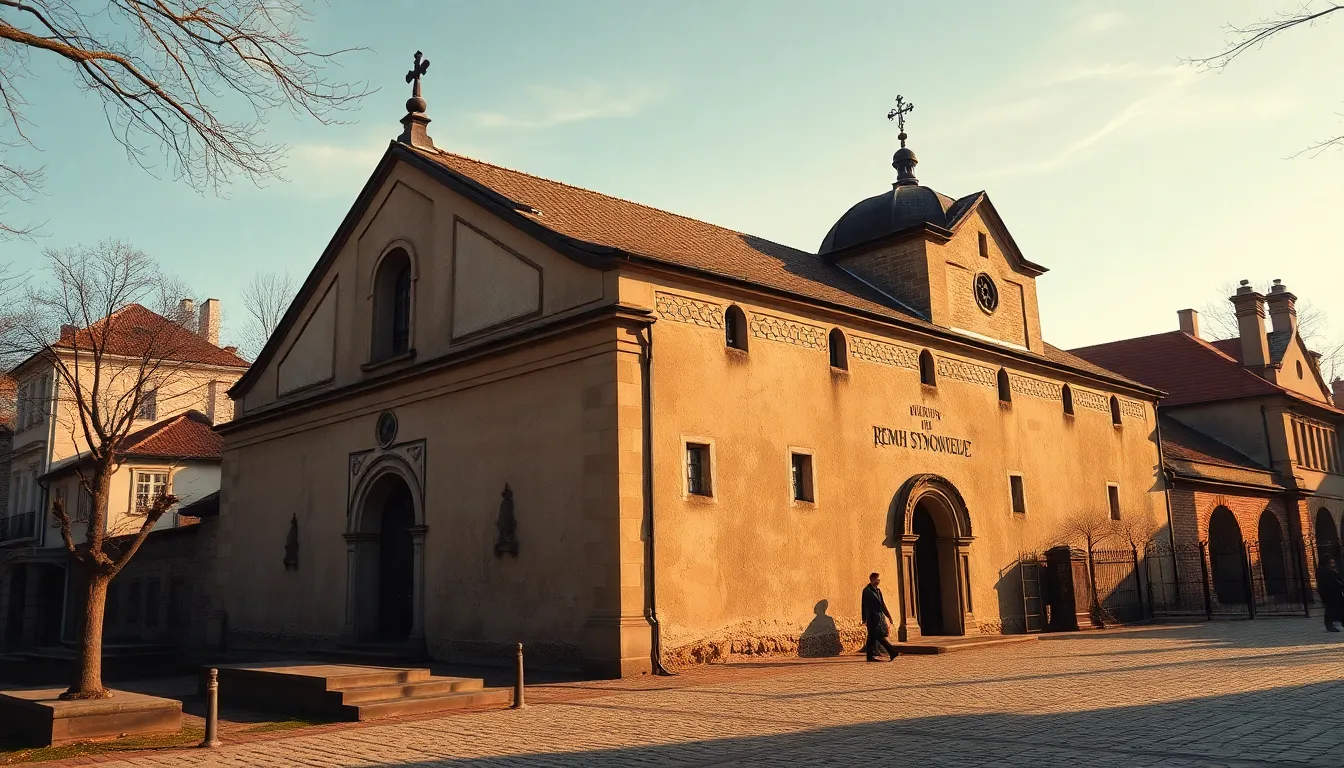
There is a small synagogue on Szeroka Street in Krakow where, on a Shabbat morning, you can still hear prayer in a room that has held prayer for nearly five centuries. Most of the synagogues in Kazimierz are museums now, beautiful and important, but quiet in the way museums are quiet. The Remuh is different. The Remuh is alive. When I bring a group here, I tell them before we go in: this is not a place we observe. This is a place where people still daven. We enter as guests in a working house of God.
The Remuh Synagogue and its adjoining cemetery are, to my mind, the spiritual center of Jewish Krakow. They carry the name and the memory of one of the towering figures of Jewish law. And the cemetery beside the synagogue is one of the oldest Jewish burial grounds in Europe. For a heritage group, this is a place that asks for reverence, and rewards it.
The Remuh: The Sage Behind the Name
Who the Remuh Was
The synagogue is named for Rabbi Moses Isserles, known across the Jewish world by the acronym Remuh. He lived in Krakow in the sixteenth century, and he is one of the most important rabbinic authorities in the history of Ashkenazi Judaism. When Rabbi Joseph Karo compiled the Shulchan Aruch, the great code of Jewish law, it reflected Sephardic practice. The Remuh wrote a companion work, the Mappah, that added Ashkenazi custom. To this day, when an Ashkenazi Jew studies the Shulchan Aruch, they are reading the Remuh alongside it. His rulings shape how Jews keep Shabbat, mark the holidays, and live their daily religious lives.
That is the weight a group should carry into this place. The Remuh is not a local figure. He is a foundation of Jewish practice, and he taught, prayed, ruled, and is buried here.
The Synagogue Itself
The synagogue was built around 1553, and tradition holds that the Remuh’s father founded it, with the building later associated with the Remuh himself. It is small, far smaller than visitors expect from a site of such importance. The main prayer hall is modest. The aron kodesh, the ark that holds the Torah scrolls, is a Renaissance-era stone structure of real beauty. The bimah stands at the center under a wrought-iron canopy.
What moves people is not the scale. It is the continuity. This room survived the war, survived the communist decades when so many synagogues were abandoned, and remains an active congregation today. Services are held here. The Remuh is the working synagogue of Krakow, and on the High Holidays and Shabbat, Jews gather in this room as Jews have gathered in it for centuries.
Entering with Respect
Because the Remuh is active, I prepare groups to enter properly. Men cover their heads. Everyone dresses with modesty appropriate to a house of prayer. We speak softly. If a service is underway, we wait or we adjust. I want my groups to feel the difference between visiting a monument and entering a sanctuary, because that difference is the heart of what this place offers.
The Cemetery: A Resting Place of Sages
One of the Oldest Jewish Cemeteries in Europe
Beside the synagogue lies the Remuh Cemetery, established in 1535. It is one of the oldest surviving Jewish cemeteries on the continent. For more than two hundred years it served the Jewish community of Krakow, until burials there ended in the late eighteenth century and a newer cemetery took its place.
Walking into this cemetery, a group steps into Renaissance-era Jewish Krakow. The headstones, the matzevot, are carved in Hebrew, many bearing the symbols that mark the lineage and life of the person beneath: the hands of the priestly blessing for a kohen, the pitcher of the Levite, the books of a scholar. These are not abstract artifacts. They mark real people who lived, prayed, and died in this community across two centuries.
The Grave of the Remuh
The Remuh himself is buried here, against the eastern wall of the synagogue, and his grave is the reason many Jews come. For generations, the faithful have visited his resting place, especially on the anniversary of his death, Lag BaOmer. It is customary to leave a small stone on the grave and to offer a prayer. I tell my groups that this is a place of pilgrimage, and that standing at the grave of the Remuh connects them to an unbroken chain of Jews who have stood there before them.
The Wailing Wall of Krakow
There is one feature of the cemetery that stops every group I have brought here. During the war, the Germans desecrated the cemetery and shattered many of the gravestones. After the war, the broken fragments were gathered, and rather than discard them, the community embedded them into a wall along the cemetery’s edge. It is called the Wailing Wall of Krakow. The shards of hundreds of headstones, the names and blessings now broken and pieced together, form a mosaic of loss and of refusal to forget.
I do not say much when I stand a group in front of that wall. I let it speak. The broken stones say what no guide can.
Visiting the Remuh as a Group
What to Prepare For
The Remuh complex is compact, and it can absorb a quiet group well, but it is not a place for hurry. I plan unhurried time so that people can sit in the synagogue, walk the cemetery slowly, and stand at the Remuh’s grave and at the Wailing Wall without being rushed toward the next stop. Reverence requires time. I build it in.
Because this is an active site of prayer and a working cemetery, I ask groups to follow the customs of a Jewish burial ground. We do not eat or drink among the graves. We tread carefully. Those who wish to may leave a stone. A leader who prepares a group for these small acts of respect gives them a deeper experience.
Where It Fits
The Remuh sits in the heart of Kazimierz, Krakow’s Jewish quarter, a few steps from the Old Synagogue museum. I build a Kazimierz morning around these two anchors, the living synagogue and the historical one, so a group feels both the continuity and the depth of Jewish Krakow. Our wider Jewish heritage in Poland guide places this within the full journey.
You can see how we shape a complete Poland trip on our Poland destination page, and our group heritage tours page explains how we support group leaders throughout.
FAQ: The Remuh Synagogue and Cemetery
Who was the Remuh?
The Remuh is Rabbi Moses Isserles, a sixteenth-century Krakow sage and one of the foundational authorities of Ashkenazi Jewish law. His glosses on the Shulchan Aruch, known as the Mappah, added Ashkenazi custom to the code and remain essential to Jewish practice today. He lived, taught, and is buried in Krakow.
Is the Remuh Synagogue still active?
Yes. Unlike most of the synagogues in Kazimierz, which now serve as museums, the Remuh is the active congregational synagogue of Krakow. Services are held here, including on Shabbat and the High Holidays, so groups enter as guests in a working house of prayer rather than a museum.
How old is the Remuh Cemetery?
The cemetery was established in 1535 and is one of the oldest surviving Jewish cemeteries in Europe. It served the Krakow community for more than two hundred years, and its Renaissance-era headstones mark the sages, scholars, and ordinary people of early Jewish Krakow.
What is the Wailing Wall of Krakow?
After the Germans desecrated the cemetery during the war and shattered many gravestones, the surviving fragments were gathered and set into a wall along the cemetery’s edge. This mosaic of broken headstones is known as the Wailing Wall of Krakow, and it stands as a memorial to the desecration and to the community’s refusal to discard the names of its dead.
How should a group behave when visiting?
Because the synagogue is active and the cemetery is a working Jewish burial ground, groups should enter with reverence. Men cover their heads, everyone dresses modestly, and people speak softly. In the cemetery, do not eat or drink, tread carefully, and, if you wish, leave a small stone on a grave in the Jewish custom.
The Remuh is one of the places where I see a group grow quiet on its own, without my asking. There is something about standing in a room that has held prayer for five hundred years, and at a grave that Jews have visited for longer than the United States has existed, that does its own work. If you are planning to bring your community to Krakow, I would be glad to help you prepare for this place with the care it deserves.
Contact us whenever you are ready to talk it through.