The first time most of my groups see the Divine Mercy image, they pause longer than they expect to. It is a simple painting: Christ stepping forward, one hand raised in blessing, the other touching his heart, and two rays, one pale and one red, streaming out of it. Below it, four words. “Jesus, I trust in You.” People stand in front of it and read those four words and something settles. I have watched it happen with Catholic and Protestant groups alike.
Lagiewniki, a district on the southern edge of Krakow, is where that image and the devotion behind it were born. It is now the world center of the Divine Mercy message, drawing pilgrims from every continent. A young nun named Faustina Kowalska lived here, received visions she recorded in a diary, and died here in 1938. Decades later a Krakow archbishop named Karol Wojtyla carried her message to the whole church as Pope John Paul II.
This guide covers what the sanctuary is and how to visit it well. It builds on our overview of spiritual sites in Poland, and it sits at the heart of the John Paul II story in Krakow.
What Lagiewniki Is
Lagiewniki is home to the Sanctuary of Divine Mercy, a complex centered on the convent of the Congregation of the Sisters of Our Lady of Mercy. Sister Faustina entered this order, lived in this convent, and is buried here. The site has two main churches and the original convent, and together they form one of the most visited Catholic pilgrimage destinations in the world.
The devotion that radiates from here is straightforward at its core. It teaches that God’s mercy is the greatest attribute of God, available to anyone who turns to it, no matter the weight of their past. Faustina’s diary records visions in which Christ asked that this message of mercy be spread, that the image be painted, and that a Feast of Divine Mercy be established. John Paul II answered all three calls as pope.
The Two Churches
Two churches anchor the site, and groups should see both.
The convent chapel, the older church, holds the original miraculous image of the Merciful Jesus venerated here, along with the tomb of Saint Faustina. This is the intimate heart of the sanctuary, where the sisters pray and where Faustina herself lived out her short life. The relics of Saint Faustina rest beneath the side altar.
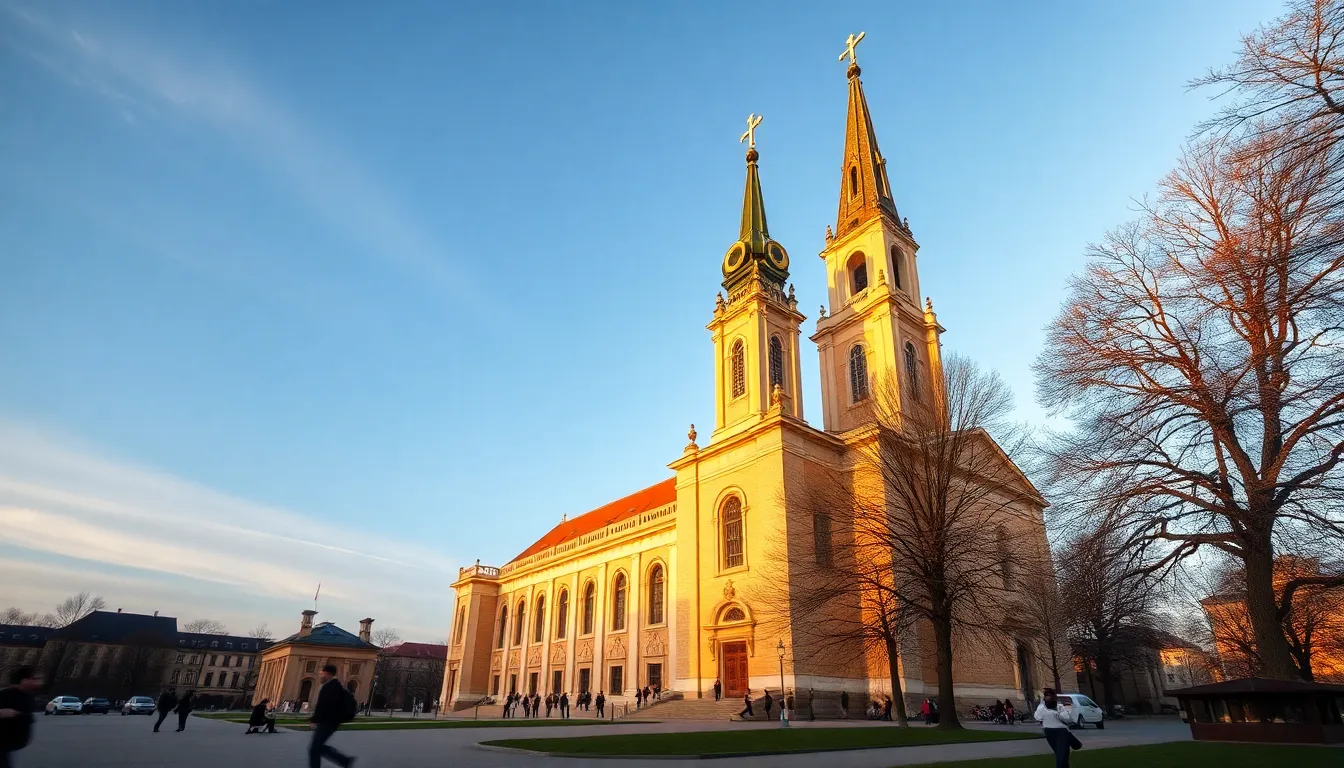
The Basilica of Divine Mercy, the large modern church consecrated by John Paul II in 2002, dominates the complex. It is grand, light-filled, and built to hold the crowds that now come. From its tower you can see across Krakow. The basilica was conceived as the spiritual center from which the Divine Mercy message would reach the world, and the pope’s consecration homily entrusted the entire world to God’s mercy from this spot.
The Image of the Merciful Jesus
The image at the center of all this deserves a closer look, because groups always ask about it.
In 1931, Faustina recorded a vision of Christ dressed in white, one hand raised in blessing, the other drawing back his garment at the chest, with two rays, one pale and one red, pouring from his heart. Christ told her to have the image painted with the inscription “Jezu, ufam Tobie,” which means “Jesus, I trust in You.” Faustina, who could not paint, eventually worked with an artist in Vilnius to produce the first version.
The two rays carry specific meaning that I always explain. The pale ray represents the water that makes souls righteous; the red ray represents the blood that is the life of souls. Together they point to the sacraments and to the mercy flowing from the cross. Once a group understands that the image is not just a portrait but a teaching, they look at it differently.
The original image venerated at Lagiewniki draws pilgrims who come specifically to pray before it. It is worth noting that several versions of the image exist across the world, and the one here at the convent chapel is the one most directly tied to the sanctuary’s life.
The John Paul II Connection
You cannot tell the Lagiewniki story without John Paul II, and the connection is unusually direct. As Archbishop of Krakow, Karol Wojtyla advanced the cause of Faustina, whose writings had earlier been viewed with caution by the Vatican. He helped clear her name and reopen her case. As pope, he beatified her in 1993 and canonized her in 2000, the first saint of the new millennium. At that canonization he established Divine Mercy Sunday, the feast Faustina’s diary had asked for, for the universal church.
Then in 2002 he returned to Lagiewniki to consecrate the new basilica and entrust the world to Divine Mercy. The hill where the sanctuary stands is close to the Solvay quarry where the young Wojtyla labored during the war. The geography of his life and the geography of this message overlap. For pilgrims, that closeness is part of what makes Lagiewniki so moving.
Visiting Lagiewniki Well
A few practical notes I share with every group:
- Give it a half day. Both churches, the convent chapel with Faustina’s tomb, and time to pray and reflect do not fit into a quick stop. Do not rush this one.
- See the convent chapel, not just the basilica. The big basilica draws the eye, but the original image and the saint’s tomb are in the smaller convent chapel. Make sure your group gets there.
- Time the Chaplet. The Chaplet of Divine Mercy is prayed daily at 3 p.m., the “Hour of Mercy” tied to the hour of Christ’s death. Being present for it adds something a guidebook cannot.
- Dress and conduct. Modest dress, quiet behavior, photography restricted inside the chapels. This is an active convent and a working sanctuary.
- Pair it with the Sanctuary of John Paul II. The neighboring Sanctuary of Saint John Paul II sits a short distance away and completes the pilgrimage block.
For the human story behind the image, our guide to Saint Faustina and the Divine Mercy heritage trail follows the visionary nun’s life and the spread of the devotion across Poland and the world.
Where Lagiewniki Fits in Your Itinerary
Lagiewniki sits on the southern edge of Krakow, easily reachable from the Old Town. It anchors the Divine Mercy and John Paul II dimension of a Krakow trip, and it pairs naturally with Wawel Cathedral, the Archbishop’s Palace, and the Sanctuary of John Paul II next door. For a Catholic group, it is essential. For a Protestant or interfaith group, it offers a clear and accessible window into one of the most influential modern Catholic devotions, and the message of mercy and trust crosses denominational lines with ease.
Heritage Tours builds custom faith itineraries across Poland for groups of every denomination. Group leaders travel free with 15 or more participants. You can see how we structure these journeys on our Poland destination page or learn about the group leader experience.
FAQ: The Divine Mercy Sanctuary at Lagiewniki
What is the Divine Mercy Sanctuary at Lagiewniki?
It is the world center of the Divine Mercy devotion, located in the Lagiewniki district of Krakow. The complex includes the convent where Saint Faustina Kowalska lived and is buried, the chapel holding the original miraculous image of the Merciful Jesus, and the large Basilica of Divine Mercy consecrated by John Paul II in 2002. It is one of the most visited Catholic pilgrimage sites in the world.
What does the Divine Mercy image mean?
The image shows Christ with one hand raised in blessing and the other touching his heart, from which two rays stream: a pale ray representing the water that justifies souls, and a red ray representing the blood that is the life of souls. Beneath it are the words “Jesus, I trust in You.” It is a teaching about God’s mercy as much as a devotional portrait.
Where is Saint Faustina buried?
Saint Faustina Kowalska is buried at the convent chapel in Lagiewniki, with her relics beneath a side altar near the original image of the Merciful Jesus. Pilgrims come specifically to pray at her tomb and before the image.
What is the connection between John Paul II and Divine Mercy?
As Archbishop of Krakow, Karol Wojtyla advanced Faustina’s cause. As Pope John Paul II, he beatified her in 1993, canonized her in 2000 as the first saint of the new millennium, established Divine Mercy Sunday for the universal church, and consecrated the new Lagiewniki basilica in 2002, entrusting the world to God’s mercy.
How long should a group spend at Lagiewniki?
Plan a half day. The basilica, the convent chapel with the original image and Faustina’s tomb, and time for prayer and reflection do not fit into a brief stop. Being present for the daily Chaplet of Divine Mercy at 3 p.m. adds to the experience, and the neighboring Sanctuary of John Paul II pairs well with the visit.
If you want to bring your community to Lagiewniki, I would be glad to help you plan a visit that gives the sanctuary the time it deserves. The message of mercy here reaches people across every tradition. Contact us whenever you are ready to start.