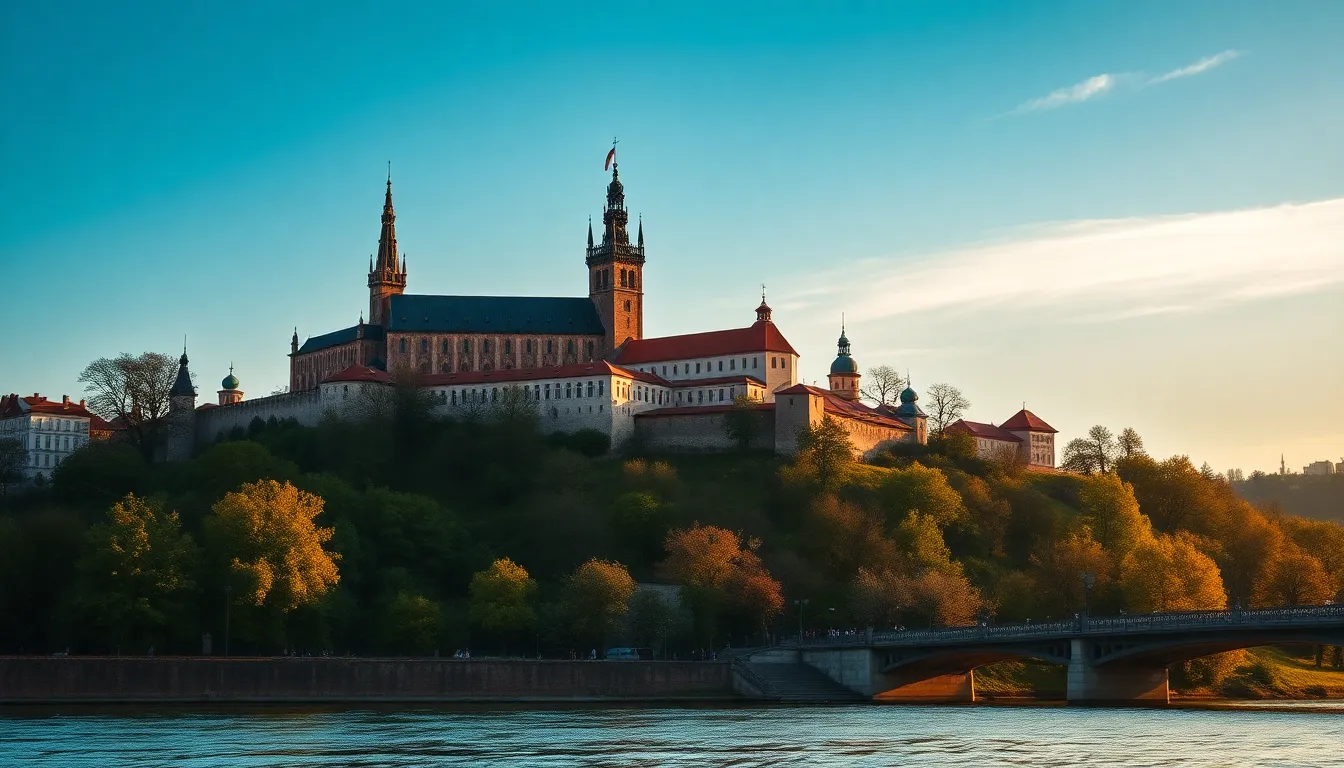
Most groups I bring to Krakow are there for the heritage that breaks your heart, the synagogues of Kazimierz, the memorial sites, Auschwitz-Birkenau an hour to the west. That is the center of gravity for a heritage journey here, and it should be. But I have learned not to skip Wawel, and I tell groups why before we climb the hill.
To understand what was lost in Poland, you have to understand what Poland was. For most of a thousand years this was a real kingdom, a major European power, a place of kings and cathedrals and high culture. Wawel is where you stand inside that story. The Jewish community that built Kazimierz did not live on the margins of some backwater. They lived in the shadow of one of the great royal capitals of Europe. Wawel is the proof of that, sitting right there on the hill above the river.
If you are building a deeper Krakow itinerary, our guide to hidden heritage sites in Poland covers the lesser-known stops. Wawel is the opposite, the most visited site in the country, and worth understanding properly.
The Hill That Made a Kingdom
Wawel is a limestone hill on the bank of the Vistula River in Krakow. People have lived on it since the Stone Age, and a stronghold has stood here for well over a thousand years. By the early Middle Ages it was the seat of Polish power, and when Krakow became the capital of the Kingdom of Poland, Wawel became the place where the kingdom was governed and where its kings were crowned and buried.
For roughly five centuries, from the 1300s until the capital moved to Warsaw around 1600, Wawel was the political and spiritual heart of Poland. Two structures dominate the hill, and they tell two halves of the same story, the Royal Castle and the Cathedral.
The Royal Castle
The castle you see today is largely a Renaissance palace, rebuilt in the early 1500s under King Sigismund I after an earlier Gothic castle burned. He brought Italian architects to Krakow, and the result is one of the finest Renaissance buildings north of the Alps, built around a stately arcaded courtyard.
Inside, the castle holds the State Rooms and Royal Private Apartments, with a collection that includes a famous set of monumental tapestries commissioned in the 1500s, woven in Brussels, that once decorated the halls for coronations and royal weddings. The castle’s history runs through the heights of Polish power and the depths of its later losses, including the period when Poland was partitioned out of existence and foreign powers used Wawel as a barracks. That it survived and was restored is part of the Polish story of endurance that runs through nearly every heritage site in this country.
Wawel Cathedral: Where Kings and Saints Lie
If the castle is the seat of Polish kingship, the Cathedral is its soul. The Cathedral of Saints Stanislaus and Wenceslaus has stood on Wawel in some form for around a thousand years, and the present Gothic structure dates mainly to the 1300s, with chapels added across the centuries in every style that followed.
This is the coronation church of Poland. For centuries, Polish monarchs were crowned here and then, in time, buried here. The cathedral and its crypts hold the tombs of kings, queens, national heroes, and poets. It is, in a real sense, the resting place of the Polish nation’s memory.
Saint Stanislaus and the Heart of Polish Faith
At the center of the cathedral stands the shrine of Saint Stanislaus, the bishop of Krakow martyred in 1079 and the patron saint of Poland. For Polish Catholics this is sacred ground, the spiritual focal point of a deeply Catholic nation, which is why I cover the cathedral’s religious weight in more detail in our guide to spiritual sites in Poland.
For a heritage group, even one that is not Catholic, the cathedral matters because it shows how completely faith and nation were bound together in Poland. You cannot understand Polish identity, or what the destruction of the twentieth century did to it, without standing in this church where a thousand years of that identity is buried.
The Sigismund Bell hangs in the cathedral tower, cast in 1520, one of the largest bells in Poland, rung only on the greatest occasions. Tradition holds that touching its clapper brings good fortune, and groups that climb the tower usually try.
How Heritage Groups Visit Wawel
Wawel is a hill with several distinct attractions, and that shapes how a group experiences it. The grounds, the outer courtyards and the cathedral approach, are open and free to walk. The ticketed interiors, the State Rooms, the Royal Apartments, the Crown Treasury, the cathedral and its crypts and tower, each require separate tickets, and the most popular ones are released in limited numbers.
For a group, this means planning ahead. I do not recommend arriving at Wawel and improvising. The lines are real, the timed-entry tickets sell out, and a group that wants to see the State Rooms and the royal tombs needs those tickets secured in advance. Our local operators handle the booking and the timing so your group moves through without the friction that frustrates independent visitors.
A focused visit usually covers the castle courtyard, the cathedral with the royal crypts and Saint Stanislaus shrine, and one or two of the interior routes, depending on the group’s interest and time. Half a day is reasonable. Trying to see everything on the hill in one visit tends to leave a group exhausted rather than moved.
Practical Access
Wawel sits at the southern edge of Krakow’s Old Town, a short walk from the main Market Square and within easy reach of Kazimierz. That location is part of why it fits so naturally into a heritage itinerary, you can move from the royal hill to the historic Jewish quarter in a matter of minutes, and feel the two worlds that lived side by side in this city.
The cathedral is a working church, so modest dress is appropriate and quiet is expected, especially near the shrine and tombs. The interiors involve a fair amount of stairs, the tower especially, which is worth knowing if your group includes anyone with limited mobility.
For a group of 15 or more traveling with a leader, we arrange the group leader’s place at no cost, so whoever is shepherding the group can give their attention to their people rather than to ticketing and timing.
Where Wawel Fits in the Journey
Wawel works best early in a Krakow stay, before the heavier days. Seeing the height of Polish civilization first gives a group the context to absorb what came later. When they stand in Kazimierz, or at Auschwitz, they carry the memory of this hill, and they understand that the destruction did not fall on a poor or marginal place. It fell on one of Europe’s great kingdoms.
From here, many groups move on to the Warsaw Old Town, another monument to Polish endurance, rebuilt stone by stone from wartime ruin. Wawel survived. Warsaw was rebuilt. Together they tell you how this nation holds onto its heritage.
FAQ: Wawel Castle and Royal Poland
What is Wawel Castle and why is it important?
Wawel is a hill in Krakow holding the Royal Castle and Cathedral of Poland. For roughly five centuries, until the capital moved to Warsaw around 1600, it was the seat of Polish kings, the place where they were crowned and buried. It is the heart of historic Poland and the most visited heritage site in the country.
What can groups see at Wawel Cathedral?
The cathedral is the coronation and burial church of Polish monarchs and holds the tombs of kings, queens, national heroes, and poets in its crypts. It contains the shrine of Saint Stanislaus, the patron saint of Poland, and the great Sigismund Bell in its tower. It remains an active church and a spiritual center of Polish Catholicism.
Do groups need tickets in advance for Wawel?
Yes. The grounds and courtyards are free to walk, but the interiors, including the State Rooms, Royal Apartments, Crown Treasury, and the cathedral crypts and tower, require separate tickets that are released in limited numbers and sell out. Groups should book in advance, which our local operators handle along with the timing.
Where is Wawel and how much time does a group need?
Wawel sits at the southern edge of Krakow’s Old Town, a short walk from the Market Square and the Kazimierz Jewish quarter. A focused visit covering the courtyard, the cathedral, and one or two interior routes takes about half a day. Seeing everything on the hill in one visit tends to exhaust a group.
Why visit a royal castle on a Jewish heritage trip?
To understand what was lost in Poland, a group has to understand what Poland was. Wawel shows that the Jewish community of Krakow lived in the shadow of one of Europe’s great royal capitals, not on the margins of a backwater. Seeing the height of Polish civilization gives a group the context to absorb the destruction that came later.
If you want Wawel placed where it does the most for your group’s journey, tell us what you are planning and we will build it with you. You can reach out here.