Most heritage groups that visit Poland follow the same route: Warsaw, Krakow, Auschwitz-Birkenau. And those are essential stops. They should be part of every journey. But if that is where your trip ends, you have seen only part of what Poland holds.
The deeper story of Jewish life in Poland did not unfold in the large cities alone. It lived in hundreds of small towns across the eastern countryside, in synagogues built by hand from local stone, in cemeteries where generations of families are buried side by side, in market squares where Jewish merchants traded for centuries. Some of those places still exist. Many are crumbling. A few have been carefully restored. Almost none of them appear in standard travel guides.
If you have already read our Poland heritage travel guide and you are ready to go further, this is where the journey gets personal.
Why Poland’s Deepest Heritage Is Often Invisible to First-Time Visitors
There is a reason most Poland itineraries stick to the major cities. The well-known sites are easier to reach, well-documented, and staffed by professional guides. They are important. Nobody should skip Auschwitz or POLIN.
But the small-town sites tell a different kind of story. They show you what Jewish life in Poland actually looked like at the community level, before the world that created those communities was destroyed. A synagogue in a town of two thousand people is not a museum exhibit. It is evidence that real people lived here, prayed here, raised children here.
These places are harder to get to. They require local knowledge. And they ask something of you that the major sites do not: patience, attention, and a willingness to sit with what is incomplete.
Heritage Tours builds custom itineraries that include these sites alongside the standard Poland route. Our local operators know the custodians, the access arrangements, and the stories that no guidebook carries.
Tykocin: A 17th-Century Synagogue, Almost Untouched
Tykocin is a small town in northeastern Poland, about two hours from Warsaw. If you have never heard of it, you are not alone. It rarely appears in heritage travel content. But what stands in Tykocin is one of the most remarkable Jewish sites in all of Europe.
What Tykocin Was Before 1941
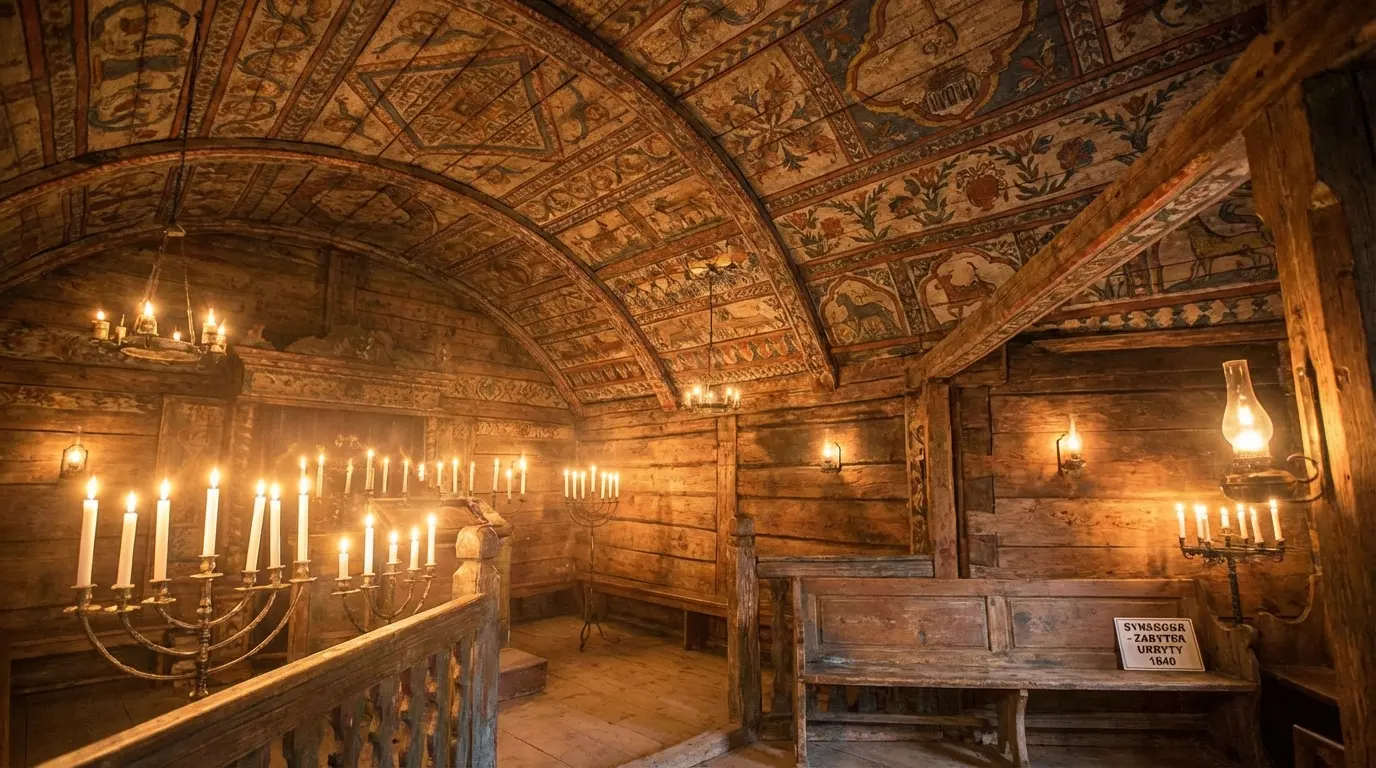
The Great Synagogue of Tykocin was built in 1642. It is a Baroque structure, built from brick, with a soaring interior that was designed for a community that took its prayer life seriously. Before the war, Tykocin’s Jewish population made up more than half the town. The synagogue was the center of that community for three hundred years.
In August 1941, the Nazis gathered Tykocin’s entire Jewish population, approximately 1,400 people, and murdered them in the nearby Lopuchowo Forest. The community that had prayed in that synagogue for three centuries was eliminated in a single day.
What Remains Today
The synagogue survived. It was used as a warehouse during and after the war, which, perversely, is what preserved it. In the 1970s, it was restored and turned into a museum of Jewish heritage.
Walking into the Great Synagogue of Tykocin today, you stand in a space that has not been rebuilt or reimagined. The bimah, the aron kodesh, the women’s gallery, these are the original architectural elements, preserved through neglect and then through intention. The scale of the interior surprises people. This was not a modest village shul. This was a community that built something meant to last.
For groups that include Tykocin in their itinerary, the experience is often one of the most moving of the entire trip. There is no crowd here. No audio guide. Just the building itself and the silence of a community that is no longer there to fill it.
Lodz: The Other Jewish Capital of Poland
Lodz is Poland’s third-largest city, and before the war it was one of the most important Jewish cities in Europe. Yet it almost never appears in heritage travel itineraries. The attention goes to Krakow and Warsaw, and Lodz gets overlooked.
That is a significant gap.
The Textile District and the Ghetto That Once Held 230,000 People
Lodz was an industrial city. Its textile mills drew Jewish workers and entrepreneurs from across Poland. By the early twentieth century, Jews made up a third of the city’s population, and Jewish-owned factories were a major part of the local economy.
When the Nazis established the Lodz Ghetto in 1940, they sealed 230,000 Jewish residents into a small section of the city. The Lodz Ghetto was the second-largest in all of occupied Europe, after Warsaw. It operated for four years as a forced labor camp before its population was deported to Chelmno and Auschwitz.
The streets of the former ghetto are still there. Some of the buildings still stand. Walking through this part of Lodz, with a guide who can explain what each block was and who lived there, your group encounters a history that most Poland itineraries skip entirely.
The Radegast Station Memorial
Radegast Station is where deportation trains left the Lodz Ghetto. Today it is a memorial site. An original cattle car sits on the tracks. The names of the transports and their destinations are inscribed on the walls.
Radegast does not draw the crowds that Auschwitz does. For many groups, that is part of its significance. You stand at this station in relative solitude, reading the names and dates, and the reality of what happened here settles in without distraction.
Zamosc: A Renaissance Town with a Buried Jewish Story
Zamosc is a UNESCO World Heritage Site, and most visitors come for its remarkable Renaissance architecture. The town was designed in the sixteenth century as an “ideal city” by the Italian architect Bernardo Morando, and its market square is one of the most beautiful in Poland.
What most visitors do not know is that Zamosc had a significant Jewish community for centuries. The town’s Jewish population built a synagogue, established businesses around the market square, and became an integral part of the city’s commercial life.
During the Holocaust, Zamosc’s Jews were deported and murdered. The synagogue was destroyed. Today, there is little physical evidence of the community that lived here, which is itself part of the story. Zamosc shows your group what erasure looks like in practice: a beautiful town where an entire community has been removed so completely that most visitors do not know it was ever there.
For groups that are grappling with what it means to bear witness, Zamosc adds a dimension that the major sites cannot. It is not a memorial. It is an absence.
The Small-Town Synagogues of Eastern Poland
Across eastern Poland, in towns whose names do not appear in any guidebook, there are synagogue buildings in various states of preservation. Some have been restored through the efforts of local preservation societies, Polish cultural organizations, and Jewish heritage groups. Others are still being used as warehouses, apartment buildings, or fire stations, their original purpose visible only in the architecture.
What Happened to the Jews of the Shtetl
The word “shtetl” describes the small Jewish towns that dotted the Polish and Lithuanian countryside for centuries. These were not isolated communities. They were connected to each other through trade, marriage, and religious scholarship. A rabbi in one shtetl might have studied in another. A merchant’s daughter might marry into a family three towns away.
The shtetl world was destroyed almost completely during the Holocaust. What remains, in physical terms, is a handful of synagogue buildings, cemeteries, and the outlines of market squares that were once the center of Jewish life.
Sites That Are Being Restored, and Sites That Are Not
Some of these small-town synagogues are being restored with care and devotion. Others are deteriorating. The difference often comes down to whether a local advocate, a Polish historian, a Jewish descendant who returned, or a preservation organization has taken an interest.
For group leaders who want to include one or two of these sites, Heritage Tours’ local operators can identify which buildings are accessible, which have knowledgeable custodians, and which will add the most depth to your specific itinerary. These are not sites you can find on a tourist map. They require someone who knows the territory.
Jewish Cemeteries Off the Standard Route
Poland has hundreds of Jewish cemeteries. Some, like the Remuh Cemetery in Krakow’s Kazimierz, are well-maintained and regularly visited. But most are not.
In small towns across the country, Jewish cemeteries sit behind overgrown fences, their headstones tilted or fallen, their paths barely visible under decades of vegetation. A few dedicated volunteers, both Polish and Jewish, maintain some of these sites. Many others receive no regular care.
Reading a Polish Jewish Cemetery
A Jewish cemetery in Poland is not just a burial ground. It is a record. The headstones carry Hebrew inscriptions that identify the person buried there, often including their father’s name, their community role, and the date of death by the Jewish calendar. The symbols carved into the stones, a menorah, a pair of hands for a kohen, a pitcher for a Levite, tell you about the family and their place in the community.
For groups that include a visit to a rural Jewish cemetery, the experience is intimate in a way that the large memorial sites are not. You are standing among the graves of ordinary people, families who lived quiet lives in a town that may no longer have a single Jewish resident. The care, or neglect, of these cemeteries tells your group something about memory and what it takes to maintain it.
What These Sites Add to a Heritage Group Journey
The standard Poland itinerary is important. Auschwitz, POLIN, Kazimierz, these sites form the backbone of any heritage journey. But the places described here add texture, nuance, and a dimension of reality that the major sites sometimes cannot provide.
When your group stands in the Great Synagogue of Tykocin, they are not in a museum designed for visitors. They are in a building that was built for a community that no longer exists. When they walk through the streets of the Lodz Ghetto, they encounter a scale of suffering that the Warsaw-Krakow route does not fully convey. When they visit a crumbling cemetery in a town whose Jewish population was murdered in a single day, they confront what it means for a community to be erased.
These sites require more planning, more travel time, and guides with specific local knowledge. Heritage Tours can build them into your itinerary. If you are a group leader who wants your community’s journey to go deeper than the standard route, that is exactly what we are here to help with.
You are welcome to reach out and tell us what kind of journey your group is looking for. We will build it with you.
Frequently Asked Questions
What is the Tykocin synagogue and why is it significant?
The Great Synagogue of Tykocin was built in 1642 and is one of the best-preserved Baroque synagogues in Europe. It served as the center of Jewish life in Tykocin for three hundred years before the town’s Jewish community was murdered in 1941. The building survived because it was repurposed as a warehouse. Today it is a museum of Jewish heritage and one of the most powerful, least-visited Jewish sites in Poland.
What Jewish heritage sites are in Lodz, Poland?
Lodz was home to one of the largest Jewish communities in prewar Poland. Key heritage sites include the former Lodz Ghetto streets, which are still walkable today, the Radegast Station memorial where deportation trains departed, the Jewish cemetery on Bracka Street, one of the largest Jewish cemeteries in Europe, and the Survivors’ Park. Despite its significance, Lodz is rarely included in standard heritage tour itineraries.
Are there Jewish cemeteries in rural Poland that heritage travelers can visit?
Yes, there are hundreds of Jewish cemeteries across rural Poland. Many are in small towns and are accessible to visitors, though conditions vary widely. Some are maintained by volunteer organizations, while others are overgrown and receive no regular care. Heritage Tours’ local operators can identify accessible cemeteries with historical significance and arrange visits as part of a custom itinerary.
What is the Radegast Station memorial in Lodz?
Radegast Station is the railway station from which Jews in the Lodz Ghetto were deported to the Chelmno and Auschwitz extermination camps. Today it is a memorial site featuring an original cattle car on the tracks and walls inscribed with the names and destinations of the transports. It is a quieter, less-visited memorial that offers groups space for reflection without the crowds of larger sites.
What small-town Jewish heritage sites in Poland are worth visiting?
Beyond the major cities, significant sites include the Great Synagogue of Tykocin, the Renaissance town of Zamosc with its buried Jewish history, restored synagogues in towns across eastern Poland, and rural Jewish cemeteries that serve as the last physical record of communities that were destroyed. These sites require local knowledge to access and are best visited with a guide who understands their history and current condition.