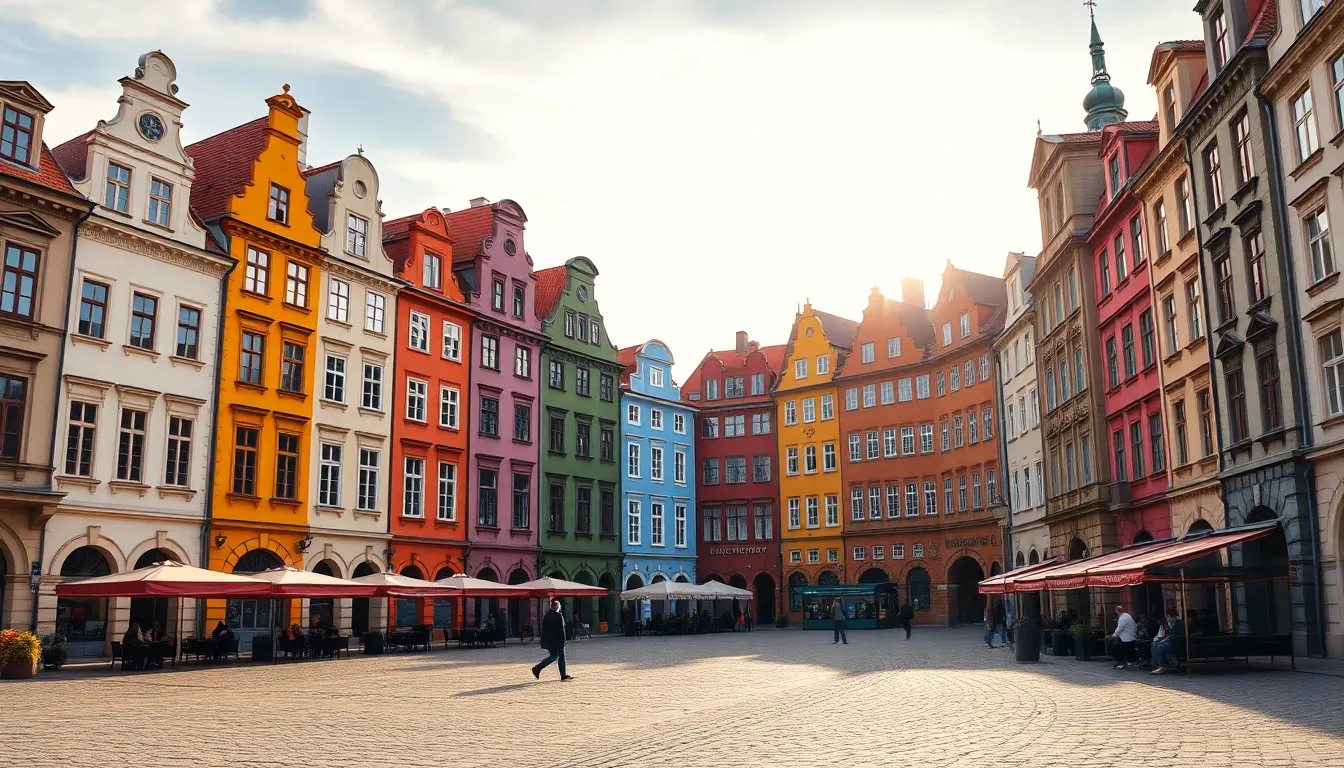
When I walk a group into the Warsaw Old Town, the first thing they say is how beautiful it is. Colorful townhouses around a market square, narrow lanes, a castle, church spires. It looks like a medieval city that has stood for centuries. Then I tell them the thing that changes how they see every stone around them. Almost none of this is old. By the end of the war, this entire district was rubble. What they are looking at was rebuilt from nothing.
That fact is the whole point of bringing a group here. The Warsaw Old Town is not a story about old buildings. It is a story about a nation that refused to let its heritage be erased, and rebuilt its capital’s heart deliberately, painstakingly, as an act of defiance and memory. For a heritage group, that is a more powerful lesson than any genuinely ancient city could teach.
If your group is also visiting Wawel Castle in Krakow, the contrast is worth holding in mind. Wawel survived the war. Warsaw did not. The two cities show two faces of how Poland kept its heritage.
What Warsaw Was, and What Was Done to It
Warsaw’s Old Town, the Stare Miasto, dates back to the 1200s. For centuries it was the historic core of the city, a dense quarter of merchant houses, churches, guild halls, and the Royal Castle, growing through the Gothic, Renaissance, and Baroque periods into one of Central Europe’s notable old towns.
Then came the war, and Warsaw suffered as few cities in Europe did.
First, the Jewish quarter and the ghetto were destroyed. After the Warsaw Ghetto Uprising of 1943, the Germans razed the ghetto district to the ground. Then, in 1944, the broader city rose in the Warsaw Uprising, a desperate attempt by the Polish resistance to liberate the capital. The uprising was crushed after sixty-three days. In reprisal, and on Hitler’s explicit order, the Germans set about the systematic destruction of Warsaw. They dynamited and burned the city block by block, deliberately targeting monuments, churches, archives, and historic buildings. The Old Town and the Royal Castle were blown apart.
By the time the war ended, something on the order of eighty-five percent of the historic city was destroyed. The Old Town was a field of broken brick. Photographs from 1945 show a wasteland where a thousand-year-old city had stood.
The Decision to Rebuild
What happened next is what makes Warsaw a heritage site of a rare kind.
Faced with ruins, the Poles made a decision that was not obvious. They could have cleared the rubble and built a modern city. Instead, they chose to rebuild the Old Town as it had been, to reconstruct the historic core brick by brick, restoring the look of the seventeenth and eighteenth centuries.
The reconstruction, carried out mostly between 1945 and the 1960s, was a national effort. Architects worked from old plans, photographs, and paintings, including the detailed cityscapes painted by Bernardo Bellotto in the eighteenth century, which were used as references for facades. Citizens donated labor and salvaged original bricks from the rubble to use again. Decorative details, doorways, and architectural fragments that could be recovered were worked back into the new buildings.
The Royal Castle came later, rebuilt from the 1970s after years when it stood as an empty ruin, funded in part by donations from Poles at home and abroad. When it was finished, the reconstruction was so complete that it is hard to believe the building had been dynamited to its foundations.
Why UNESCO Recognized It
The Warsaw Old Town was added to the UNESCO World Heritage List in 1980, and the reasoning is unusual. Normally a reconstruction would not qualify, because authenticity is the standard, and a rebuilt building is by definition new. Warsaw was recognized as an exceptional case, an outstanding example of the near-total reconstruction of a historic city, and a powerful symbol of a deliberate act of preservation in the face of destruction.
In other words, UNESCO did not recognize the Old Town for being old. It recognized it for what the rebuilding represents, the will of a people to restore their heritage rather than surrender it. That is exactly why it belongs on a heritage itinerary.
Walking the Old Town With a Group
The Old Town rewards a slow walk with someone who can tell the story, because the meaning is invisible without it. To the eye, it is a charming historic quarter. With a guide, every facade becomes a testament to what was lost and what was deliberately brought back.
A typical walk centers on the Old Town Market Square, the Rynek, ringed by tall colorful townhouses, each rebuilt to its prewar appearance. From there a group can take in the Royal Castle, the city walls and the Barbican, the cathedral of St. John, and the Castle Square with its column of King Sigismund. I make a point of showing groups the archival photographs of the same spots in 1945, the ruins set against what stands today. That contrast is where the visit lands.
Connecting It to the Jewish Story
For a heritage group, the Old Town does not stand alone. A short distance away lies the area of the former Warsaw Ghetto, where the city’s destruction began, and the POLIN Museum of the History of Polish Jews, which tells the thousand-year story of Jewish life in Poland. Many of my groups pair the rebuilt Old Town with the ghetto memorials and POLIN in the same Warsaw stay.
The pairing is deliberate. The Old Town was rebuilt. The Jewish quarter, for the most part, was not, and the community that filled it was murdered. Walking both in the same day, a group feels the difference between what could be restored and what was lost forever. That is a hard and honest lesson, and it is the one Warsaw teaches best.
Practical Access
Warsaw is Poland’s capital and largest city, with the country’s main international airport and excellent rail connections. It is a frequent starting or ending point for a Poland itinerary, with Krakow roughly two and a half hours away by fast train.
The Old Town is compact and walkable, with the market square, castle, and city walls all within a few minutes of each other on foot. The streets are cobbled, which is worth noting for anyone in the group with limited mobility. The Royal Castle interior requires a ticket and is worth the time for the restored royal apartments and the story of the reconstruction itself, which the castle museum tells well.
A focused Old Town visit takes a couple of hours on foot, or a half day if you include the Royal Castle interior. It pairs naturally with the ghetto sites and POLIN to make a full and meaningful Warsaw day.
For a group of 15 or more traveling with a leader, we arrange the group leader’s place at no cost, so the person organizing the journey can be present with their group rather than managing the details.
The Lesson Warsaw Leaves
I bring groups to Warsaw’s Old Town because it answers a question that hangs over the whole Poland journey. After so much destruction, after the murder of millions and the leveling of cities, what do you do? Warsaw answers by rebuilding, by insisting that heritage cannot be bombed out of existence if a people decides to carry it forward.
That answer matters for the kind of groups I work with. Pastors, rabbis, and educators bring their communities to Poland to witness loss, but also to learn what endurance looks like. The Old Town, rebuilt from its own ashes, is endurance you can walk through. From here, a group ready to see Jewish life continuing in Poland often travels on to the White Stork Synagogue in Wroclaw, where the same spirit of revival takes a quieter form.
FAQ: The Warsaw Old Town
Is the Warsaw Old Town actually old?
No, and that is the point. The historic Old Town dates to the 1200s, but it was almost entirely destroyed by the Germans in 1944 after the Warsaw Uprising. What stands today was rebuilt brick by brick between 1945 and the 1960s, reconstructed to its prewar appearance using old plans, photographs, and paintings as references.
Why is a rebuilt town a UNESCO World Heritage Site?
UNESCO listed the Warsaw Old Town in 1980 as an exceptional case. It was recognized not for being old but for what the reconstruction represents, a near-total rebuilding of a historic city and a powerful symbol of a people’s determination to restore their heritage in the face of deliberate destruction.
What can a group see in the Warsaw Old Town?
A walk centers on the Old Town Market Square, ringed by rebuilt townhouses, and includes the Royal Castle, the city walls and Barbican, St. John’s Cathedral, and Castle Square with the column of King Sigismund. Seeing archival photographs of the 1945 ruins alongside the rebuilt streets makes the visit land.
How does the Old Town connect to the Jewish heritage of Warsaw?
The former Warsaw Ghetto area and the POLIN Museum of the History of Polish Jews are a short distance away. Many groups pair the rebuilt Old Town with the ghetto memorials in the same visit, which lets them feel the difference between what could be restored and the community that was lost forever.
How do groups reach Warsaw and how much time do they need?
Warsaw is Poland’s capital, with the main international airport and fast rail links, about two and a half hours from Krakow by train. A focused Old Town walk takes a couple of hours, or a half day including the Royal Castle interior, and pairs well with the ghetto sites and POLIN for a full Warsaw day.
If you want the Warsaw Old Town woven into a journey that does justice to both Poland’s endurance and its losses, tell us what your group needs and we will build it with you. You can reach out here.