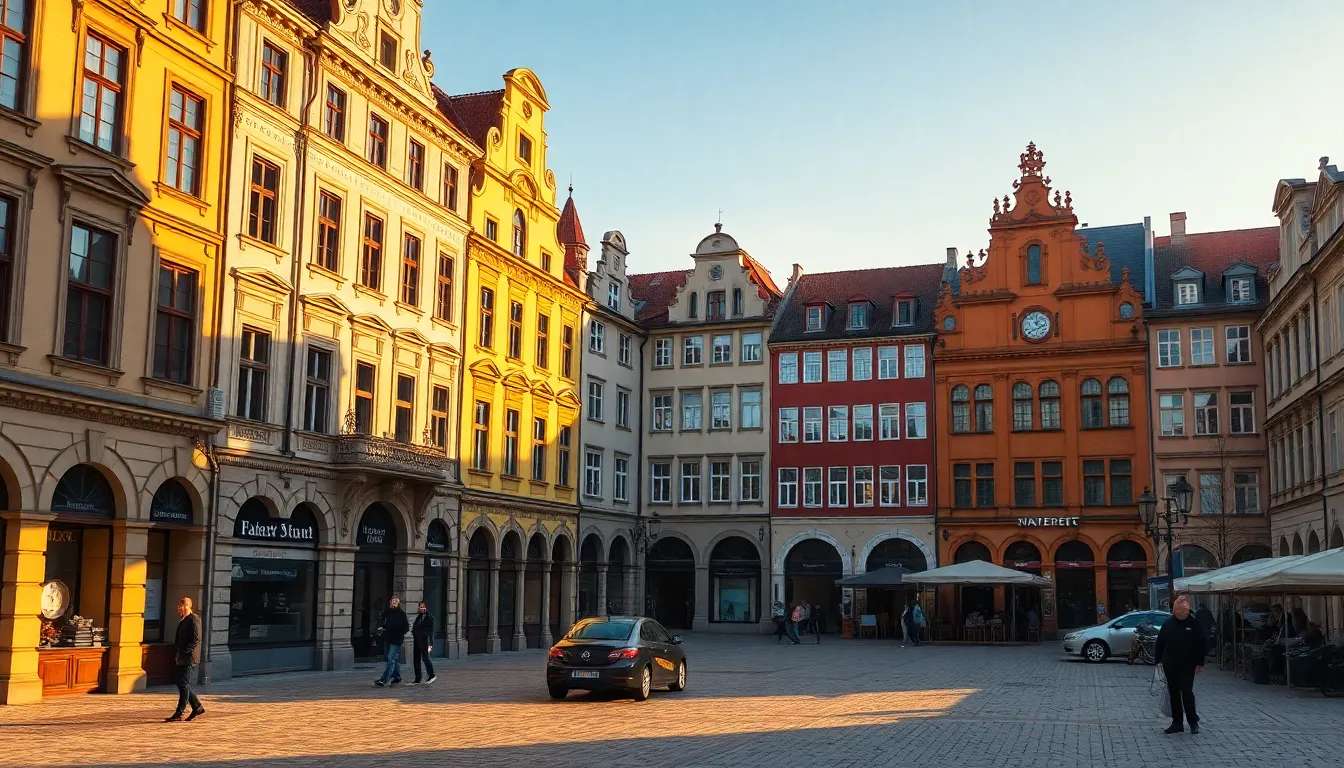
Warsaw confuses people at first, and I think that is the right response. You walk into the Old Town, and it looks like a medieval city that has stood for centuries. Then your guide tells you that almost every brick was laid after 1945, because the Germans deliberately razed this city to the ground at the end of the war. What you are looking at is not old. It is a resurrection.
That is the key to understanding Warsaw, and it is why I always tell group leaders that this city teaches a different lesson than Krakow. Krakow survived. Warsaw was destroyed and rebuilt by people who refused to let it disappear. Both stories matter, and a group that grasps the difference comes away with something deeper. So let me orient you to the city the way I would brief one of my own leaders before a trip.
Understanding Warsaw Before You Arrive
Warsaw is larger and more spread out than Krakow, so the heritage sites that matter to a faith group sit in clusters that you move between rather than walk in a single loop. The main areas are the former ghetto district, where the POLIN Museum and the major memorials stand, and the Old Town, with its churches and rebuilt market square.
What Warsaw holds, more than any other Polish city, is the full thousand-year arc of Jewish life laid out in one museum, and right outside that museum, the ground where that life was confined and destroyed. The proximity is not an accident. It is the whole point. If you are weighing Poland for your community, the Poland heritage travel guide gives the country-wide picture, and Warsaw is usually where a journey begins.
POLIN: Start Here
If I could give a group leader only one piece of advice about Warsaw, it would be this: schedule the POLIN Museum early, ideally on your first full day.
POLIN, the Museum of the History of Polish Jews, sits on the ground of the former Warsaw Ghetto, facing the Ghetto Heroes Monument. What makes it the single most important museum a heritage group can visit in Poland is its structure. It does not begin with the Holocaust. It begins a thousand years earlier, with the first Jewish communities arriving in Poland. It walks your group through centuries of settlement, scholarship, commerce, conflict, creativity, and daily life. Only after all of that does it arrive at the twentieth century.
That sequence changes everything. It means your group meets the people before they encounter what happened to them. They understand the civilization first. By the time they reach the Holocaust galleries, they are not looking at abstract victims. They are looking at the end of a world they have just spent hours getting to know. Every site you visit afterward carries that context. This is why I put POLIN first.
The Ghetto: Walking Ground That Was Built Over
The area that was the Warsaw Ghetto is now a modern neighborhood. This is one of the hardest things for a group to absorb. Four hundred thousand people were confined to a few square blocks here, and today there are apartment buildings, streets, and traffic. The physical space was built over after the war.
That absence asks something of you as a leader. Without a knowledgeable guide and some preparation, a group can walk these streets and feel nothing, because there is little to see. With preparation, the modern surface becomes its own kind of testimony.
The Memorials
The Ghetto Heroes Monument stands where the Warsaw Ghetto Uprising began in April 1943. For Jewish groups, this is one of the most emotionally significant stops in the country. It marks resistance, the decision to fight when no good outcome remained. Many leaders tell me this is where their community’s grief turns, for a moment, into something like pride.
The Umschlagplatz Memorial marks the point from which residents of the ghetto were loaded onto trains and deported to Treblinka. It is a quieter site, a white marble enclosure inscribed with first names, and it carries a particular heaviness. Fragments of the original ghetto wall still survive in a few courtyards, and standing beside the actual brick changes the experience for a group.
I sequence these sites with care. POLIN gives the life. The memorials give the loss. Moving in that order, rather than the reverse, lets a group hold both without being overwhelmed by the second before they have understood the first.
The Old Town: A City That Refused to Disappear
Warsaw’s Old Town is a UNESCO World Heritage Site, and the reason is unusual. It was not preserved. It was rebuilt, painstakingly, from paintings, photographs, and the memory of the people who had lived there. After the Germans systematically demolished the city following the 1944 Warsaw Uprising, Poles reconstructed the Old Town brick by brick.
For a faith group, the Old Town carries a theological weight that goes beyond architecture. It is a monument to refusal. A people decided that their city would not be erased, and they put it back together. Walking the market square, the Castle Square, and the narrow streets, your group is standing inside an act of collective will. I often pause a group here to name that out loud, because it is easy to miss when the result is simply a pretty square.
The Churches of Warsaw
Warsaw’s churches tell the same story of destruction and rebuilding, and they give Christian groups a heritage layer woven through the whole city.
St. John’s Archcathedral, in the heart of the Old Town, is the mother church of Warsaw. It was reduced to rubble in the 1944 uprising and rebuilt afterward. As the coronation and burial site of Polish figures across centuries, it anchors the Catholic story of the capital.
Holy Cross Church holds a detail that moves many visitors: the heart of Frederic Chopin, sealed inside a pillar, brought back to the city he loved. Beyond that, the church was destroyed in the uprising and rebuilt from rubble, echoing the story of the entire city.
For Christian heritage groups, these churches are not isolated stops. They are part of the same resurrection narrative as the Old Town and the ghetto memorials. The city was destroyed, and faith was part of what put it back.
Practical Orientation for Group Leaders
Warsaw is more spread out than Krakow, so plan for coach transfers between clusters rather than a single walking route. The ghetto sites and POLIN form one area; the Old Town and its churches form another. Distances are manageable, but a group of fifteen or more moves more smoothly with transport between them.
Two to three nights in Warsaw is a comfortable base. That covers a POLIN day, a ghetto memorials day, and an Old Town and churches day, with room to breathe. Many groups open their Poland journey in Warsaw and travel on to Krakow afterward, which gives the trip a natural arc: the thousand-year story and the rebuilt capital first, then the surviving city of Krakow and Auschwitz nearby.
If you are leading a group of fifteen or more, your travel is covered. You fly free, stay free, and tour free. For a synagogue or church working within a congregational budget, that changes the math, because the leader who does the organizing does not also pay for the privilege.
You can see how we structure these journeys on the Poland destination page, and the group heritage tours page explains how the leader experience works.
How Warsaw Fits a Wider Poland Itinerary
Warsaw pairs most naturally with Krakow, and the two cities balance each other. The Krakow heritage guide covers Kazimierz, Wawel, and Auschwitz nearby. Groups focused on the depth of Jewish scholarship often add Lublin, and the Lublin heritage guide walks through the yeshiva and the old Jewish quarter. Together these cities give a group the full Polish-Jewish story alongside the Catholic and Christian heritage layers.
FAQ: Warsaw Heritage Travel
What is the POLIN Museum and why visit it first?
POLIN is the Museum of the History of Polish Jews, built on the site of the former Warsaw Ghetto. It tells the full thousand-year story of Jewish life in Poland, beginning with medieval settlement rather than the Holocaust. Visiting it early gives your group the context to meet the people before encountering what happened to them, which deepens every site you see afterward.
Is the Warsaw Ghetto still visible today?
Most of the ghetto area was destroyed and built over after the war, so it is now a modern neighborhood. Fragments of the original wall survive in a few courtyards, and the key memorials remain: the Ghetto Heroes Monument and the Umschlagplatz Memorial. A knowledgeable guide and some group preparation are essential, because much of the testimony here lies in what is no longer visible.
Why does the Warsaw Old Town look medieval if it is new?
The Germans systematically demolished Warsaw after the 1944 uprising. Poles rebuilt the Old Town after the war from paintings, photographs, and memory, brick by brick. It is now a UNESCO World Heritage Site recognized precisely as an act of reconstruction. For a faith group, it stands as a monument to a people who refused to let their city be erased.
What Christian heritage does Warsaw offer?
Warsaw’s churches, including St. John’s Archcathedral and Holy Cross Church, were destroyed in the war and rebuilt afterward, echoing the city’s wider resurrection story. Holy Cross Church also holds the heart of Frederic Chopin. For Christian groups, these sites tie the Catholic heritage of the capital into the same narrative of destruction and renewal as the Old Town.
How many days should a faith group spend in Warsaw?
Two to three nights is comfortable. That allows a day at POLIN, a day at the ghetto memorials, and a day in the Old Town and its churches, with room for reflection. Many groups begin their Poland journey in Warsaw and continue to Krakow, which gives the trip a natural emotional arc.
If Warsaw is part of the journey you are imagining for your community, I would welcome a conversation about it. Not a sales pitch, just a chance to help you think through the shape and the sequence that fit your group. You can reach us through our contact page whenever you are ready.