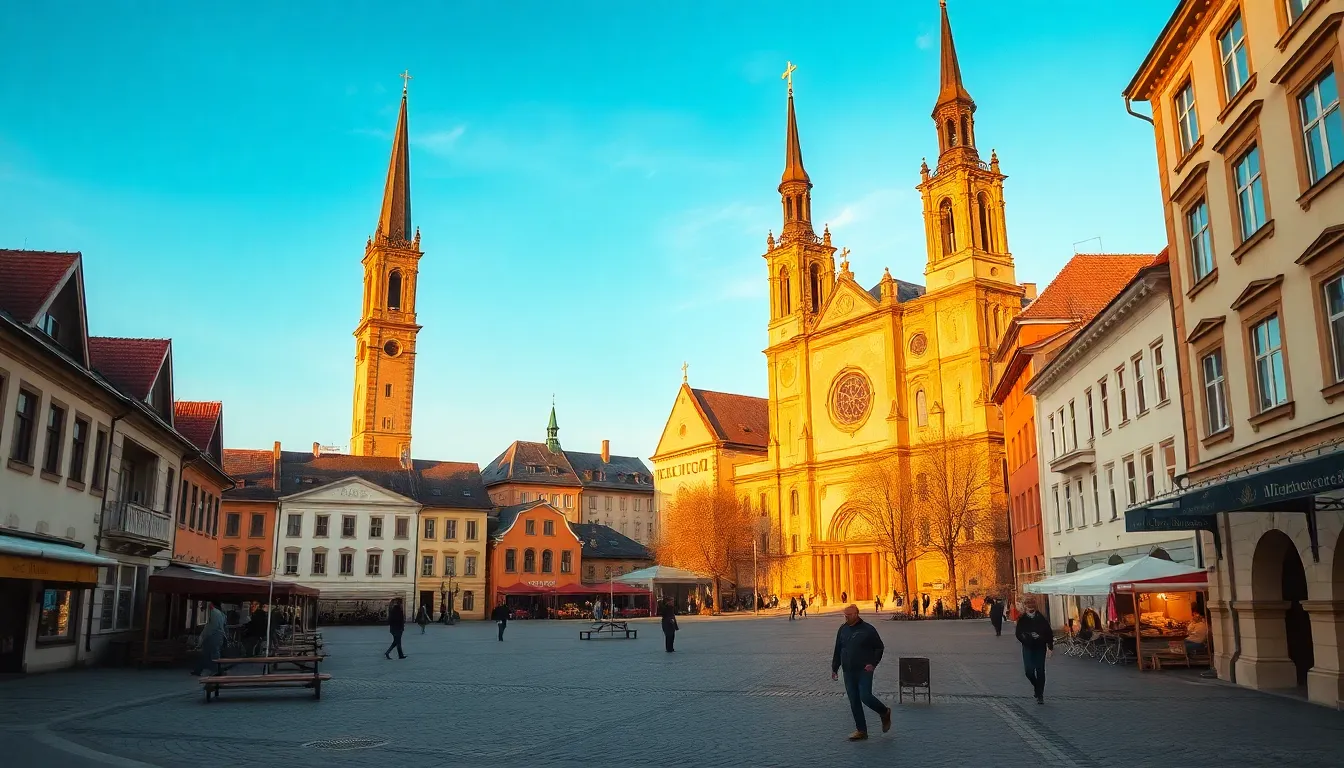
I have a habit, when I bring groups to Wadowice, of starting in the market square rather than the museum. I let people stand there for a minute first. The basilica on one side, the cafe famous for the cream cakes the future pope loved as a boy on the other, the small-town quiet of the place. Then I say it plainly: a child grew up here, in an apartment you can see from where you are standing, and that child became one of the most consequential figures of the 20th century.
People expect grandeur from a papal birthplace. Wadowice gives them something better. It gives them ordinariness. And once a group understands that John Paul II came from a normal Polish town, from grief and a modest home and a love of theater and football, the rest of the trip lands differently. Krakow, Czestochowa, the Divine Mercy sites all make more sense once you have seen where the man began.
This guide walks through Wadowice and what a group should see there. It pairs naturally with the broader story of spiritual sites in Poland.
The Town That Shaped a Pope
Wadowice is a small town in southern Poland, about an hour southwest of Krakow, near the foothills of the Beskid mountains. Karol Jozef Wojtyla was born here on May 18, 1920, in an apartment on a street now named for him, directly behind the parish church.
To understand the man, you have to understand the losses he carried out of this town. His mother, Emilia, died when he was eight. His older brother, Edmund, a doctor, died of scarlet fever caught from a patient when Karol was twelve. His father, a retired army officer, raised him alone after that, and the two of them lived a quiet, disciplined, deeply prayerful life in the apartment. His father died in 1941, when Karol was twenty. By then the family of four was reduced to one.
I tell groups this not to be morbid but because it matters. The compassion that defined John Paul II’s papacy, the way he spoke about suffering, did not come from nowhere. It came from a boy in Wadowice who buried his whole family before he was an adult.
A Normal Boyhood
The losses are only half the story. The other half is how ordinary and full his boyhood was. He loved theater and was a gifted amateur actor. He played goalkeeper in football matches, often, by his own account, on the Jewish side when the town’s Catholic and Jewish boys made up teams. He hiked the nearby mountains. He was a strong student.
That last point deserves a pause. Pre-war Wadowice had a substantial Jewish community, and young Karol grew up alongside Jewish neighbors and classmates. Historians of his life trace his later commitment to Catholic-Jewish reconciliation, the first papal visit to a synagogue, the establishment of diplomatic relations with Israel, back in part to these friendships. The town taught him to see across the line before he ever wrote a word about it.
The Family Home Museum
The apartment where Karol was born and raised is now the Family Home of John Paul II Museum, and it is the centerpiece of any visit. The museum was thoroughly redeveloped and reopened in 2014, and it is well done, modern, and moving without being sentimental.
The exhibition follows his entire life, not just his childhood, through the original family rooms and additional gallery space. You see personal objects, photographs, and recreations of the home as it was. The route moves from Wadowice through his years as a worker and underground seminarian during the Nazi occupation, his priesthood, his time as Archbishop of Krakow, the conclave of 1978, and the long pontificate that followed.
What to Expect Inside
A few practical notes for group leaders:
- Book ahead. The museum admits visitors in timed groups, and it can fill, especially in summer and around papal anniversaries. Reservations are essential for a group of 15 or more.
- Allow 90 minutes. The full route takes time, and rushing it undercuts the point.
- Audio guides help. They are available in multiple languages and add context the displays alone do not carry.
- It can be emotional. Many group members, Catholic and not, find the family rooms moving. Build in a quiet moment in the square afterward.
The Basilica of the Presentation of the Blessed Virgin Mary
Steps from the apartment stands the parish church where Karol was baptized on June 20, 1920, the Basilica of the Presentation of the Blessed Virgin Mary. He served here as an altar boy, made his first communion here, and prayed here through the years of his youth. The baptismal font where he was christened is still in use, and groups often stop before it.
The church is a working parish, so visits work around the Mass schedule. It is worth coordinating, because seeing the font and the church together with the apartment completes the picture. The whole world of his boyhood sits within a hundred steps: home, church, school, square.
The Cream Cakes
I am going to mention the cakes, because every honest account of Wadowice does. There is a local cream cake, kremowka, that the town serves, and during a 1999 visit John Paul II reminisced publicly about buying them as a boy after passing his exams. The cafes on the square now sell them as “papal cream cakes.”
This is not a trivial detail. It is the kind of human, grounding thing that makes a group smile and reminds them that holiness and ordinary life are not opposites. I always build in time for coffee and a kremowka on the square. It is part of the pilgrimage, not a break from it.
Where Wadowice Fits in Your Itinerary
Wadowice works best as a half-day stop combined with the wider John Paul II story. The town sits roughly between Krakow and the Tatra region, and it links naturally to the sites where Karol Wojtyla lived and served as a priest, bishop, and cardinal. After Wadowice, the obvious next stops are the heritage of John Paul II in Krakow and the Divine Mercy Sanctuary at Lagiewniki, the shrine he consecrated as pope.
For a Catholic group, Wadowice, Krakow, and Czestochowa together form the backbone of a John Paul II pilgrimage. For a Protestant or interfaith group, Wadowice still rewards the visit, because it tells a universal story: ordinary beginnings, real loss, and a life that reached far beyond the town it started in.
Heritage Tours builds custom faith itineraries across Poland for groups of every size and denomination. Group leaders travel free with 15 or more participants. You can see how we shape these journeys on our Poland destination page or read about the group leader experience.
FAQ: Wadowice and John Paul II
Where is Wadowice and why is it significant?
Wadowice is a small town in southern Poland, about an hour southwest of Krakow, where Karol Wojtyla, the future Pope John Paul II, was born on May 18, 1920. It is significant as the place that shaped his early life, faith, and character before he became a priest, Archbishop of Krakow, and pope.
What can you see at the John Paul II museum in Wadowice?
The Family Home of John Paul II Museum occupies the apartment where Karol Wojtyla was born and raised. Reopened in 2014, it covers his entire life through the original family rooms and modern galleries, with personal objects, photographs, and recreations of his childhood home. Allow about 90 minutes and book ahead for groups.
Was Wadowice home to a Jewish community before the war?
Yes. Pre-war Wadowice had a significant Jewish population, and young Karol Wojtyla grew up alongside Jewish neighbors and classmates. Historians connect these early friendships to his later commitment to Catholic-Jewish reconciliation as pope, including the first papal visit to a synagogue.
Can you visit the church where John Paul II was baptized?
Yes. The Basilica of the Presentation of the Blessed Virgin Mary, steps from his family home, is where Karol Wojtyla was baptized in 1920, served as an altar boy, and made his first communion. The original baptismal font remains in use. Visits work around the parish Mass schedule.
How long does a visit to Wadowice take?
Most groups spend a half day in Wadowice, allowing roughly 90 minutes for the museum, time in the basilica, and a stop on the market square. The town pairs naturally with Krakow and the other John Paul II sites in southern Poland.
If you want to build Wadowice into a pilgrimage for your community, I would be glad to help you shape it. The town is where so much of the John Paul II story begins, and seeing it first changes everything that comes after. Contact us whenever you are ready.