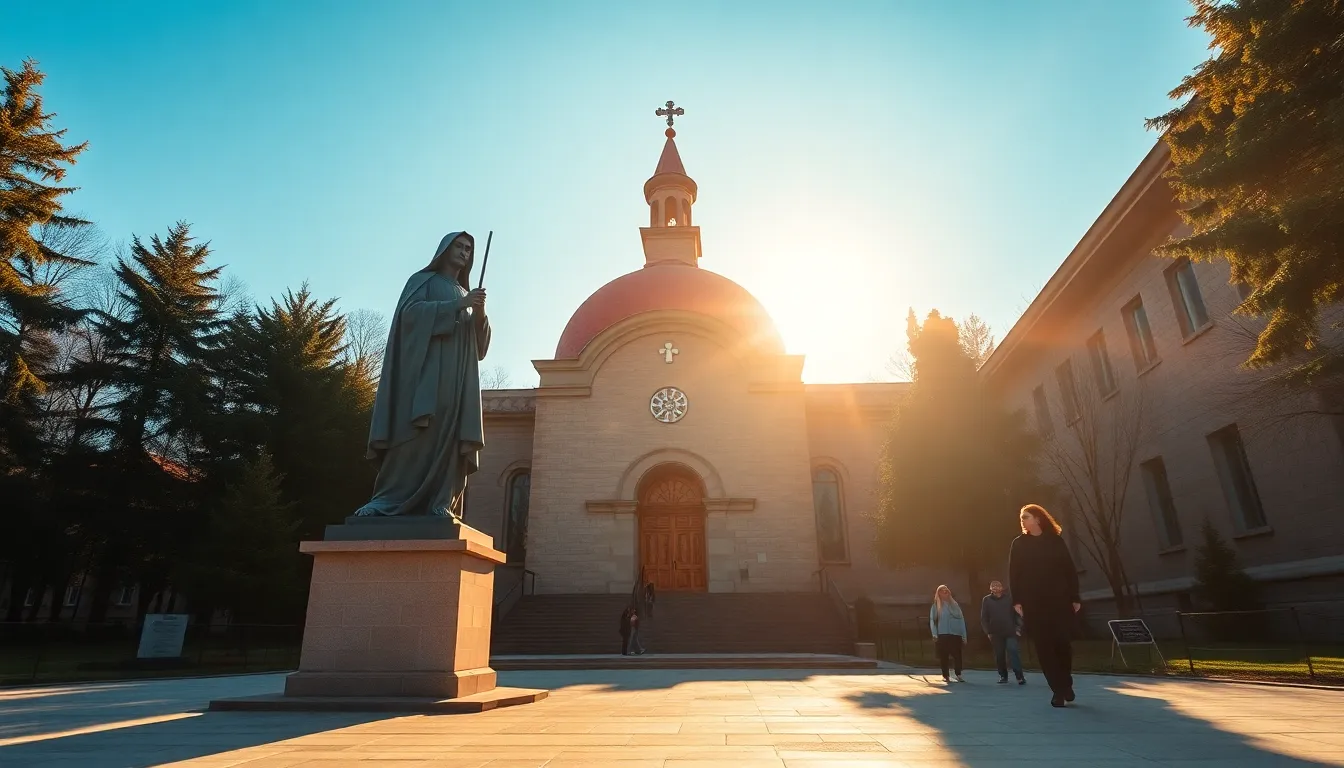
I tell groups that the most remarkable thing about Saint Faustina is how unremarkable her life looked from the outside. She was a young nun with three years of schooling who cooked, gardened, and answered the convent door. She owned almost nothing. She died of tuberculosis at thirty-three, largely unknown. And yet the devotion that grew out of her diary is now prayed on every continent, and the feast she said Christ asked for is on the universal calendar of the church.
When a group understands her, the sites in Krakow stop being buildings and start being a story. The image at Lagiewniki, the basilica, the world center of Divine Mercy, all of it traces back to a Polish farm girl named Helena Kowalska who believed she had been given a message and spent her short life trying to be faithful to it.
This guide tells her story and maps the trail her life left across Poland. It builds on our overview of spiritual sites in Poland and pairs directly with the Divine Mercy Sanctuary at Lagiewniki, the trail’s culmination.
Who Saint Faustina Was
Helena Kowalska was born in 1905 in the village of Glogowiec in central Poland, the third of ten children in a poor farming family. She had almost no formal education. She felt a call to religious life early but, lacking a dowry and her parents’ blessing, worked for years as a domestic servant in cities like Lodz and Warsaw to support herself.
In 1925 she entered the Congregation of the Sisters of Our Lady of Mercy in Warsaw and took the name Maria Faustina. For the next thirteen years she served in the order’s convents in various Polish cities, including Vilnius, Plock, and Krakow, doing ordinary work. She cooked, she gardened, she kept the gate.
What set her apart was hidden. Beginning in 1931, she recorded visions and conversations she believed she had with Christ, focused entirely on the theme of divine mercy. Her spiritual director encouraged her to write them down, and the result is the diary now published as “Divine Mercy in My Soul,” one of the most widely read spiritual texts of the 20th century. She died in Krakow on October 5, 1938, at the convent in Lagiewniki.
The Three Requests
Faustina’s diary records three central requests she believed Christ made of her, and they are worth knowing because every Divine Mercy site connects to them:
- That an image be painted of the Merciful Jesus, with the inscription “Jesus, I trust in You.”
- That a Feast of Divine Mercy be established on the Sunday after Easter.
- That the Chaplet of Divine Mercy and the devotion to mercy be spread throughout the world.
In her lifetime, almost none of this came to pass publicly. She saw the first image painted in Vilnius, but the wider message stayed local and was even, for a time after her death, restricted by the Vatican over translation and doctrinal concerns. The story could easily have ended there.
How the Devotion Spread
It did not end there because of a chain of people who carried her message forward, and the most important link was a Krakow archbishop. Karol Wojtyla, who became Archbishop of Krakow in 1964, knew the Lagiewniki convent and took up Faustina’s cause. He worked to lift the Vatican’s restrictions, which were eased in 1978. When he became Pope John Paul II later that same year, the message had its most powerful possible advocate.
He beatified Faustina in 1993 and canonized her in 2000, the first saint of the new millennium. At the canonization he established Divine Mercy Sunday for the entire church, fulfilling the second request. He consecrated the new basilica at Lagiewniki in 2002 as the world center of the devotion. The farm girl from Glogowiec was now a saint, and her message was global.
I find this arc genuinely moving to share with a group, Catholic or not. It is a story about faithfulness in obscurity, and about how a single hidden life can ripple outward for generations.
The Heritage Trail Across Poland
Several sites trace Faustina’s life, and a group can follow as much of the trail as time allows. Most itineraries focus on Krakow, where the story culminates, but the wider trail rewards a longer trip.
Lagiewniki, Krakow
This is the heart of the trail and the destination most groups prioritize. Faustina lived and died in the convent here, and she is buried in the convent chapel beside the original image of the Merciful Jesus venerated at the sanctuary. The great basilica consecrated by John Paul II stands beside it. Give this site a half day. Our full guide to the Divine Mercy Sanctuary at Lagiewniki covers it in depth.
Plock
In the convent at Plock, in central Poland, Faustina recorded her first vision of the Merciful Jesus in 1931. A sanctuary of Divine Mercy now stands at the site. For groups doing a deeper Divine Mercy pilgrimage, Plock is where the message was first revealed.
Glogowiec and Swinice Warckie
Faustina’s birthplace village of Glogowiec lies in central Poland, and she was baptized in the nearby parish church of Swinice Warckie, which is now a shrine to her. These sites suit groups wanting to see where her life began, though they are well off the main southern Poland route and require a deliberate detour.
The John Paul II Sanctuary, Krakow
Adjoining Lagiewniki, the Sanctuary of Saint John Paul II ties the two great figures of this story together. It sits near the quarry where Wojtyla worked during the war and now honors the pope who carried Faustina’s message to the world. Visiting both completes the picture.
Planning the Trail Well
A few notes for group leaders:
- Krakow first. If your group has limited time, Lagiewniki in Krakow is the essential stop. The full life story can be told there.
- Add Plock for depth. Groups doing a dedicated Divine Mercy pilgrimage benefit from Plock, where the first vision occurred, but it requires routing through central Poland.
- Read ahead. Encourage group members to read a little of Faustina’s story before the trip. The sites land far more deeply when people know whose life they are walking through.
- Time the Chaplet. Wherever you are at 3 p.m., the Hour of Mercy, the Chaplet of Divine Mercy is a powerful shared moment.
For the architecture, the image, and the practical visit details at the trail’s heart, lean on our Lagiewniki sanctuary guide, and for the broader Krakow connection see the heritage of John Paul II in Krakow.
Why This Trail Reaches Everyone
For Catholic groups, the Divine Mercy trail is a pilgrimage in the fullest sense. But I have watched Protestant and interfaith groups connect with it just as deeply, and I think I know why. The message at the center is not complicated theology. It is trust in mercy. “Jesus, I trust in You.” That is an idea people of many traditions can stand in front of and feel.
And Faustina’s life, a poor, uneducated, obscure young woman whose faithfulness changed the church, is a universal kind of story. It rewards anyone willing to listen to it.
Heritage Tours builds custom faith itineraries across Poland for groups of every denomination. Group leaders travel free with 15 or more participants, which makes a real difference when planning a trip for your congregation. You can see how we structure these journeys on our Poland destination page or learn about the group leader experience.
FAQ: Saint Faustina and Divine Mercy
Who was Saint Faustina Kowalska?
Saint Faustina Kowalska, born Helena Kowalska in 1905, was a Polish nun of the Congregation of the Sisters of Our Lady of Mercy. Despite little formal education, she recorded visions of Christ centered on divine mercy in a diary now read worldwide. She died in Krakow in 1938 and was canonized by John Paul II in 2000.
What is the Divine Mercy devotion?
The Divine Mercy devotion grew from Faustina’s diary and centers on trust in God’s mercy. Its main elements are the image of the Merciful Jesus inscribed “Jesus, I trust in You,” the Chaplet of Divine Mercy prayed daily at 3 p.m., and the Feast of Divine Mercy on the Sunday after Easter, established for the whole church by John Paul II in 2000.
Where can you visit Saint Faustina sites in Poland?
The central site is the Lagiewniki sanctuary in Krakow, where Faustina lived, died, and is buried. The convent at Plock holds the place of her first vision in 1931. Her birthplace village of Glogowiec and the shrine at Swinice Warckie, where she was baptized, lie in central Poland for groups doing a deeper pilgrimage.
Why is John Paul II connected to Saint Faustina?
As Archbishop of Krakow, Karol Wojtyla advanced Faustina’s cause and helped lift Vatican restrictions on her writings. As Pope John Paul II, he beatified her in 1993, canonized her in 2000, established Divine Mercy Sunday, and consecrated the Lagiewniki basilica in 2002. He was the message’s most important advocate.
Can non-Catholic groups appreciate the Divine Mercy trail?
Yes. The core message of trust in God’s mercy crosses denominational lines easily, and Faustina’s life as a poor, obscure young woman whose faithfulness reached the whole world is a universal story. Protestant and interfaith groups regularly find the trail meaningful on both spiritual and human grounds.
If you want to follow Saint Faustina’s story with your community, I would be glad to help you build the trail to fit your time and focus. It is one of the most quietly powerful pilgrimages in Poland. Contact us whenever you are ready to begin.