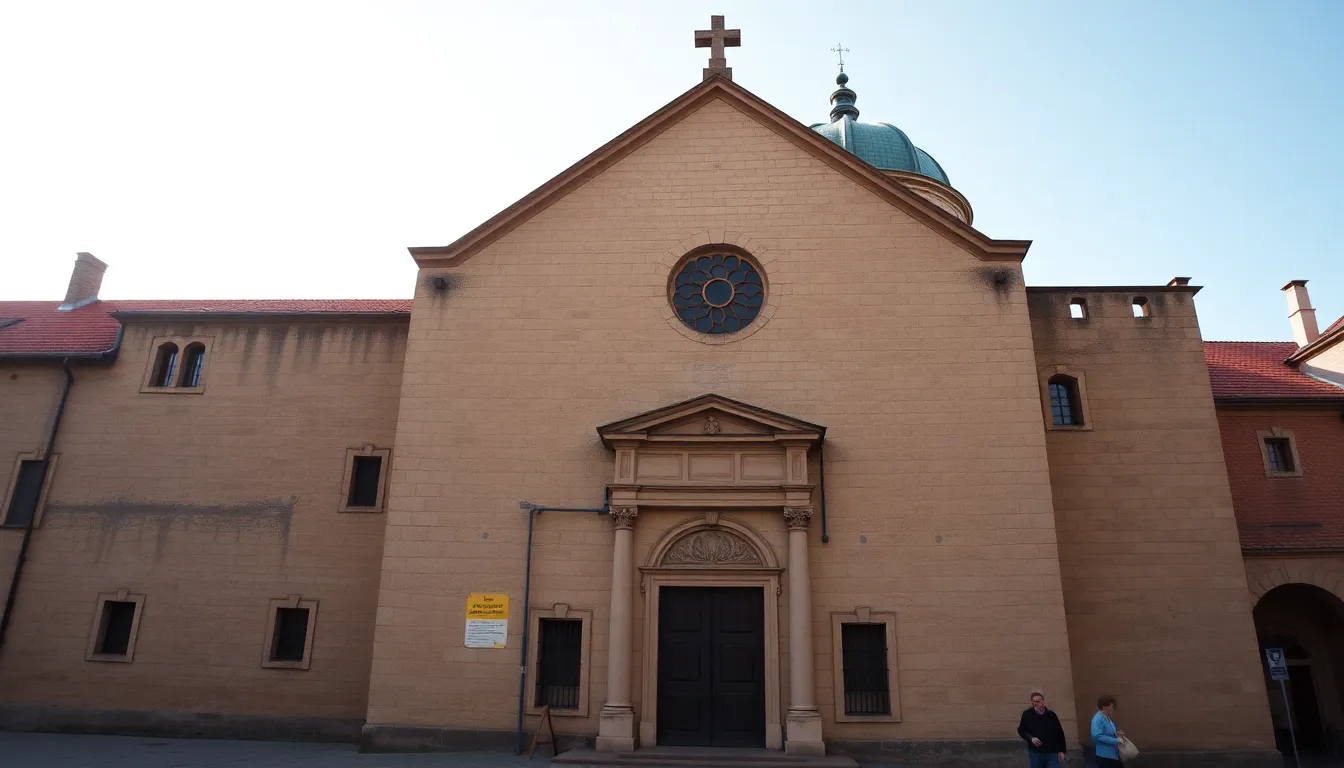
When I stand a group in front of the Old Synagogue in Krakow, I ask them to do some arithmetic. This building went up in the fifteenth century. That means Jews were praying inside these walls before Columbus sailed, before the printing press spread across Europe, before most of the cities my groups come from existed at all. It is the oldest surviving synagogue building in Poland, and one of the oldest in Europe. To put your hand on its stone is to touch the very beginning of Jewish Krakow.
The Old Synagogue, the Stara Synagoga, no longer holds services. It is a museum now, part of the Historical Museum of Krakow, devoted to the religious and communal life of the city’s Jews. For a heritage group, it serves a particular purpose. Where the Remuh down the street shows you Jewish life as it continues, the Old Synagogue shows you Jewish life laid open and explained, so that people understand what they are looking at when they encounter the rest of Jewish Poland.
The Oldest Synagogue in Poland
A Building From the Fifteenth Century
The Old Synagogue dates to the fifteenth century, with the structure that survives today shaped in the sixteenth century after a major rebuilding. It was constructed in a fortress-like style, with thick stone walls, a sign of an age when a Jewish house of prayer needed to be solid and defensible. The building you see is heavy, grounded, built to last, and it has lasted.
For four centuries this was the central synagogue of Kazimierz, the most important house of prayer in the Jewish town. The community’s leaders were installed here. Public announcements affecting the whole community were made from here. When the Jews of Krakow needed to gather as one body, this is where they came.
It is worth pausing on what that meant. A central synagogue was not only a place of prayer. It was the civic heart of a self-governing Jewish town. Oaths were sworn here. Communal decisions were announced here. Distinguished guests and visiting scholars were received here. When I help a group understand the Old Synagogue, I want them to see it not as a single building but as the seat of an entire community’s life, the place where the Jews of Krakow were, in every sense, most fully themselves.
The Prayer Hall
Inside, the main prayer hall is the heart of the building. Its vaulted ceiling rises over a central bimah enclosed by a wrought-iron grille, a Renaissance-era feature of striking craftsmanship. The aron kodesh, the ark, is set into the eastern wall in carved stone. Standing in this hall, even empty of worshippers, a group can feel the seriousness of the space, the dignity that the community invested in its central synagogue.
I take time here. I want people to understand that everything around them, the bimah, the ark, the women’s section, the architecture itself, was shaped by Jewish law and Jewish need. Once a group can read a synagogue, they can read every synagogue they encounter for the rest of the journey.
From House of Prayer to Museum
What the War Did
During the German occupation, the Old Synagogue was desecrated. The occupiers stripped it, looted its furnishings, and used the building as a warehouse. They turned the central synagogue of Jewish Krakow into a storehouse, and during the occupation the site was also used for executions. The community that had prayed here for four hundred years was driven out and destroyed.
The building survived where the community did not. That is the hard truth that runs through so much of Jewish Poland, and the Old Synagogue states it plainly.
A Museum of Jewish Krakow
After the war, the building was restored over the course of years and opened as a museum of the history and culture of Krakow’s Jews. Today its exhibitions walk a visitor through the religious year and the religious life of the community: the Shabbat, the festivals, the cycle of birth, marriage, and death, the objects and customs that filled a Jewish life in this city. There are Torah ornaments, prayer items, photographs, and documents that together reconstruct a world.
For my groups, this is exactly why the Old Synagogue earns a place in the itinerary. It teaches. A person who walks through these exhibitions arrives at the memorial sites understanding what was lost, not in the abstract, but in its detail: the candles, the canopies, the daily acts of a faith lived in this place.
I have watched this happen many times. A visitor lingers over a Torah crown or a worn prayer book in a display case, and something shifts in their face. They are no longer looking at a fact about history. They are looking at an object that a real family once held in their hands, in this city, before that family was murdered. The exhibitions make the loss specific, and specific loss is what a heart can actually grieve. That is the quiet work the Old Synagogue does for a group, and it is why I never treat it as an optional stop.
Visiting the Old Synagogue as a Group
How I Use It in an Itinerary
I usually place the Old Synagogue early in a Kazimierz visit, because it gives a group the vocabulary it needs. After people have walked these exhibitions and understood the shape of Jewish religious life, the Remuh Synagogue and its cemetery a few steps away land with more depth, and so does everything that follows. The two sites sit at the core of the Kazimierz quarter, and I build a Krakow morning around the pair.
Plan an unhurried visit. The exhibitions reward attention, and a good guide can bring the displays to life rather than letting a group drift past glass cases. Our wider Jewish heritage in Poland guide shows how this fits into the full arc of a journey.
Practical Notes
The Old Synagogue is a museum, so it keeps museum hours and charges admission, and these can change, so we confirm them as part of planning each trip. Because it is no longer a place of active prayer, the atmosphere is different from the Remuh, more reflective and educational, though no less worthy of respect. I still ask groups to move through it quietly. It was a sanctuary for four centuries, and that history deserves a calm bearing even now.
You can see how we structure a complete Poland journey on our Poland destination page, and our group heritage tours page explains how we support group leaders from first call to final day.
FAQ: The Old Synagogue of Krakow
Why is the Old Synagogue significant?
It is the oldest surviving synagogue building in Poland, dating to the fifteenth century, and one of the oldest in Europe. For four hundred years it was the central synagogue of Jewish Krakow, the place the community gathered for its most important religious and communal moments. Today it survives as a museum of the city’s Jewish life.
Is the Old Synagogue still used for prayer?
No. Unlike the nearby Remuh Synagogue, which remains an active congregation, the Old Synagogue no longer holds services. It now operates as a museum within the Historical Museum of Krakow, devoted to the religious and cultural history of the city’s Jews.
What happened to the Old Synagogue during the war?
During the German occupation the building was desecrated, looted, and used as a warehouse, and the site was also used for executions. The community that had worshipped there for centuries was driven out and destroyed. The building survived and was restored after the war, while the community it served did not.
What can a group see inside?
The restored prayer hall, with its vaulted ceiling, central bimah, and carved stone ark, is the heart of the building. The museum exhibitions reconstruct Jewish religious life through the Shabbat and festival cycle, life-cycle customs, and the ritual objects of the community, giving groups the vocabulary to understand Jewish sites across the rest of their journey.
Where does the Old Synagogue fit in a Poland itinerary?
I place it early in a Kazimierz visit because it teaches a group how to read a synagogue and understand Jewish religious life. With that foundation, the Remuh Synagogue nearby and the memorial sites later in the trip carry far more depth and detail.
The Old Synagogue is where I watch a group begin to truly see. Once people understand what filled a Jewish life in this city, century after century, everything they encounter afterward stops being a set of facts and becomes a story about real human beings. If you are planning to bring your community to Krakow, I would be glad to help you use this place well.
Contact us whenever you are ready to start the conversation.