For a thousand years, Poland was the center of Jewish life in Europe. Not at the margins. At the center. More Jews lived in Poland than in any other country on earth. They built yeshivas that shaped Jewish thought for generations. They created a network of communities, the shtetls, that became the foundation of Ashkenazi Jewish culture. They prayed, traded, studied, argued, and raised families across a country that, for all its complications, was home.
Then, in the span of five years, most of it was destroyed.
If you are a rabbi considering bringing your congregation to Poland, or a pastor who wants your community to understand what happened on this soil, you need to hold both of these truths at the same time. Poland is not only a place of destruction. It is a place where something extraordinary was built. Your group’s journey through Jewish Poland should honor both.
This is the guide I wish every group leader would read before they start planning.
Before the Catastrophe: 1,000 Years of Jewish Poland
Why Jews Came to Poland: The Medieval Invitation
The story begins in the thirteenth century. While Jews were being expelled from England, France, and much of Western Europe, Polish rulers were inviting them in. The Statute of Kalisz, issued in 1264, granted Jews the right to trade, worship, and govern their own communal affairs. It was not perfect protection, and pogroms occurred throughout Polish history. But compared to the rest of medieval Europe, Poland offered Jewish communities something rare: the legal right to exist and to build.
Jews responded by building. Over the next seven centuries, they created the most extensive Jewish civilization in the Diaspora. By the eighteenth century, roughly 80 percent of the world’s Jews lived in the Polish-Lithuanian Commonwealth or its successor territories.
What Polish Jewish Life Looked Like at Its Height
To understand what Poland lost, you have to understand what Poland had.
In Lublin, the Council of Four Lands met to govern Jewish communal affairs across the entire region. It was a parliament, a court system, and a religious authority all at once. Lublin’s yeshivas produced scholars whose commentaries are still studied in every Jewish seminary in the world.
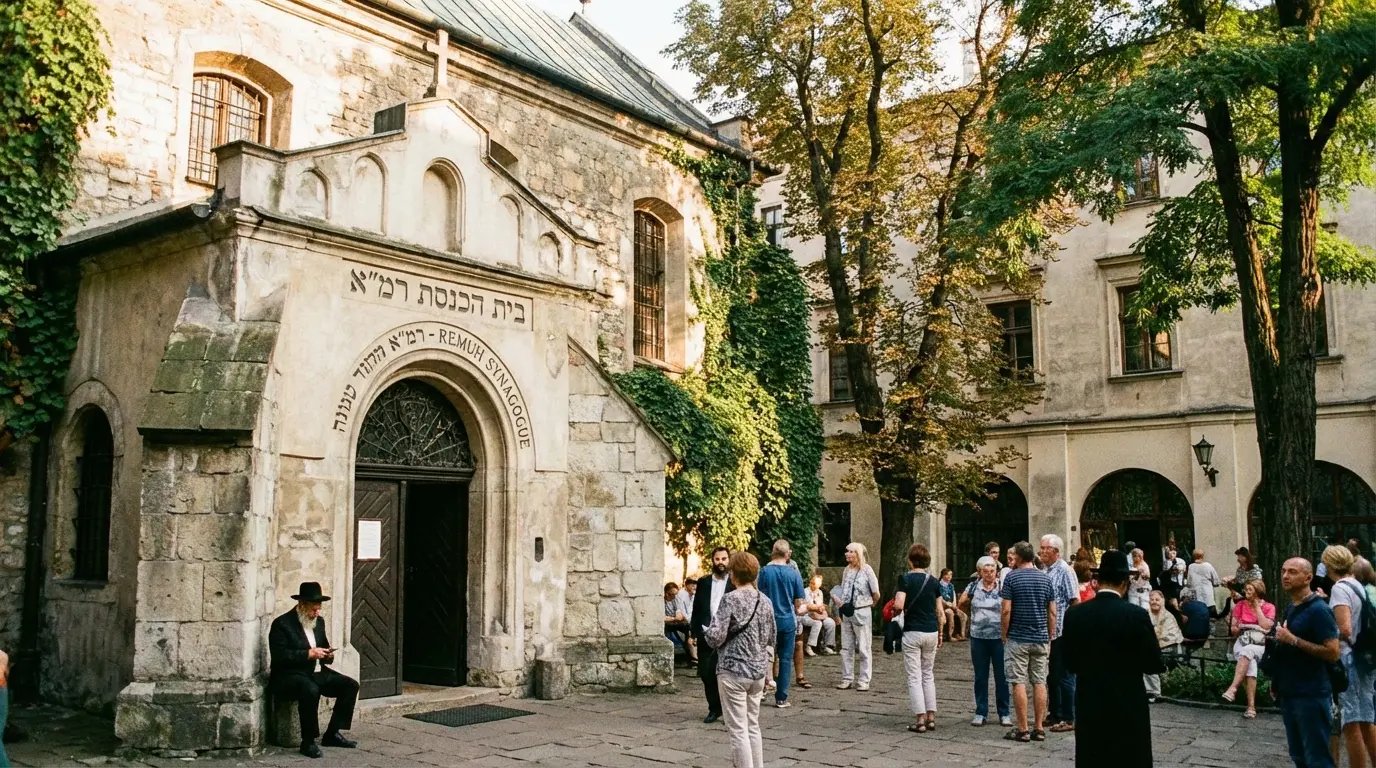
In Krakow, the Kazimierz district was a self-governing Jewish city. It had its own courts, its own market, its own internal politics. The Remuh Synagogue, built in the sixteenth century, still stands and still holds services.
In hundreds of smaller towns, Jewish communities maintained synagogues, schools, burial societies, charitable organizations, and the dense social fabric of daily life. A shtetl was not a ghetto. It was a community, often self-governing, with its own rhythms of prayer, study, celebration, and mourning.
This is the civilization that the Holocaust tried to erase. Visiting Poland without understanding what existed before is like reading the last chapter of a book and calling it the whole story.
The Shtetl: A World That No Longer Exists
The Yiddish word “shtetl” describes the small Jewish towns of Eastern Europe. These communities were neither wealthy nor powerful in worldly terms. But they were complete worlds unto themselves, places where Jewish law, Jewish language, Jewish culture, and Jewish faith shaped every aspect of daily life.
The shtetl produced the stories of Sholem Aleichem, the music of klezmer, the Hasidic movement, and the intellectual ferment that shaped modern Jewish thought. It was a world of matchmakers and rabbis, market days and Shabbat, poverty and piety and humor.
That world is gone. What remains are a handful of synagogue buildings, some cemeteries, and the cultural memory carried by descendants. When your group visits the small towns of eastern Poland, they are walking through the physical remnants of the shtetl world. A good guide will help them see what was there.
The Sites of Pre-War Jewish Life
Krakow’s Kazimierz: The Jewish Quarter That Survived and Is Alive Again
Kazimierz is the single best place in Poland to experience what a thriving Jewish community looked and felt like. The district’s buildings survived the war. Its synagogues, seven in total, are still standing. The streets still carry the footprint of centuries of Jewish life.
Today, Kazimierz is not a museum. It is a neighborhood. There are kosher restaurants, Jewish bookshops, cultural centers, and active synagogues. The annual Krakow Jewish Culture Festival, held each summer, draws thousands of people and fills the streets with music, lectures, and celebration.
For your group, Kazimierz offers warmth. After the weight of memorial sites, walking through a neighborhood where Jewish life continues, even in a changed form, gives people something they need. The Remuh Synagogue and its cemetery, the Old Synagogue museum, and the Galicia Jewish Museum are all worth your group’s time.
Lublin: The City Called “Jerusalem of Poland”
Lublin earned its title through the depth of its Jewish intellectual life. The Chachmei Lublin Yeshiva, which opened in 1930, was the crown jewel of European Jewish scholarship. The building has been beautifully restored and today serves as both a hotel and a memorial to the world of learning it represented.
Before the war, Jews made up roughly a third of Lublin’s population. The city’s Grodzka Gate once separated the Jewish and Christian quarters. Today, the Grodzka Gate Centre preserves the memory of Jewish Lublin through photographs, oral histories, and community records.
Lublin is quieter than Krakow and less visited by heritage groups. That is a mistake. For groups that want to understand what Polish Jewish intellectual and spiritual life actually looked like, Lublin is essential. I recommend it to every group leader I work with.
Tykocin: A Frozen Moment From the 17th Century
The Great Synagogue of Tykocin, built in 1642, is one of the oldest and best-preserved synagogues in Poland. It stands in a small town in northeastern Poland, far from the standard tourist routes.
Before August 1941, Jews made up more than half of Tykocin’s population. They were gathered and murdered in the Lopuchowo Forest in a single day. The synagogue survived because the Nazis repurposed it as a warehouse.
Today, the interior of the Great Synagogue is almost exactly as it was. The bimah, the aron kodesh, the women’s gallery. Standing inside, your group is in a space that was built by and for a community that existed for three hundred years and was erased in one day. For many groups, Tykocin is the most emotionally affecting site on their entire journey.
For more about Tykocin and other sites beyond the standard route, see our guide to Poland’s lesser-known heritage sites.
Lodz: A Jewish Industrial City the World Forgot
Lodz was the Manchester of Poland, an industrial powerhouse built in large part by Jewish entrepreneurs and workers. Before the war, its Jewish population numbered over 230,000, making it one of the largest Jewish communities in Europe.
The Lodz Ghetto, established in 1940, confined the city’s entire Jewish population to a sealed district. It operated as a forced labor camp for four years before its residents were deported to Chelmno and Auschwitz.
Today, the streets of the former ghetto are still walkable. The Radegast Station, where deportation trains departed, is a memorial site. Lodz deserves a place on heritage itineraries, and Heritage Tours can build it into your group’s journey.
Memory and Witness: The Holocaust Sites
Why We Use the Word “Witness”
I want to explain a word choice that matters. When I describe a heritage group’s visit to Poland’s Holocaust sites, I use the word “witness.” Not “visit.” Not “tour.” Witness.
The Jewish community has long used this language deliberately. To come to Auschwitz-Birkenau or Treblinka is not to see a historical site. It is to stand in a place where something happened and to refuse to look away. Witnessing is an act. It carries responsibility. And for a group leader, it means preparing your community not just for what they will see, but for what seeing it will ask of them.
Auschwitz-Birkenau: What to Know Before Your Group Arrives
I will not try to describe Auschwitz-Birkenau in a way that captures what it is. Every attempt to do so falls short. What I will share is what I have learned from decades of helping groups prepare for this visit.
First: the physical reality of Auschwitz is different from what most people expect. The camp is enormous. The scale of Birkenau, the rows of barracks stretching to the horizon, communicates something that photographs cannot. Your group members will walk through rooms in Auschwitz I that contain the physical evidence of mass murder. Some people are silent afterward. Some weep. Some feel numb and do not understand why.
Second: the guide matters more here than at any other site. Heritage Tours works with Polish educators who specialize in guiding heritage groups through Auschwitz. They understand pacing. They understand when to speak and when to let the place speak for itself. They understand that a Jewish group and a Christian group may need different framing for the same site.
Third: scheduling matters. Do not place Auschwitz on the first day of the trip. Your group needs context first. POLIN, Kazimierz, Lublin, these sites build an understanding of what was destroyed before your group arrives at the place where the destruction happened.
The Warsaw Ghetto: What Stood Here
The Warsaw Ghetto was the largest of the Nazi ghettos. At its peak, over 400,000 Jews were confined to an area of roughly 1.3 square miles. The conditions were designed to kill through starvation and disease. Those who survived were deported to Treblinka.
Today, the physical ghetto is gone. Modern Warsaw has been built over it. What remains are markers, memorials, and the site of the Warsaw Ghetto Uprising Monument, which commemorates the revolt of April 1943, when the remaining residents fought back with almost no weapons and no hope of survival.
Walking through the former ghetto streets requires a guide who can reconstruct what was there. Heritage Tours’ guides carry maps and photographs that allow your group to see what stood in the places where apartment buildings and shops now stand.
Treblinka: A Site of Death That Left No Buildings
Treblinka was an extermination camp. Unlike Auschwitz, which served multiple functions, Treblinka had one purpose. An estimated 800,000 to 900,000 people were murdered there, almost all of them Jews.
The Nazis dismantled Treblinka before the end of the war. There are no buildings to walk through. What remains is a memorial field of 17,000 stones, each one representing a Jewish community that was destroyed. A large central stone bears the name “Treblinka.”
Standing in that field is an experience unlike any other memorial site in Poland. The absence is the testimony. Your group will be surrounded by stones bearing the names of towns, and the silence of a place where nearly a million people were killed and nothing was left standing.
POLIN Museum: The Most Important Jewish Museum in Europe
What the Museum Shows, and What It Asks of You
POLIN, the Museum of the History of Polish Jews, sits on the site of the former Warsaw Ghetto. It opened in 2014, and in my experience, it has fundamentally changed how heritage groups experience Poland.
The museum’s permanent exhibition begins not with the Holocaust but with the arrival of Jews in Poland a thousand years ago. You walk through reconstructed streets, see artifacts of daily life, listen to the languages that were spoken, and encounter a civilization in its fullness. The Holocaust gallery comes near the end of the exhibition, after you have spent hours learning about the world that was destroyed.
This structure is the museum’s greatest gift to heritage groups. When your community arrives at Auschwitz having first walked through POLIN, they understand that they are bearing witness not just to a crime, but to the destruction of a civilization. That difference matters.
I recommend scheduling POLIN on the first or second day of your Poland journey. It provides the foundation for everything else your group will see.
Memory Tourism vs. Heritage Tourism: Why the Distinction Matters
This is a distinction I find myself explaining to group leaders often, and I believe it is one of the most important decisions you will make when planning your trip.
Memory tourism focuses on the Holocaust. The itinerary centers on Auschwitz, Treblinka, the Warsaw Ghetto, and other sites of destruction. The purpose is to bear witness to what happened.
Heritage tourism includes those sites but places them within the larger story of Jewish life in Poland. The itinerary includes Kazimierz, Lublin, Tykocin, POLIN, and the pre-war sites alongside the memorial sites. The purpose is to understand what was built, not only what was destroyed.
Both approaches are valid. Both serve important purposes. But they create very different experiences for your group.
A memory-focused trip can leave people with grief and no context. A heritage-focused trip gives the grief a home. When your community understands that Lublin’s yeshivas produced some of the greatest minds in Jewish history before they were destroyed, the destruction carries a different weight. It becomes specific. Personal. And, for many people, more bearable.
Heritage Tours designs both types of journeys. When group leaders call, one of the first conversations I have with them is about which approach is right for their community.
Returning to Poland: Descendants and Their Communities
Some of the most meaningful heritage journeys I have helped plan are for descendants of Polish Jews who want to trace their family’s origins.
These trips are deeply personal. A group member might know that their grandparents came from a specific town. They might have a family name, a photograph, a story passed down through generations. They want to stand in the place where their family lived.
Tracing Family History in Polish Records
Poland has extensive Jewish records, including birth and death registers, community documents, and in some cases, synagogue records that survived the war. Organizations like JRI-Poland and the Polish State Archives can help identify specific records.
Heritage Tours can coordinate a stop at a family’s town of origin as part of a broader group itinerary. Our local guides can often arrange access to archives, cemeteries, and community records. For group leaders whose community includes descendants, building in even a single personal stop transforms the trip.
Planning Your Group’s Journey Through Jewish Poland
If you have read this far, you are likely the kind of group leader who takes this responsibility seriously. You are not looking for a packaged tour. You are looking for a journey that serves your community.
Here is what I would suggest as a next step. Read our guide for pastors and rabbis planning a group heritage tour to Poland. It covers the practical side: the free leader program, how to recruit participants, how to prepare your community emotionally, and what Heritage Tours handles so you do not have to.
And if you are ready to start a conversation, I am here. I have been helping group leaders plan journeys like this for over forty years. I will listen to what you are hoping for, what concerns you, and what your community needs. We will build something together.
Frequently Asked Questions
What is the history of the Jewish community in Poland?
Jews first settled in Poland in the medieval period, drawn by royal charters that offered legal protections unavailable elsewhere in Europe. Over the next seven centuries, Poland became home to the largest Jewish population in the world. Jewish communities built synagogues, yeshivas, and a rich cultural life across hundreds of towns and cities. By the early twentieth century, over three million Jews lived in Poland. The Holocaust destroyed the vast majority of this civilization between 1939 and 1945.
What is Kazimierz in Krakow and why is it significant for Jewish heritage travelers?
Kazimierz is the historic Jewish quarter of Krakow. Its synagogues, streets, and buildings survived the war largely intact, making it the best-preserved example of a living Jewish district in Poland. Today it is home to active synagogues, Jewish cultural organizations, kosher restaurants, and an annual Jewish Culture Festival. For heritage groups, Kazimierz offers the rare experience of walking through a space where Jewish life continues in the same buildings where it has existed for centuries.
What is the POLIN Museum and why should heritage groups visit?
POLIN is the Museum of the History of Polish Jews, located in Warsaw on the site of the former ghetto. Its permanent exhibition covers the full thousand-year history of Jewish life in Poland, beginning with medieval settlement and moving through centuries of community and culture before addressing the Holocaust. For heritage groups, POLIN provides essential context. It ensures that visitors understand the civilization that was destroyed, not only the destruction itself.
What is the difference between heritage tourism and Holocaust memorial tourism in Poland?
Heritage tourism encompasses the full story of Jewish life in Poland, including pre-war communities, synagogues, cultural centers, and daily life alongside Holocaust memorial sites. Memorial tourism focuses primarily on the sites of destruction: Auschwitz, Treblinka, the Warsaw Ghetto. Both approaches are valid, but they create different experiences. Heritage tourism gives groups context for the loss, while memorial tourism focuses on bearing witness to the destruction itself. Many group leaders choose a combined approach.
How do I prepare my group emotionally for a visit to Auschwitz-Birkenau?
Preparation begins well before departure. Have honest conversations with your group about what they will see and what emotions may arise. Share historical context so members understand what Auschwitz was and what happened there. Discuss how different people may respond, including silence, tears, anger, or numbness, and normalize all of those reactions. Build reflection time into the itinerary after the visit. Consider scheduling Auschwitz later in the trip, after sites like POLIN that provide the context of what was destroyed. Heritage Tours builds these considerations into every Poland itinerary.