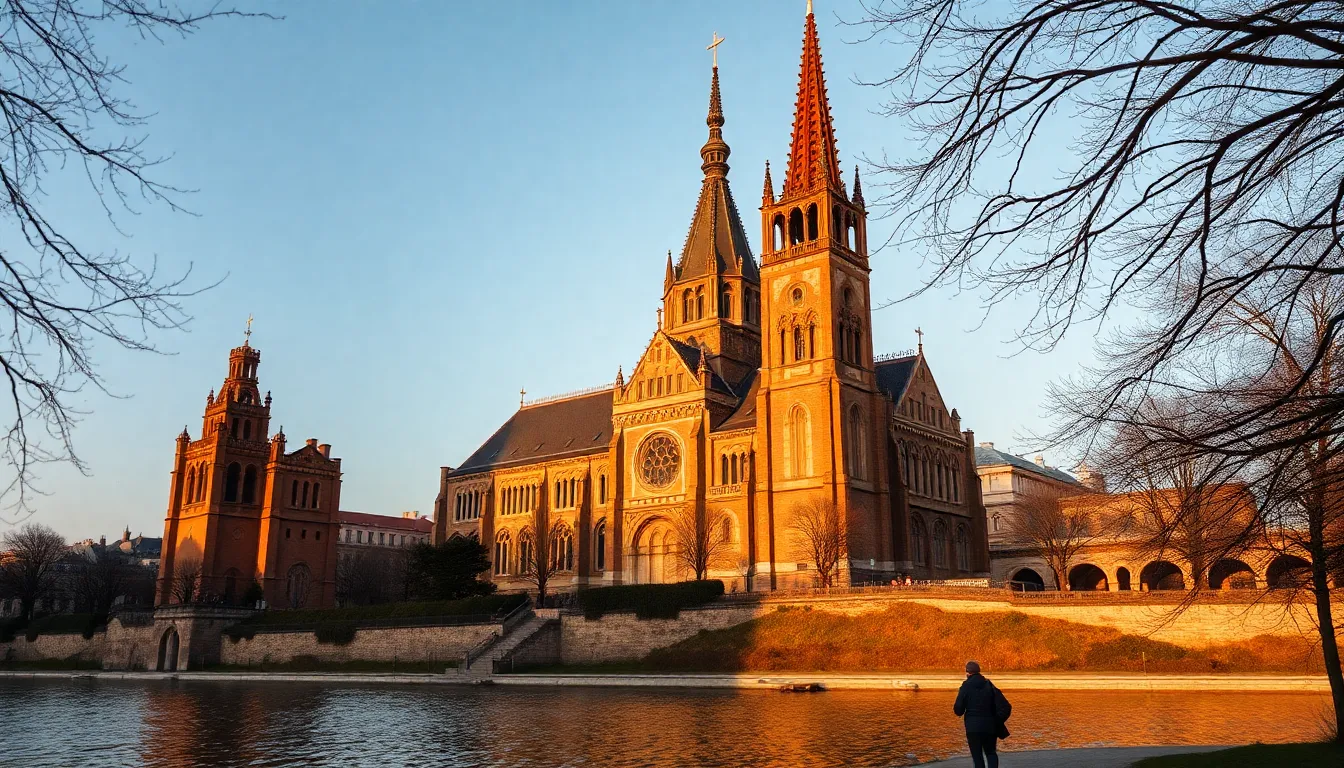
When I want a group to understand where Poland actually began, I do not take them to Krakow or Warsaw. I take them to a small island in a river in the city of Poznan, to a brick cathedral that most travelers have never heard of, and I tell them: this is the spot. Not a spot. The spot. The place where Christianity in Poland took organized form, and with it, the Polish nation.
Poznan Cathedral does not have the fame of the great shrines. It is not the busiest church in the country, and groups rarely arrive expecting much. Then they stand in the crypt, beneath the floor, looking at the remains of the very first structures and at the resting place of Poland’s first rulers, and the weight of it lands. This is the beginning. Everything else in Polish Christian heritage flows from here.
This guide tells you what Poznan Cathedral is, why it matters more than its modest fame suggests, and how to bring a group here well. For the broader story it belongs to, our piece on the heritage of Polish Catholicism gives the full context.
The Oldest Cathedral in Poland
The Archcathedral Basilica of St. Peter and St. Paul in Poznan is the oldest cathedral in Poland. It stands on Ostrow Tumski, Poznan’s own Cathedral Island, in the Warta River, the historic core from which the city grew.
The story begins in 966, when Duke Mieszko I, the first historical ruler of Poland, accepted baptism and brought his people into Latin Christianity. In 968, the first missionary bishopric in the Polish lands was established, traditionally associated with Poznan, making it the cradle of the organized Polish church. A cathedral has stood on this site, in successive forms, ever since.
I make sure groups hold onto that date, 966. In the Polish imagination, the baptism of Mieszko is not only a religious event. It is the founding of the nation. To stand at Poznan Cathedral is to stand at the source of both.
The First Bishops and the First Rulers
What makes Poznan more than a very old building is who lies beneath it.
The Royal Crypt
In the crypt of the cathedral are the resting places of the first rulers of Poland, including Mieszko I, who brought the country to Christianity, and his son Boleslaw the Brave, the first crowned king of Poland. Archaeological work beneath the cathedral has also uncovered the remains of the earliest structures on the site, including what are believed to be the foundations of the first cathedral and an early baptismal basin.
I always slow a group down in the crypt. Above us is a working Gothic cathedral. Below us are the physical beginnings of the Polish church and the bones of the men who founded the state. There are not many places in Europe where the start of a nation and the start of its faith are this literally in one spot.
The Birth of the Church Hierarchy
Poznan’s early bishopric was the first thread of a church structure that would soon spread across the Polish lands. Within a few decades, bishoprics were established in other cities, and an archbishopric was founded at Gniezno nearby, organizing the young Polish church. The cathedrals that followed, including the one at Wroclaw’s Cathedral Island, all trace back to this founding moment. Poznan is where the structure began.
The Cathedral You See Today
A practical word, because I never want a group surprised. The cathedral standing today is a Gothic brick church, with later additions, that was reconstructed after the Second World War.
Poznan was badly damaged in 1945, and the cathedral was left largely in ruins. The rebuilding that followed returned it to its Gothic form and, in the process, revealed the early archaeological remains now displayed beneath the floor. So the building is at once very old and, in its present fabric, substantially rebuilt. That layering, ancient foundations under a restored Gothic shell, is itself part of the story. Polish Christian heritage is full of this pattern: destruction, patient recovery, and the old made to stand again.
The Golden Chapel, a 19th-century mausoleum within the cathedral honoring Mieszko I and Boleslaw the Brave, is the most ornate space inside and a fitting place to gather a group and tell the founding story.
Visiting Poznan Cathedral With a Group
A few practical notes from years of bringing groups here.
What to See and How Long
Plan around ninety minutes to two hours. That covers the cathedral interior, the Golden Chapel, and, most importantly, the crypt and archaeological remains beneath, which are the real reason to come. Some of the underground displays may require a separate ticket or arranged access, so it is worth confirming in advance rather than discovering a locked door on the day.
Pair It With the Island
Ostrow Tumski in Poznan is a quiet, walkable district, and the cathedral sits at its center. Give your group a little time to walk the island itself, the same kind of set-apart ecclesiastical core you find in Wroclaw. It helps people feel the age of the place rather than just being told about it.
Reading the Site
This is a cathedral that means little without its story and everything with it. Spend a few minutes before you enter, or down in the crypt, laying out the founding: 966, Mieszko, the first bishopric, the birth of the church and the nation together. With that framing, a modest brick cathedral becomes one of the most significant stops in the country.
Where Poznan Fits in a Poland Trip
Poznan sits in west-central Poland, on the main line between Warsaw and Berlin, which makes it a natural stop for groups traveling overland across the country. It pairs especially well with the Basilica of Our Lady of Sorrows in Lichen, only about two hours east, letting a group see the oldest cathedral in Poland and one of the newest and largest basilicas in a single sweep. Beginning and present, in one route.
For groups who want a Poland itinerary with real historical depth and not just the famous shrines, Poznan is where I like to start the Christian story. You can see how a route like this comes together on our Poland destination page.
FAQ: Visiting Poznan Cathedral
Why is Poznan Cathedral called the birthplace of the Polish church?
Because Poland’s organized Christianity began here. After Duke Mieszko I was baptized in 966, the first missionary bishopric in the Polish lands was established, traditionally associated with Poznan, in 968. A cathedral has stood on the site ever since, making it the oldest cathedral in Poland and the cradle of the Polish church.
Who is buried in Poznan Cathedral?
The crypt holds the resting places of the first rulers of Poland, including Mieszko I, who brought the country to Christianity, and his son Boleslaw the Brave, the first crowned king of Poland. Archaeological remains of the earliest structures on the site are also displayed beneath the cathedral floor.
Is the cathedral original or rebuilt?
Both, in a sense. The standing building is a Gothic brick cathedral reconstructed after heavy damage in the Second World War. The rebuilding revealed the ancient foundations now shown beneath the floor. So you see a restored Gothic shell above genuinely ancient remains, a layering that is common in Polish Christian heritage.
How much time should a group plan at Poznan Cathedral?
Around ninety minutes to two hours. That covers the interior, the ornate Golden Chapel, and the crypt with its archaeological remains, which are the main reason to visit. Confirm access to the underground displays in advance, as they may require a separate ticket.
How does Poznan fit into a Poland heritage itinerary?
Poznan sits in west-central Poland on the main overland route across the country and works well as the place to begin the Christian story chronologically. It pairs naturally with the Lichen basilica two hours east, letting a group see the oldest cathedral and one of the largest modern basilicas in Poland in a single day.
If you want your group to begin its Polish Christian heritage where the church and the nation actually began, Poznan Cathedral is the right first chapter. I would be glad to help you build it into your route and your travel dates.
Contact us whenever you are ready to start planning.