If you have never been to Poland and you are planning to bring a group, I want to tell you something that most travel guides will not: Poland asks something of you before you arrive. It asks you to prepare. Not just your suitcase and your itinerary, but yourself.
This is not a criticism. It is a recognition that Poland is not a standard heritage destination. The history here is heavy, and it sits alongside a country that is modern, vibrant, and more beautiful than most first-timers expect. Holding both of those things at the same time is what makes a Poland heritage trip so significant. But it helps to know what you are walking into.
I have been helping rabbis, pastors, and community leaders bring groups to Poland for over 40 years. This guide is what I wish I could hand every first-timer before they board the plane.
What Poland Will Ask of You Before You Arrive
Poland will ask you to know the basics of what happened here. Not in exhaustive detail, but enough to understand why you are standing where you are standing.
Before the war, Poland was home to over three million Jews. They built synagogues, yeshivas, theaters, businesses, and entire neighborhoods. They lived here for a thousand years. And then, in the span of six years, almost all of it was destroyed.
If you are bringing a group, some of your members will know this history well. Others will not. As a leader, your job is not to teach a Holocaust course on the bus. But having a shared baseline before the trip starts will make every site visit more meaningful.
For a broader overview of Poland as a heritage destination, start there. This guide focuses on what a first-timer specifically needs to know.
The Two Polands a First-Timer Needs to Know
Pre-War Poland: A World That Existed for a Thousand Years
The first Poland is the one that existed before 1939. Jewish communities arrived in Poland as early as the 10th century. By the 16th century, Poland was the center of Jewish life in Europe. The rabbinical academies in Lublin, the synagogues of Krakow, the Yiddish press in Warsaw, all of this was real, flourishing, and rooted.
Understanding this matters because many first-time heritage travelers arrive in Poland thinking only about the Holocaust. And if that is your only lens, you will miss what was actually lost. What was lost was not an abstraction. It was a civilization.
The Poland of Memory: What Was Destroyed and What Remains
The second Poland is the one you see at the memorial sites. Auschwitz-Birkenau. Majdanek. Treblinka. The Warsaw Ghetto. These are places of destruction, and they are part of why your group is coming.
But between these two Polands, there is a third one: the Poland of what remains. Synagogues that survived. Cemeteries that were buried and then uncovered. Neighborhoods like Kazimierz in Krakow where Jewish life continues today. First-timers are often surprised by how much is still here.
Practical Orientation
Language and Getting Around
Polish is the national language. In the major cities, especially Krakow and Warsaw, English is widely spoken in hotels, restaurants, and at tourist sites. Your Heritage Tours guide and local operators speak English fluently, so language will not be a barrier during organized portions of the trip.
For free time, a few Polish phrases go a long way. “Dziekuje” (thank you) and “Przepraszam” (excuse me) are appreciated.
Currency and Daily Life
Poland uses the zloty, not the euro. As of 2026, one US dollar is roughly four zloty. Credit cards are accepted nearly everywhere in cities, but carrying some cash is useful for smaller vendors and tips.
Poland is affordable compared to Western Europe. Meals, coffee, and local transportation cost noticeably less than in Paris or London.
How Poland Feels as a Country Today
This is the thing first-timers comment on most: Poland does not feel the way they expected. Krakow is a university city. Warsaw is a modern capital with a rebuilt Old Town and a thriving cultural scene. The food is excellent. The people are welcoming.
If you expected Poland to feel gray and somber, you will be surprised. The country is warm, alive, and proud of its culture. The memorial sites carry their weight, but Poland as a whole is not defined by them.
What First-Time Heritage Travelers Are Usually Surprised By
Krakow Is Not What You Expected
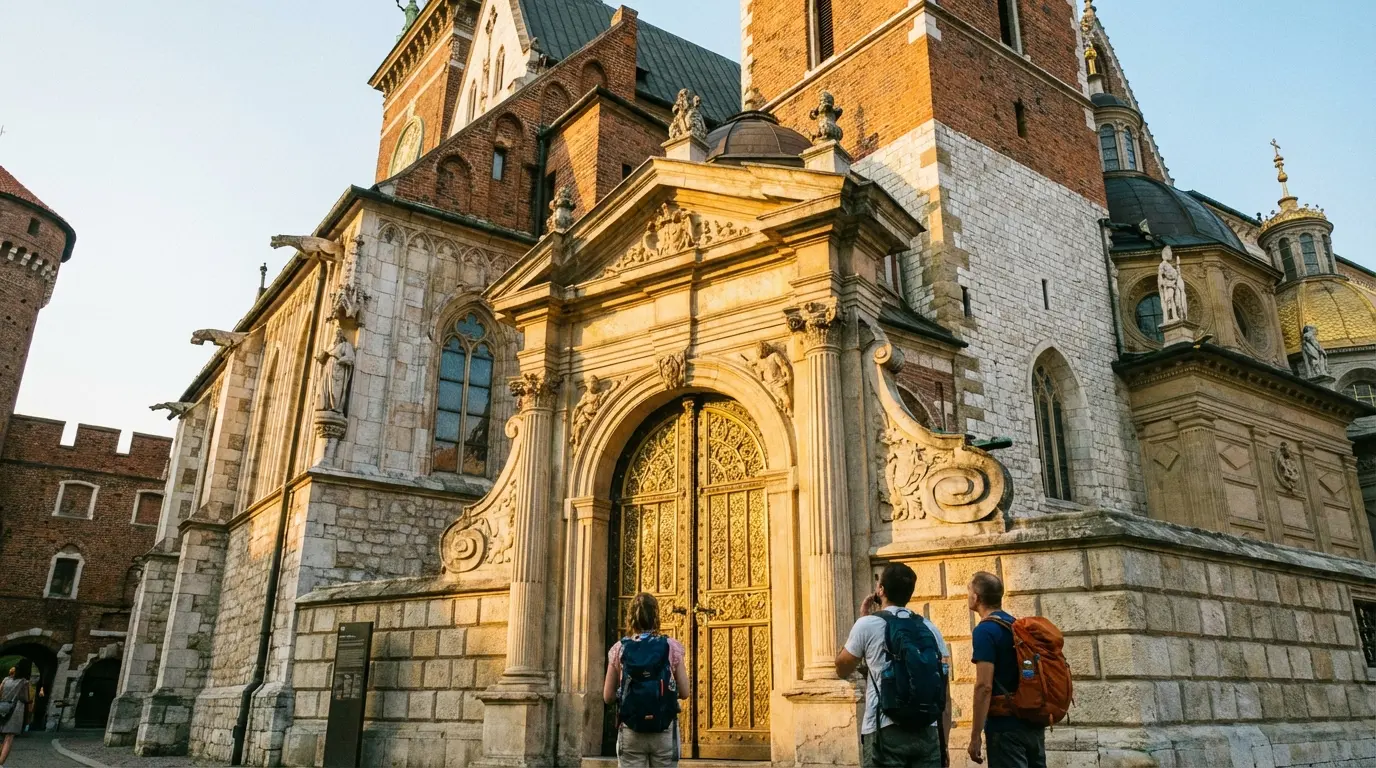
Almost every first-timer I have worked with says the same thing after arriving in Krakow: “I did not expect this.” The city is beautiful. The main square, Rynek Glowny, is one of the largest medieval squares in Europe. The restaurants and cafes are lively. The architecture is intact because Krakow, unlike Warsaw, was not destroyed during the war.
This beauty can be disorienting when you know what happened nearby. That disorientation is part of the experience. Let your group sit with it.
Kazimierz Still Has Life
Krakow’s historic Jewish quarter, Kazimierz, is not a memorial district. It is a living neighborhood. Young people live here. There are bookshops, galleries, bars, and a weekly market. The synagogues are surrounded by street life.
For first-timers who expected a somber, museum-like atmosphere, Kazimierz is a revelation. Jewish life in Krakow was nearly extinguished, and yet this neighborhood persisted. It changed, but it did not disappear. Walking through it, your group will see what survival looks like in a place.
The Scale of Auschwitz-Birkenau
Photographs do not prepare you for the physical scale of Birkenau. Auschwitz I, the original camp, is smaller than most people expect, contained within brick buildings that look, from the outside, almost institutional. Birkenau is the opposite. It is enormous. The train tracks stretch into the distance. The ruins of the gas chambers sit at the far end. The sheer size of the site communicates something that no exhibition can.
Preparing for Auschwitz: What Group Leaders Should Know
What to Tell Your Group the Night Before
The evening before your Auschwitz visit, gather your group. Keep it simple. Tell them what the day will look like: you will visit Auschwitz I in the morning, Birkenau in the afternoon, and return to Krakow in the late afternoon. Tell them what is and is not permitted. And then tell them the most important thing: there is no right way to feel.
What Happens to People There, and Why That Is Okay
Some people cry at Auschwitz. Some people go completely silent. Some people feel nothing at all and then feel guilty about it. Some people are angry. Some people laugh nervously, and then feel ashamed.
Every one of those reactions is normal. The human nervous system responds to overwhelming information in unpredictable ways. As a group leader, the most valuable thing you can do is name this ahead of time. Tell your group that whatever they feel is acceptable. Nobody owes anyone tears. Nobody needs to perform grief.
In my experience, the people who feel “nothing” at Auschwitz often process the visit days or weeks later. The numbness is not indifference. It is the mind protecting itself.
After the Visit
Heritage Tours does not schedule activities on the evening after Auschwitz. Your group needs unstructured time. Some people will want to eat together and talk. Some will want to be alone. Some will want to walk through Krakow and see life happening.
As a leader, you might consider gathering the group briefly after dinner, not for a formal session, but to check in. A simple “how is everyone doing?” can open a conversation that people need to have.
For a full day-by-day breakdown of how this fits into a longer trip, see our 10-day Poland heritage itinerary.
What Coming With a Group Changes
You Will Not Experience This Alone, and That Is the Point
The single biggest difference between visiting Poland on your own and visiting with your community is this: you have people to turn to.
When you walk out of Birkenau and you do not know what to say, someone from your congregation is standing next to you. They do not know what to say either. And that shared silence is, in its own way, the beginning of processing what you just saw.
This is why Heritage Tours encourages communal travel for Poland specifically. The sites ask more of you than most destinations. Having your community with you changes what that asking feels like.
If you are a group leader considering this trip for the first time, our group leader’s guide walks through the planning process from start to finish.
The Question First-Timers Always Ask (And the Honest Answer)
Is Poland Safe?
Yes. Poland is a safe country for travelers, including Jewish heritage groups. The cities are well-policed, public transportation is reliable, and violent crime against tourists is very rare.
Heritage Tours works with local operators in every city who know the ground, and your group will have support throughout the trip. In 40 years of bringing groups to Poland, safety has not been a significant issue.
That said, antisemitic incidents do occur in Poland, as they do across Europe. They are not common, but they are not nonexistent. Heritage Tours briefs group leaders on current conditions before departure, and our local contacts are available if anything arises.
The honest answer is: Poland is as safe as any major European destination, and the experience your group will have here is worth the trip.
If this is your first time considering Poland for your community, I understand the weight of that decision. It is not a trip you take lightly. But I can tell you, after decades of helping leaders prepare for it, that the groups who come back from Poland carry something with them that no other destination provides. If you want to talk about what a first trip could look like for your group, we are here.
Frequently Asked Questions
How do you prepare for a first visit to Auschwitz-Birkenau?
Gather your group the evening before. Explain the structure of the day, what is permitted, and what to expect physically. Most importantly, tell people there is no correct emotional response. Some cry, some feel numb, some are angry. All of it is normal. As a leader, giving that permission beforehand helps your group arrive open rather than guarded.
What should a first-time heritage traveler know before visiting Poland?
Know the basics of Polish Jewish history before the war, not just the Holocaust. Poland was home to the largest Jewish community in Europe for a thousand years. Understanding what existed before helps you understand what was lost. Practically, Poland is safe, affordable, and more modern than most first-timers expect.
Is Poland safe for Jewish heritage travelers?
Yes. Poland is a safe country for Jewish travelers. The major cities are well-policed, and Heritage Tours works with local operators who know the ground. Antisemitic incidents are rare but not nonexistent, consistent with the rest of Europe. Heritage Tours provides a current conditions briefing before every departure.
What is Krakow like for a first-time visitor?
Krakow surprises most first-timers. It is a beautiful, lively university city with one of Europe’s largest medieval squares. Unlike Warsaw, it was not destroyed during the war, so the historic architecture is intact. The Kazimierz Jewish quarter is a living neighborhood with cafes, galleries, and active synagogues, not a somber memorial district.
How do I explain to my congregation what to expect on a Poland heritage trip?
Be direct. Tell them this is not a standard trip. There will be beautiful cities, excellent food, and vibrant culture. There will also be memorial sites that ask something of everyone who visits. Let them know you will prepare them before each major visit, and that their experience, whatever it turns out to be, is valid. Framing Poland as both a living country and a place of memory gives your group a more complete picture.