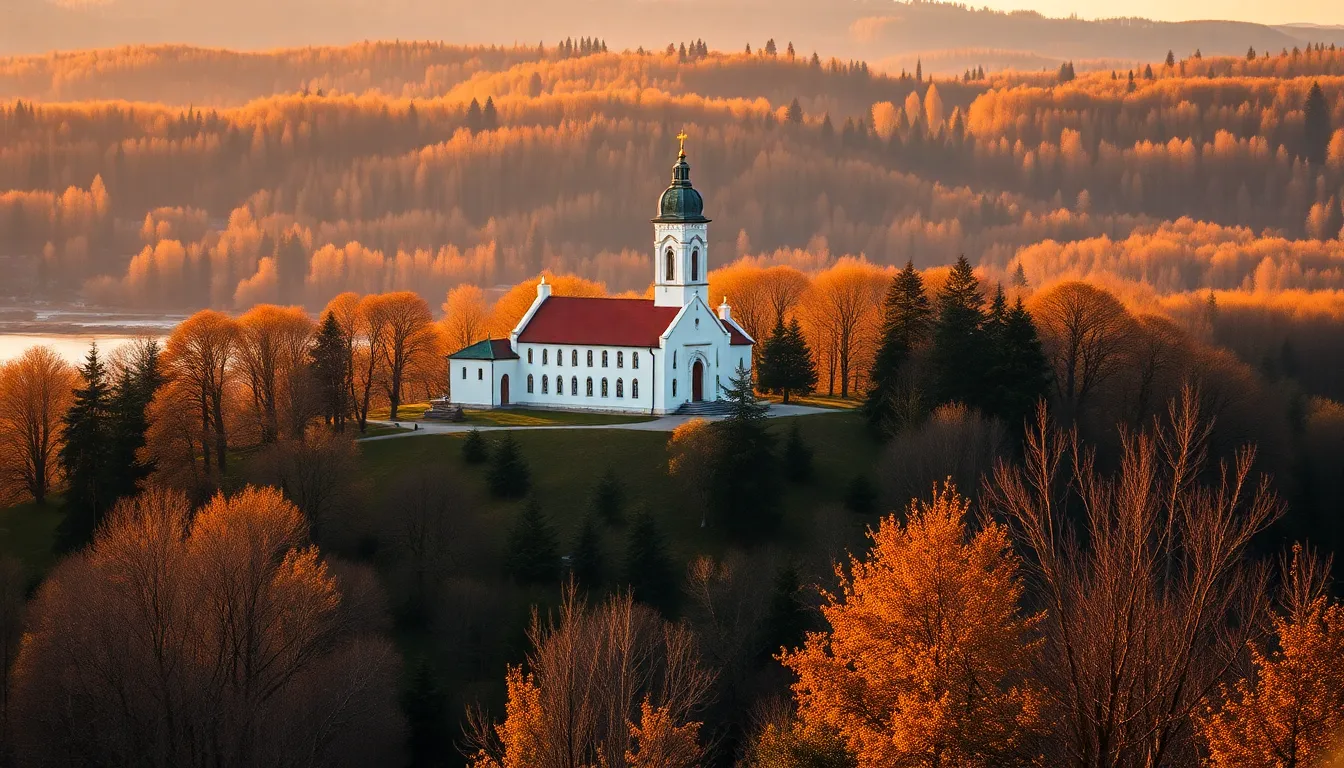
There is a white church on a wooded hill above Krakow that most visitors never reach. You can see it from parts of the city, a pale facade rising out of the trees on Srebrna Gora, the Silver Mountain. That is the Camaldolese monastery at Bielany, and behind that facade live monks who have chosen a way of life so quiet and so set apart that it is hard to believe it still exists in the 21st century. I have stood at its gate with groups and watched people go from curiosity to genuine awe as they understood what this place is.
Bielany is not a typical stop on a Krakow itinerary, and I want to be honest about that from the start. It is a working hermit monastery with strict enclosure, which means access is limited and women, in particular, can enter only on a handful of days each year. But for a group leader willing to plan carefully, or even to make it a teaching point seen from outside, the monastery offers something the busier shrines cannot: a living encounter with contemplative silence, the oldest and most radical form of Christian withdrawal from the world.
For the wider map of sacred sites, see our guide to spiritual sites in Poland.
Who the Camaldolese Are
To understand Bielany, you have to understand the order that built it. The Camaldolese are a branch of the Benedictine family founded in Italy around the year 1000 by Saint Romuald. What sets them apart is that they combine two forms of monastic life that are usually kept separate. They are both hermits and a community.
The Camaldolese live as hermits, each monk in his own small cottage with its own walled garden, devoting himself to solitude, prayer, manual work, and silence. Yet they are also a community, gathering for the liturgy and the major feasts. Their motto, often rendered as a reminder to remember death, points to the seriousness of the life: it is an existence stripped down to the essentials, oriented entirely toward God.
This is one of the most austere ways of life in the Western church. The monks keep strict silence for much of the time, eat a simple diet with long periods of fasting, and rise in the night to pray. They withdraw from the world not out of disdain for it but to intercede for it. For a group encountering this for the first time, it reframes what the word monk even means.
The Monastery on the Hill
The Bielany monastery was founded in 1604, on land given by Mikolaj Wolski, a court official who brought the Camaldolese to Poland. He chose the hill of Srebrna Gora deliberately, a place of natural seclusion above the Vistula valley, set apart from the city below.
The Church and the Hermitage
The monastery church, the Church of the Assumption of the Blessed Virgin Mary, has a tall white facade of local limestone that gives the whole complex its luminous appearance from a distance. Inside, it is richly decorated, with chapels and a crypt, in contrast to the severity of the life lived around it.
Behind and around the church lies the hermitage proper: the individual cottages of the monks, each self-contained, arranged so that the brothers live in solitude even within the shared enclosure. This area is the heart of the contemplative life and is closed to ordinary visitors. The whole site sits within extensive grounds on the wooded hill, part of the protected Bielany-Tyniec landscape area on the western edge of Krakow.
Strict Enclosure
The defining fact for any group leader is the enclosure. Bielany observes a strict rule that limits access, and there are well-known restrictions on when women may enter the monastery grounds, traditionally only on about a dozen designated feast days throughout the year. Men can generally enter the church at set times, but the hermitage itself remains closed.
This is not a barrier to be resented. It is the point. The enclosure is what makes the silence possible, and the silence is what the place exists for. I always explain this to groups in advance so that the restriction is understood as part of the witness, not as an inconvenience.
Visiting Bielany as a Group
Because of the enclosure, planning a Bielany visit takes more thought than planning a visit to an open church. There are a few ways to approach it.
Check the Access Days
If entering the church matters to your group, and especially if your group includes women, you need to confirm the specific dates and hours of access for your travel period well in advance. The designated feast days when women may enter are limited and fixed, so the monastery’s schedule has to drive your itinerary, not the other way around. Verify the current arrangements before you build the day around a visit inside.
Consider the View From Outside
Here is something I have learned: even when entry is not possible, Bielany is worth approaching. The walk up through the woods to the gate, the white church rising above the trees, the simple act of standing at the threshold of a place of such radical silence, all of it teaches. I have led groups who could not go inside and who still counted the visit among the most affecting moments of the trip, precisely because the inaccessibility made the contemplative life so tangible. Sometimes a closed door says more than an open one.
Use It as a Teaching Moment
Whether you enter or not, Bielany is a chance to teach about contemplative prayer, a dimension of the faith that most of our group members rarely encounter. In a trip that may include the crowds of Czestochowa and the weight of Auschwitz, a quiet hour near the hermit monastery offers a different register entirely: stillness, withdrawal, intercession. It rounds out a group’s understanding of how broad the Christian tradition really is.
Fitting It Into a Krakow Itinerary
Bielany sits on the western edge of Krakow and pairs naturally with a visit to the nearby Benedictine abbey at Tyniec, dramatically set above the Vistula, which has its own long history and is more accessible to groups. Together the two make a contemplative half-day on the quiet side of the city, a deliberate counterpoint to the great pilgrimage sites covered in our guides to Czestochowa and the Calvary of Zebrzydowska.
One practical note as you plan: with Heritage Tours, the group leader travels free with fifteen or more participants, which makes building a group around your parish or community much easier to reach.
FAQ: The Camaldolese Monastery at Bielany
What is the monastery at Bielany?
Bielany is a Camaldolese hermit monastery on the wooded hill of Srebrna Gora on the western edge of Krakow, founded in 1604. The monks live as hermits, each in his own cottage, devoted to silence, prayer, and withdrawal from the world, while gathering as a community for the liturgy. Its white limestone church is visible from parts of the city.
Who are the Camaldolese monks?
The Camaldolese are a branch of the Benedictine family founded in Italy around the year 1000 by Saint Romuald. They combine the life of a hermit with that of a community, keeping strict silence, fasting, rising in the night to pray, and living each in his own cottage. It is one of the most austere contemplative ways of life in the Western church.
Can groups visit the Bielany monastery?
Access is limited because of strict enclosure. Men can generally enter the church at set times, but the hermitage is closed to visitors. Women may enter the monastery grounds only on about a dozen designated feast days each year. Group leaders should confirm the current access dates and hours well before building an itinerary around a visit.
Why are women restricted from entering most of the year?
The restriction is part of the monastery’s strict enclosure, the rule of separation that makes its silence and solitude possible. It is not an arbitrary exclusion but a feature of the contemplative life the monks have chosen. Understanding it this way helps a group see the enclosure as part of the witness rather than as an obstacle.
Is Bielany worth visiting if a group cannot go inside?
Yes. Many group leaders find that approaching the monastery, walking up through the woods to the gate and standing before the white church, is moving precisely because the place is so set apart. It offers a tangible encounter with contemplative silence and pairs well with the nearby and more accessible Benedictine abbey at Tyniec for a quiet half-day on the western edge of Krakow.
If your group is coming to Krakow and you want to include a quieter, more contemplative dimension alongside the major shrines, I would be glad to help you plan a visit to Bielany and Tyniec. Sometimes the stillest place on a trip is the one people remember most. Contact us whenever you are ready to begin.