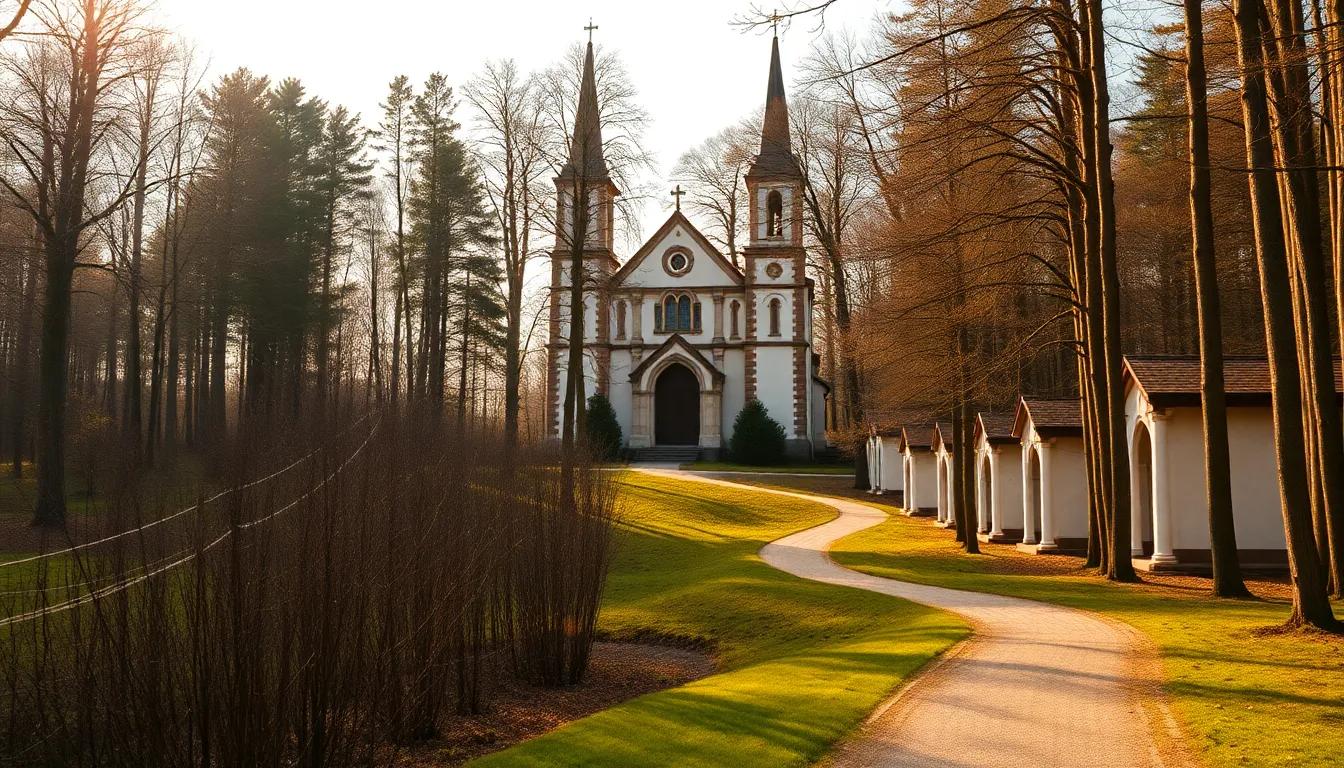
Most people who plan a Catholic trip to southern Poland know about Czestochowa and the Krakow shrines. Far fewer know about Kalwaria Zebrzydowska, and that is a shame, because it is one of the most quietly moving places I bring groups to in all of Poland. It is not a single church. It is an entire landscape turned into a devotion, a hillside laid out as Jerusalem, with chapels scattered through the woods that pilgrims walk between as they trace the Passion of Christ and the life of Mary.
The name is a mouthful, so let me set it at ease right away. Kalwaria means Calvary. Zebrzydowska comes from the founder. Together they name a Mannerist pilgrimage park founded in the early 17th century, now a UNESCO World Heritage Site, southwest of Krakow. It was also a place dear to Karol Wojtyla, the future Pope John Paul II, who came here as a boy and returned throughout his life. For a group, it offers something the great basilicas cannot: a pilgrimage you walk, through nature, at the pace of prayer.
For where it fits among the country’s sacred sites, see our guide to spiritual sites in Poland.
What a Calvary Park Is
The idea behind a Calvary, or Sacro Monte, is old and beautiful. In the centuries when travel to the Holy Land was dangerous or impossible for most believers, the church created “New Jerusalems” closer to home: landscapes laid out to mirror the geography of Christ’s Passion, so that pilgrims could walk the path of the cross without leaving Europe.
Kalwaria Zebrzydowska is one of the finest surviving examples. Founded in 1600 by Mikolaj Zebrzydowski, a Polish nobleman, it was deliberately planned so that the hills and valleys around the Bernardine monastery corresponded to the topography of Jerusalem. The distances between chapels, the rise and fall of the paths, the placement of each station were all designed to let a pilgrim physically retrace the events of Holy Week.
The result is a devotion in three dimensions. You do not read about the Way of the Cross or look at it on a wall. You walk it, up and down real hills, from chapel to chapel, with the same effort and the same rhythm that the journey itself once demanded.
The Chapels and the Devotional Paths
The complex centers on the Bernardine monastery and the Basilica of Our Lady of the Angels, built in Mannerist and baroque style on the hillside. Radiating out from it through the wooded grounds are around forty chapels and shrines, built over the 17th and 18th centuries.
Two Interwoven Paths
What makes Kalwaria distinctive is that it holds two devotions at once, woven together across the same landscape. One set of chapels traces the Passion of Christ, the Way of the Cross from the Last Supper to the tomb. The other traces the life and, especially, the Dormition and Assumption of the Virgin Mary, the Paths of Our Lady. Pilgrims walk one or both, depending on the season and the devotion.
The chapels themselves are varied and often architecturally inventive, some built in unusual shapes meant to evoke the scenes they commemorate. Walking between them, through the trees and across the valleys, is a quiet, contemplative experience. The grounds are large, and the full circuit covers several kilometers.
The Living Tradition
Kalwaria is not a museum. It remains an active pilgrimage site cared for by the Bernardine friars, drawing pilgrims throughout the year. Its most famous events are the Holy Week Passion Mysteries, when the scenes of the Passion are enacted across the chapels and paths, and the August celebrations of the Assumption of Mary. During these times the site fills with tens of thousands of pilgrims and the whole landscape becomes a single living act of devotion.
The John Paul II Connection
For many groups, the link to John Paul II is part of what makes Kalwaria so meaningful. Karol Wojtyla grew up in Wadowice, just a few kilometers away. As a boy and a young man, he came to Kalwaria often. He spoke later in life about how formative this place was for him, how he would walk the paths and pray among the chapels.
Even after he became pope, he returned. He made pilgrimages here as John Paul II and spoke movingly about the hold the place had on him since childhood. For a group, this adds a layer: you are not only walking an ancient Calvary, you are walking paths that shaped one of the most significant figures in modern church history. Many itineraries pair Kalwaria with his birthplace at Wadowice, which is close by and well worth the short additional drive.
Planning a Group Visit
Kalwaria Zebrzydowska sits about an hour southwest of Krakow, which makes it an easy addition to a southern Poland itinerary. Most groups visit it as a half-day trip from a Krakow base, often combined with Wadowice.
How Much to Walk
The first decision a group leader has to make is how much of the park to walk. The full circuit of chapels covers several kilometers over hilly, sometimes uneven terrain, and for a mixed-age group that can be a lot. I usually plan a meaningful partial route: the basilica, a selection of the most significant chapels, and enough of the path to give the group the experience of walking the devotion, without exhausting anyone. For a fit and motivated group, the longer route is rewarding. Know your people and plan accordingly.
Footwear and Weather
Tell your group plainly: this is a walking pilgrimage on natural paths. Comfortable shoes are not optional, and in wet weather the trails can be muddy. A group that arrives prepared moves through the day far better than one that does not.
Timing
If your travel dates fall near Holy Week or the Assumption in mid-August, you can witness Kalwaria at its most alive, but you will also share it with very large crowds, and logistics become more demanding. Outside those peaks, the park is quieter and more contemplative, which many groups actually prefer. Decide which experience suits your community.
Pairing It With the Region
Kalwaria fits naturally into a southern Poland Catholic circuit alongside the Czestochowa pilgrimage and the Krakow shrines. Together they give a group a full and varied pilgrimage: the great icon at Jasna Gora, the urban shrines of Krakow, and the walked Calvary at Kalwaria.
One practical note as you plan: with Heritage Tours, the group leader travels free with fifteen or more participants, which makes building a pilgrimage group around your parish much more achievable.
FAQ: Kalwaria Zebrzydowska
What is Kalwaria Zebrzydowska?
Kalwaria Zebrzydowska is a Mannerist pilgrimage park southwest of Krakow, founded in 1600 by Mikolaj Zebrzydowski. Its landscape was designed to mirror the geography of Jerusalem, with around forty chapels scattered through wooded hills that pilgrims walk between to trace the Passion of Christ and the life of the Virgin Mary. It is a UNESCO World Heritage Site.
Why is it a UNESCO World Heritage Site?
It was inscribed for its exceptional integration of religious devotion and designed landscape. The way the natural topography was shaped into a symbolic Jerusalem, combined with the architectural quality of its Mannerist and baroque chapels, makes it one of the finest surviving Calvary parks in Europe.
What is the connection to John Paul II?
Karol Wojtyla, the future Pope John Paul II, grew up in nearby Wadowice and came to Kalwaria often from boyhood. He spoke of how formative the place was for him and returned on pilgrimage even as pope. Many groups pair a visit with his birthplace at Wadowice, a short drive away.
How much walking does a visit involve?
The full circuit of chapels covers several kilometers over hilly, sometimes uneven terrain. Many groups walk a meaningful partial route covering the basilica and the most significant chapels. Comfortable shoes are essential, and the paths can be muddy in wet weather, so groups should come prepared.
When is the best time for a group to visit?
Outside the peak celebrations, the park is quiet and contemplative, which many groups prefer. Holy Week, when the Passion Mysteries are enacted, and the Assumption celebrations in mid-August bring the site to life but also draw very large crowds and more demanding logistics. Choose the experience that suits your community.
If your group is coming to southern Poland and you want a pilgrimage you can walk, through woods and chapels at the pace of prayer, I would love to help you fit Kalwaria into the journey. It is one of the quiet treasures of Catholic Poland. Contact us whenever you are ready to plan.