There is a moment on almost every Morocco heritage trip when someone in the group gets very quiet. It usually happens in a mellah, or standing in front of a headstone in a Jewish cemetery, or inside a synagogue that has been restored but no longer holds regular services. The quiet comes from recognition. This is not a foreign country for many American and Israeli Jewish families. This is where their grandparents were born. This is where their family name was spoken every Shabbat for hundreds of years before anyone in the family had set foot in Brooklyn or Tel Aviv.
Morocco was home to one of the largest and oldest Jewish communities in the world. At its peak in the 1940s, roughly 250,000 Jews lived across the country, from Casablanca’s modern boulevards to the Atlas Mountains to the edge of the Sahara. Today, fewer than 2,000 remain. But what was built over three thousand years does not disappear completely. The synagogues are still standing. The cemeteries are still here. The mellahs still carry the physical shape of Jewish communal life. And for families with Moroccan roots, coming back is not tourism. It is something much more personal than that.
If you are a rabbi bringing a community with Sephardic roots to Morocco, or a group leader organizing a heritage journey for people who want to understand this history firsthand, this guide tells you what your group will encounter, what they will feel, and why it matters.
When Morocco Was One of the World’s Largest Jewish Countries
The Sephardic Expulsion of 1492, Why Morocco Became a Refuge
In 1492, the Spanish Crown expelled all Jews from Spain. It was one of the largest forced migrations in Jewish history, and it reshaped the Sephardic world permanently. Some families went east, to the Ottoman Empire. Some went to Italy or the Netherlands. And a very large number went south, across the Strait of Gibraltar, to Morocco.
They arrived in a country that already had a Jewish population. Moroccan Jews had lived on this land for over two thousand years, long before Islam arrived in the seventh century. The Spanish refugees, known as the Megorashim, joined the existing Toshavim (the native Moroccan Jews), and together they built communities that lasted for nearly five hundred years more. The two groups sometimes merged, sometimes maintained separate synagogues and customs, and over time developed a uniquely Moroccan Jewish culture that blended Sephardic liturgy with local traditions.
That is the story your group is stepping into when they land in Morocco. It is not ancient history in the way that feels distant and academic. It is family history, especially for the many American Jewish families whose Moroccan roots trace directly back to this period. The recipes their grandmothers made, the melodies they sang at the Seder table, the family names that sound Spanish or Arabic or both, all of it started here.
3,000 Years of Continuous Jewish Life
Jewish presence in Morocco predates Islam, predates Christianity in the region, and may predate the Roman Empire’s reach into North Africa. Archaeological evidence points to Jewish communities in Morocco as far back as the 2nd century BCE, and oral tradition goes back further still.
For three thousand years, Jewish life in Morocco was not marginal. It was central to the country’s commerce, culture, and intellectual life. Jewish merchants traded across the Sahara, connecting sub-Saharan Africa to Mediterranean markets. Jewish scholars contributed to Moroccan intellectual tradition. Jewish craftspeople, particularly silversmiths and jewelers, were renowned throughout the region. Synagogues stood alongside mosques in cities across the country, and the two communities shared more daily life than most people today realize.
Understanding this depth is important for group leaders. When you bring your community to Morocco, you are not visiting a place where Jews once passed through. You are visiting a place where Jews built permanent lives, generation after generation, for longer than almost anywhere else in the diaspora. That continuity is the story. And when it ended, in the span of a single generation, it left a silence that your group will feel in every mellah and every cemetery they visit.
The Mellahs, Jewish Quarters That Still Carry Memory
Fez Mellah, the Oldest in Africa (est. 1438)
The Fez mellah was established in 1438, making it the oldest Jewish quarter in Africa and one of the oldest in the world. At its height, it was home to tens of thousands of residents who built synagogues, schools, rabbinical courts, communal ovens, and marketplaces within its walls. The mellah was a self-contained neighborhood with its own economic and religious life, and its own internal governance structures.
Walking through the Fez mellah today is a layered experience. The buildings are still there. The street layouts have not changed. You can trace the paths that Jewish residents walked to synagogue, to the market, to the communal well. But the people who filled those streets are gone, and the neighborhood has been absorbed into the wider city. Moroccan Muslim families live in many of the former Jewish homes now, and the transition happened gradually enough that the physical fabric of the quarter remains largely intact.
The Ibn Danan Synagogue, beautifully restored in the early 2000s, sits inside the mellah and is open to visitors. It is one of the most important Jewish heritage sites in North Africa, and standing inside it gives your group a tangible connection to what Moroccan Jewish religious life looked and felt like. The interior is modest but elegant, with carved plaster and painted wood that reflects the aesthetic sensibility of Moroccan Jewish communities.
For groups, the Fez mellah is often the first stop on the Jewish heritage portion of the trip, and it sets the tone. This is what remains. This is what was lost. Both of those truths live in the same streets, and your group will carry both with them for the rest of the journey.
Marrakech Mellah, Where the Market and the Prayer House Shared a Wall
The Marrakech mellah is different from Fez in character. It is noisier, more commercial, more integrated into the bustle of the surrounding souk. The Lazama Synagogue, tucked inside the quarter, is one of the most beautiful in Morocco, with blue-and-white tilework, carved wooden ceilings, and a quiet inner courtyard that feels like stepping into another century while the market roars outside.
That contrast, sacred space surrounded by the chaos of daily commerce, is part of what makes the Marrakech mellah meaningful for heritage groups. Jewish life in Morocco was never separate from the life around it. It was embedded in the same streets, the same markets, the same daily rhythms of buying and selling and greeting neighbors. The mellah was not a retreat from the world. It was a home inside the world.
For your group, the Marrakech mellah offers a conversation about what it means to maintain identity in the middle of a busy, diverse city. Your community members will recognize something in that tension, because many of them live it.
What “Mellah” Means and Why the Word Matters
The origin of the word “mellah” is debated among scholars. Some connect it to the Arabic word for salt, possibly referring to the salted earth near the original Fez quarter. Others tie it to different linguistic roots entirely. What matters for heritage travelers is that the mellah was not a ghetto in the European sense. While it was a designated area, and while the history is complicated and should not be simplified in either direction, the mellah in many Moroccan cities was also a place of community, scholarship, self-governance, and daily life that had its own dignity.
Understanding this distinction helps group leaders frame the experience for their communities. The mellah is not primarily a story of oppression. It is a story of life, of building something permanent in a designated space, of creating schools and synagogues and markets within walls that were not entirely of your choosing. And it is a story of what happens when the people leave but the buildings remain, standing there as a kind of question that has no easy answer.
Synagogues That Are Still Standing
Beth El Synagogue, Casablanca
Beth El is an active synagogue in Casablanca. Services are still held there, attended by the small but present Jewish community that remains in the city. For heritage groups, visiting a synagogue that is still in use is a fundamentally different experience than visiting one that has been turned into a museum. Beth El tells your community that Jewish life in Morocco is not entirely in the past tense. It is diminished, yes. But it is not gone.
For Jewish groups, praying in Beth El, even briefly, can be one of the most moving moments of the trip. For Christian groups, witnessing an active Jewish community in a Muslim-majority country opens a conversation about coexistence that is both rare and necessary.
Lazama Synagogue, Marrakech
Lazama is perhaps the most visited synagogue in Morocco, and for good reason. The interior is stunning, the courtyard is peaceful, and the location inside the mellah gives it a context that a standalone building would lack. For many group members, Lazama is the first time they have stood inside a Moroccan synagogue, and it tends to stay with them long after the trip. The tilework, the light, the silence inside while the market hums outside, all of it creates an impression that photographs cannot capture.
Ibn Danan Synagogue, Fez, Restored and Open
Ibn Danan was restored in the early 2000s and is now one of the best-preserved synagogues in Morocco. It sits inside the Fez mellah and offers a clear picture of what Moroccan synagogue architecture looked like at its finest. The restoration was done carefully, with attention to original materials and techniques, and the building retains its original character. For groups that are visiting the Fez mellah, Ibn Danan is not optional. It is the anchor of the visit and the place where the history of the mellah becomes physical and present.
The Jewish Museum of Casablanca, a Story Told Honestly
The Museum of Moroccan Judaism in Casablanca is the only Jewish museum in the Arab world. It is small, housed in a modest building in a residential neighborhood, and it does not try to be anything it is not. The collection includes Torah scrolls, ceremonial objects, photographs, business documents, and everyday items from Jewish homes across Morocco.
What makes the museum worth your group’s time is its honesty. It does not romanticize Jewish life in Morocco, and it does not minimize what was lost. It tells the story plainly, through objects and images, and lets your community draw their own conclusions. A pair of Shabbat candlesticks from a home in Fez. A wedding ketubah from Marrakech. A photograph of a Jewish school class in the 1940s, the children looking at the camera with the same expressions children everywhere have always had.
For groups that have spent the day visiting mellahs and cemeteries, the museum provides a different kind of encounter with the same story. It is quieter, more curated, and it fills in details that the sites themselves cannot provide. The personal objects make the abstract history concrete, and your community will leave with a fuller picture of what daily Jewish life in Morocco looked and felt like.
Jewish Cemeteries, Where the Generations Are Buried
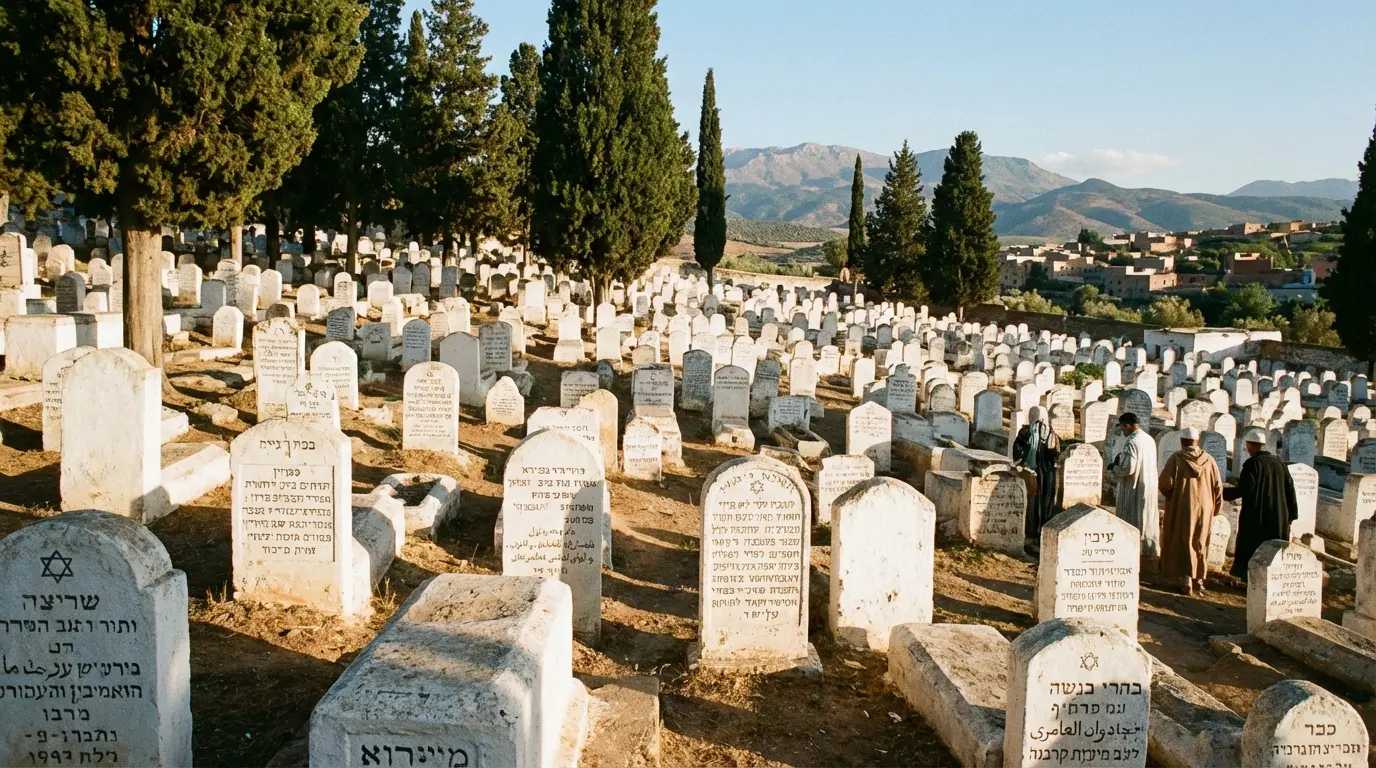
Jewish cemeteries in Morocco are among the most emotionally significant stops on a heritage trip. They exist in almost every city and in many smaller towns, whitewashed stones under open sky, organized by family and community rather than by chronological date.
For families with Moroccan roots, the cemeteries are sometimes the entire reason for the trip. Finding a great-grandparent’s headstone, reading the Hebrew inscription aloud, standing where no one in the family has stood for sixty or seventy years. That is not a tour stop. That is a homecoming. Group leaders should be prepared for this. People will cry. People will want to stay longer than the schedule allows. Build in extra time at the cemeteries. Your group will need it.
Even for groups without direct family connections, the cemeteries convey something that no other site can. The sheer number of graves, the span of dates, the presence of Hebrew in a landscape that is otherwise entirely Arabic and Amazigh. It makes the scale of Jewish life in Morocco real in a way that numbers and history books cannot achieve.
For sites beyond the major cities, including cemeteries in the Atlas Mountains and the Draa Valley, see our guide to Morocco’s lesser-known heritage sites.
The Coexistence Story, Jewish and Muslim Life in Morocco
How the Moroccan King Protected Jews During World War II
During World War II, when the Vichy French government in Morocco demanded a census of all Jews, King Mohammed V is reported to have responded that there were no Jews in Morocco, only Moroccan citizens. Whether the exact quote is verbatim or has been polished by retelling, the substance is historically supported. Mohammed V resisted Vichy pressure to deport Moroccan Jews, refused to implement the harshest anti-Jewish measures that Vichy demanded, and Morocco’s Jewish community survived the war intact.
This story matters enormously for heritage groups, especially Jewish ones. In a world where the Holocaust narrative dominates the story of Jews in WWII, Morocco offers a different chapter. Not a perfect one. The history is complicated, and life under Vichy was not easy for Moroccan Jews even with the king’s protection. But it is a chapter where a Muslim king stood between his Jewish citizens and a regime that wanted them gone. That is not a small thing, and it should not be rushed past on the way to the next site.
For group leaders, this is one of the most powerful conversations you can have with your community on the trip. It reframes the relationship between Judaism and Islam in a way that challenges assumptions and opens dialogue. It also raises questions that your community should sit with: What does it mean to protect your neighbor? What does it cost? And what happens when the threat passes but the memory remains?
The coexistence story in Morocco is not a fairy tale. Jewish communities faced real restrictions and real challenges. But it is also true that Moroccan Jewish and Muslim communities lived side by side for over a thousand years, sharing streets and markets and daily life, and that when the worst threat came, the king chose to protect his Jewish citizens. Both of those truths belong in the same conversation.
Coming Home, What Moroccan Heritage Travel Means for Families with Roots Here
For many American Jewish families, Morocco is not an exotic destination. It is the place their grandmother described at the Shabbat table. The smells of the spice market, the sound of the call to prayer mixing with Hebrew conversation on a Friday afternoon, the taste of food that the family still makes but no longer remembers the original context for.
Bringing a community to Morocco is different from bringing them to a place they have no connection to. The emotional register is different. People cry more easily. They linger longer in doorways and alleys. They ask questions they have been carrying for years, questions about why their family left, what they left behind, and whether anyone remembers them.
As a group leader, that is both a privilege and a responsibility. You are not just organizing travel. You are creating space for your community to reconnect with something they may have thought was gone. Your role on this trip is not to narrate or to teach, though there will be moments for both. Your role is to hold space for what your community members are feeling, and to make sure they have the time and the quiet to feel it fully.
That is why Heritage Tours builds custom itineraries. Because a community with Sephardic Moroccan roots needs a different trip than a community exploring interfaith history for the first time. The sites may overlap, but the emotional weight falls in different places, and the itinerary should reflect that.
Planning Your Group’s Moroccan Jewish Heritage Journey
If you are considering bringing your community to Morocco, the first step is a conversation. Every group is different. Some want to focus on the major cities and their Jewish sites. Some want to go deeper, into the Atlas Mountains, the Draa Valley, the small towns where their families lived. Some want to combine Morocco with Israel for a broader Sephardic journey that traces the path from Spain to North Africa to the Holy Land.
Heritage Tours builds custom itineraries for each group based on your community’s history, interests, and calendar. When your group reaches 15 participants, you as the group leader travel free, including flights, hotels, and ground transportation. We work with local operators in Morocco who know these sites personally, not from a screen but from years of walking the same streets and maintaining the same relationships with the communities and caretakers who preserve this heritage.
For a practical guide on how to plan and organize your group trip, including timelines, recruitment, and what to tell your community, read our guide for pastors and rabbis.
If this journey is one your community has been thinking about, or one you have been thinking about for them, we would be glad to talk. There is no pressure and no timeline. Just a conversation about what this trip could mean for your people.
Frequently Asked Questions
What is the history of the Jewish community in Morocco?
Jewish presence in Morocco dates back over 3,000 years, making it one of the oldest Jewish communities in the world. The community grew significantly after the Spanish expulsion of 1492, when Sephardic Jews settled across Morocco, joining existing native Jewish communities. At its peak in the 1940s, Morocco’s Jewish population numbered roughly 250,000. Most left in the 1950s and 1960s, primarily to Israel, France, and Canada. Fewer than 2,000 Jews remain in Morocco today, primarily in Casablanca.
What are the main Jewish heritage sites in Morocco?
Key sites include the Fez mellah (oldest in Africa, est. 1438), the Ibn Danan Synagogue in Fez, the Lazama Synagogue in Marrakech, Beth El Synagogue in Casablanca (still active), and the Museum of Moroccan Judaism in Casablanca. Jewish cemeteries in Fez, Meknes, Marrakech, and Essaouira are also significant stops. Beyond the major cities, Jewish heritage sites exist in the Atlas Mountains, the Dades Valley, the Draa Valley, and towns like Sefrou and Tinghir.
What is the Fez mellah and why is it significant?
The Fez mellah, established in 1438, is the oldest Jewish quarter in Africa. At its peak, it was home to tens of thousands of Jewish residents with its own synagogues, schools, markets, and communal institutions. Today, the neighborhood has been absorbed into the wider city, but its street layout, architecture, and the restored Ibn Danan Synagogue remain. It is the starting point for most Jewish heritage tours of Morocco and the place where the scale of Jewish life in this country becomes physically real.
Did Morocco protect its Jewish community during World War II?
King Mohammed V is widely credited with resisting Vichy French pressure to deport Moroccan Jews during WWII. While the historical record is nuanced, and life under Vichy was not without hardship for Moroccan Jews, the king refused to implement the harshest anti-Jewish measures and Morocco’s Jewish community survived the war intact. This chapter is one of the most significant in the history of Jewish-Muslim relations worldwide.
Can you trace Sephardic family roots in Morocco?
Many families with Moroccan Sephardic ancestry are able to trace their roots through cemetery records, community archives, synagogue registries, and local historians. Heritage Tours works with local contacts who can help identify specific family sites, including graves, former homes, and community records in both major cities and smaller towns. For families with direct ancestry, a Morocco trip can include visits to the specific neighborhoods and communities where their families lived for generations.