Most tours to Morocco follow the same route. Fez, Marrakech, Casablanca. Maybe Chefchaouen for the blue walls and the photographs. Those cities deserve the attention, and for many heritage groups they are the right starting point. But they are not the whole story. Not even close.
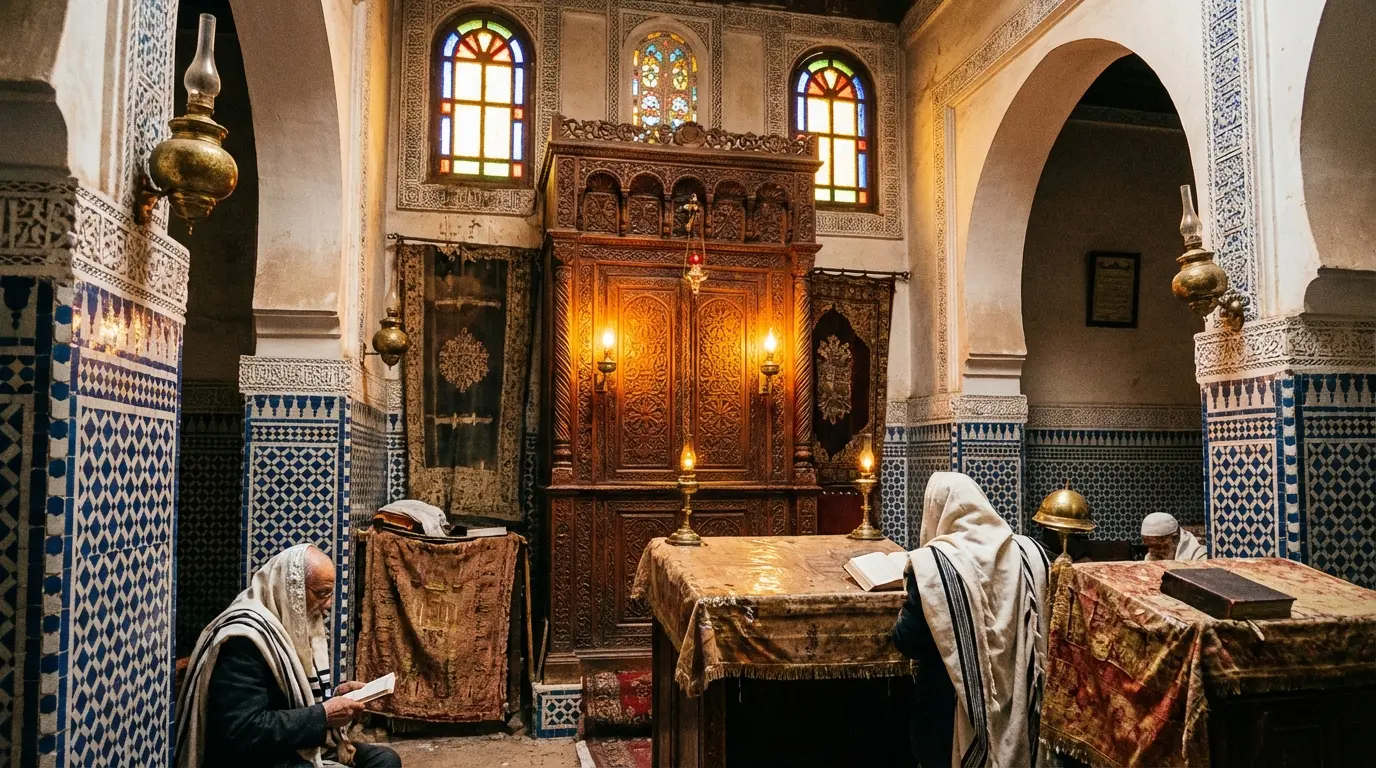
The places that carry the deepest weight, the ones that change how your community understands Morocco, are often the ones with no ticket counter, no gift shop, and no bus parking out front. They are synagogues in Berber villages. Cemeteries on hillsides with no signs pointing the way. Houses with Torah verses still carved into the doorframes, now lived in by families who have no connection to the words above their heads but who have left them there out of respect.
If you’re a group leader who has already looked at the standard Morocco itinerary and thought, “there has to be more,” you’re right. There is. And these are the sites your community will remember long after the photographs fade.
For a broader overview of Morocco’s major heritage sites, see our Morocco heritage travel guide.
Why the Real Morocco Is Rarely in Print
The guidebooks cover what is easy to find. And what is easy to find in Morocco is genuinely impressive. The medinas, the mosques, the restored mellahs, the Jewish Museum in Casablanca. All of it is worth your group’s time.
But the Jewish community in Morocco once numbered over 250,000 people, and they did not all live in Fez and Casablanca. They lived in mountain towns and river valleys, in small communities where they were sometimes the only Jewish family for miles. They built synagogues out of local stone, prayed in rooms that had no ornamentation beyond what the community could afford, and buried their dead on hillsides where the views stretched to the mountains.
When those families left, mostly in the 1950s and 1960s, their synagogues did not become museums. Some were absorbed into the neighborhood, converted into houses or workshops. Some were simply locked and left. The keys were given to a Muslim neighbor, and that neighbor’s family has sometimes kept them for sixty years.
Finding these places requires knowing where to look and who to ask. No app will lead you to them. No travel blog has mapped them out. That is where local operators make the difference. Heritage Tours works with people on the ground in Morocco who have personal connections to these communities and to the historians and families preserving their memory. It is a different kind of travel, and it asks something different of your group, but what it gives back is extraordinary.
The Dades Valley, Synagogues in the High Atlas Foothills
Tinghir and the Jewish Quarter That’s Still Standing
Tinghir is a town in the Dades Valley, east of the High Atlas Mountains. Most tourists pass through on the way to the Todra Gorge, one of Morocco’s most photographed natural sites. They do not stop in the old Jewish quarter, because most of them do not know it exists.
But it does exist. The quarter is still physically intact, with narrow streets, courtyard homes, and the remains of a synagogue. The walls are there. The layout is readable. If you stand in the right spot, you can see how the neighborhood was organized, where the communal spaces were, where families gathered.
The Jewish community of Tinghir was small but deeply rooted. Some families had been there for generations before anyone in the community had heard of Casablanca. They were not urban Jews. They were mountain Jews, living in a Berber landscape, speaking Tamazight alongside Hebrew and Judeo-Arabic, and building their religious life in a place where the nearest large Jewish community was days away by foot.
For a heritage group, Tinghir is the kind of stop that turns a good trip into a meaningful one. It is quiet. There are no crowds, no tour buses, no recorded audio guides. And the sense of something that was, that was real and daily and ordinary, is very present in the stone and the silence.
What Happened to the Jews of the Atlas Mountains
The Jewish communities of the Atlas region were among the most isolated in Morocco. They lived alongside Berber (Amazigh) communities and shared many of the same customs, language patterns, and daily rhythms. In some villages, Jewish and Berber families had been neighbors for so many generations that their traditions had blended in ways you do not see in the cities.
When Israel was established in 1948, and especially after Moroccan independence in 1956, most of these families left. Some went to Israel, where they settled in development towns and started over. Some went to France. Some went to Canada. The departure was not always voluntary in the way we think of that word. Economic pressure, political uncertainty, and organized emigration campaigns all played a role.
What they left behind was not grand. It was modest, everyday, built for function rather than display. But that is what makes it powerful. A synagogue in a Berber village is not a monument. It is evidence that people lived, prayed, and built something permanent in a place most of the world has never heard of. For heritage groups that want to understand the full scope of Jewish life in Morocco, not just the urban, cosmopolitan version, the Atlas communities are essential.
Ouarzazate, Gateway to Forgotten Jewish Morocco
The Draa Valley and Its Buried History
Ouarzazate is known to tourists as the “door of the desert” and to film fans as the location of several Hollywood productions. But for heritage travelers, the real significance of Ouarzazate is what lies south of it: the Draa Valley, one of the longest river valleys in Morocco, stretching from the Atlas Mountains toward the Sahara.
Jewish communities once dotted the entire length of the Draa. They were traders, craftspeople, silversmiths. They lived in kasbahs and small towns along the river, and they maintained synagogues, cemeteries, and communal life in places that today show almost no visible trace of their presence. Almost.
In some towns along the Draa, you can still find Jewish cemeteries. Some of them are maintained by local Muslim families who took it upon themselves to care for the graves after the Jewish community left. They were not asked to do this by any government program or religious obligation. They did it because they remembered their neighbors, and they believed the dead deserved respect regardless of faith.
That fact alone tells a story about coexistence in Morocco that is worth the trip. It is not a story you will find in a guidebook. It is a story you will hear from a local operator who knows the family that holds the cemetery key.
Heritage Tours can build a custom route from Marrakech to Ouarzazate to the Draa Valley that gives your group a journey through the deepest layer of Morocco’s Jewish story. It adds a day or two to the itinerary, and it changes the trip fundamentally.
Sefrou, the Town That Was Once Half Jewish
Sefrou is a small city about 30 kilometers from Fez. In the early 20th century, roughly half its population was Jewish. Half. That is not a minority neighborhood. That is a shared city, where Jewish and Muslim residents lived in adjacent streets, shopped in the same markets, and navigated the same civic life.
Today, the Jewish community of Sefrou is gone. But the old quarter where they lived is still there. The streets are narrow, the buildings are close together, and if you know what to look for, you can still identify the homes and communal buildings that once served the Jewish community. The architecture is different in small ways, doorway shapes, courtyard styles, window placements, that a local guide can point out.
What makes Sefrou different from the other sites on this list is scale. This was not a small community tucked into a corner of a larger city. This was a city where Jewish life was woven into every block, where the Jewish festival calendar and the Islamic calendar overlapped in the same public spaces, where coexistence was not a policy but a daily reality.
For groups with Moroccan roots, Sefrou sometimes hits harder than Fez. It is less polished, less prepared for visitors, and more personal. There is something about standing in a town where half the population was once Jewish, and realizing that not a single Jewish resident remains, that communicates loss in a way that a museum cannot.
For more on the Sephardic story across Morocco, see our full guide to Jewish heritage in Morocco.
The Jewish Cemeteries Nobody Books Into Tours
Reading a Moroccan Jewish Cemetery, What the Stones Say
Jewish cemeteries in Morocco are not like cemeteries in America. They are often whitewashed, open to the sky, and organized by family rather than by date. The headstones are sometimes simple, sometimes engraved with symbols and Hebrew text that tell you the person’s lineage, their community standing, and their tribal identity.
In some cemeteries, the stones carry blessings. In others, they carry warnings, entreaties to the living to remember and to pray. Reading these inscriptions, if someone in your group can read Hebrew, adds a layer to the visit that no tour guide narration can match. The dead are speaking directly to you. They are asking to be remembered.
For groups with Moroccan ancestry, visiting a cemetery is often the most emotional stop on the trip. Some families have been able to find the graves of great-grandparents they only knew from stories told at Shabbat tables. They stand there and read the name and the dates and they understand, in a way they could not have understood from a distance, that their family was here. That this was real.
Even for groups without direct family connections, the cemeteries are powerful. They are physical proof of how deep Jewish life went in this country, how many generations it spanned, and how much was left behind when the communities departed.
You can find Jewish cemeteries in Fez, Meknes, Marrakech, Essaouira, and scattered through the Atlas region and the Draa Valley. Most of them are not fenced or guarded in any formal way. Some require a local contact to open the gate. Heritage Tours’ network of local operators knows how to arrange access respectfully and reliably, and how to give your group the time and space to be present in these places without rushing.
What Makes These Sites Different for a Heritage Group
When you visit the Fez mellah or the Casablanca museum, you are visiting a site that has been prepared for visitors. It is maintained, interpreted, and accessible. That is valuable, and those sites deserve their place on every heritage itinerary.
But when you visit a synagogue in Tinghir or a cemetery in the Draa Valley, you are visiting something that has not been prepared for you. It is simply there, the way it was left. No explanatory plaques, no recorded narration, no curated pathway. And there is something about that rawness, that absence of interpretation, that makes a heritage group go quiet in a way that no museum can achieve.
These are the moments that group leaders tell us about years later. Not the Hassan II Mosque, as extraordinary as it is. Not the spice market in Marrakech, as vivid as it is. The moment when the group stood in a village synagogue and realized that this was a real place, where real people came to pray every Shabbat, and then one day they were gone.
That kind of moment cannot be manufactured. But it can be found, if you know where to look.
How Heritage Tours Finds What Others Miss
We do not find these sites on the internet. We find them through relationships. Dina Aharon has spent years building connections with Moroccan Jewish community leaders, local historians, preservation advocates, and the ground operators who know these towns and valleys personally. Some of these relationships go back decades. Some of them were built by traveling to a town, knocking on doors, and asking who remembers.
When you work with Heritage Tours, your itinerary can include a stop in the Dades Valley or a cemetery visit in a town that has no tourism infrastructure at all. We build it in as a scheduled stop, not a last-minute detour. Your group arrives with context, with a local contact who can open gates and tell stories, and with enough time to absorb what they are seeing without watching the clock.
If you are planning a Morocco heritage trip and want your group to go deeper than the standard route, we would be glad to talk about what is possible. Every community’s trip looks different, and that is exactly how it should be. The sites that will matter most to your group may not be the ones with the biggest names. They may be the ones with no name at all, just a locked gate and a neighbor with a key.
Frequently Asked Questions
Are there Jewish heritage sites outside Fez and Casablanca in Morocco?
Yes, many. Jewish communities once existed across Morocco, from the Atlas Mountains to the edge of the Sahara. Towns like Tinghir, Ouarzazate, Sefrou, and communities throughout the Dades and Draa Valleys all have surviving Jewish sites, including synagogues, cemeteries, and residential quarters. Most of these are not included on standard tour routes and require local contacts to access.
What is the Dades Valley known for in Jewish history?
The Dades Valley, in the foothills of the High Atlas, was home to small, deeply rooted Jewish communities that lived alongside Berber populations for centuries. Synagogues and Jewish quarters in towns like Tinghir are still physically standing, though the communities themselves left in the mid-20th century. The valley represents the rural, mountain dimension of Moroccan Jewish life that most visitors never encounter.
Can you visit Jewish cemeteries in rural Morocco?
Yes, though many require a local contact to arrange access. Jewish cemeteries exist in major cities like Fez, Meknes, and Marrakech, as well as in smaller towns throughout the Atlas region and the Draa Valley. Some are maintained by local Muslim families who have cared for the graves for decades. Heritage Tours works with local operators who can arrange respectful visits with adequate time for your group.
What is left of the Jewish community in Sefrou, Morocco?
The Jewish community of Sefrou, which once made up roughly half the town’s population, has entirely departed. However, the old Jewish quarter remains physically intact, with identifiable homes, communal buildings, and streets. The architecture still carries markers of Jewish residential patterns that a knowledgeable guide can point out. It is one of the most striking examples of Jewish-Muslim coexistence, and subsequent departure, in Morocco’s history.
How do heritage tour operators find sites not in guidebooks?
Through personal relationships with local historians, Jewish community leaders, preservation organizations, and ground operators who have spent years building trust in these communities. These are not sites that appear on travel websites or in tour databases. Finding them requires local knowledge, direct connections, and the patience to build relationships over time. Heritage Tours’ network in Morocco has been developed over years of on-the-ground work.