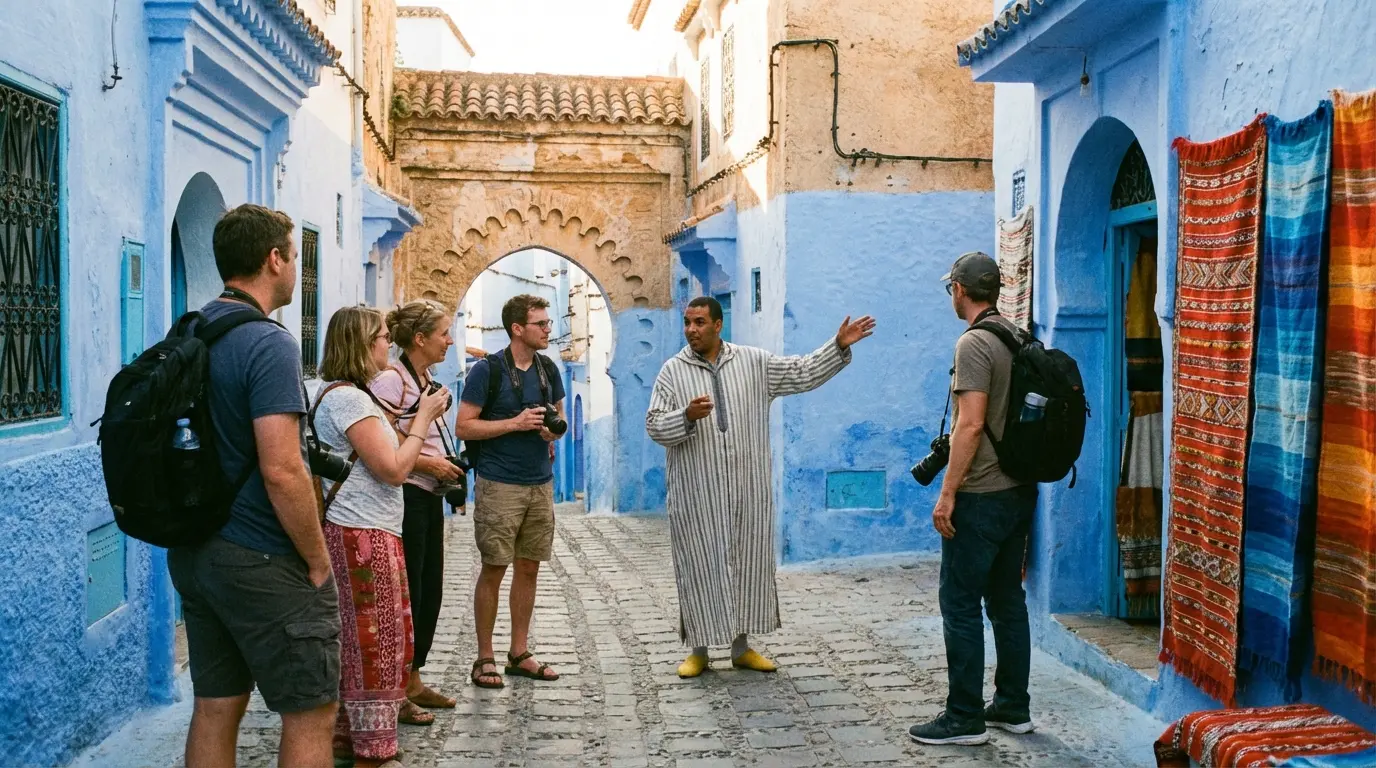
You have been thinking about Morocco. Maybe someone in your congregation mentioned their family roots there. Maybe you came across the history of the Sephardic community and thought, “My people need to see this.” Maybe another group leader told you about a trip that changed their community’s sense of connection, and you want to understand what that could look like for yours.
Whatever brought you here, this guide is for you. Not for the solo traveler scrolling through flight deals. For you, the rabbi or pastor who is going to stand in front of a budget committee and explain why Morocco matters. The one who will recruit 15 or 20 or 40 people and be responsible for what they experience when they get there. The one reading this at 9pm after a full week, wondering if this trip is worth the effort.
It is. Here is everything you need to know to make it happen.
Why Morocco Is Worth Bringing Your Community
Morocco holds over a thousand years of Jewish, Muslim, and Christian history in its streets, and that history is not behind glass. The synagogues of Fez and Marrakech are still standing, their tilework and carved wood intact. The mellahs (Jewish quarters) are physically preserved, their narrow streets still carrying the shape of communities that lived there for centuries. The cemeteries hold generations of headstones with Hebrew inscriptions that your community members can read aloud.
For Jewish groups, especially those with Sephardic ancestry, Morocco is a roots trip. It is the place where their families lived before they became American or Israeli or French. For Christian groups, Morocco offers an interfaith dimension that is rare and genuine, a country where Judaism and Islam coexisted for over a thousand years, with stories and physical evidence that give those conversations real grounding.
This is not a beach destination, not an adventure trip, and not a cultural sampler. It is a heritage journey, and it deserves to be presented that way to your community. The people you bring will come back different. That is not something you can say about every trip.
For a full overview of what Morocco offers heritage travelers, see our Morocco heritage travel guide.
The Free Leader Program, What It Means for Your Budget
How the 15-Participant Threshold Works
When your group reaches 15 confirmed, paying participants, you as the group leader travel free. That means your flights, hotels, and ground transportation are covered. You do not need to fundraise for your own spot, ask the congregation to add a line item to the budget, or explain to the finance committee why the rabbi’s trip should come out of operating funds.
This is the single most important detail for many group leaders, because it answers the question that your treasurer, your board chair, or your vestry will ask first: “Who’s paying for the rabbi’s trip?” or “How do we cover the pastor’s expenses?”
The answer: nobody has to. At 15 participants, it is included in the program. You can tell your budget committee that with a straight face and a clear number.
What “Free” Actually Covers
The free leader program covers flights, hotel accommodations, and all ground transportation during the trip. It is the same package your participants receive. You are not getting a downgraded version or a separate tier. You are traveling with your group, staying where they stay, eating where they eat, seeing what they see.
If your group grows beyond 15, the program still applies. The threshold is 15 to activate it, and it holds regardless of how large the group gets. Whether you bring 15 or 50, the leader’s spot is covered.
For some group leaders, this is the detail that makes the trip possible. Not just financially, but politically. It removes the most common objection before it can be raised.
How to Frame Morocco for Your Community
For Jewish Groups, the Sephardic Roots Conversation
If your congregation includes families with Moroccan ancestry, the conversation is straightforward. “We’re going to the place where your grandparents were born. We’re going to walk the streets they walked, visit the synagogues where they prayed, and stand at the cemeteries where your great-grandparents are buried.” That is a sentence that moves people. It does not need embellishment.
If your community does not have direct Moroccan roots, the framing is different but still powerful. Morocco was home to one of the largest Sephardic communities in the world for over 500 years. For any Jewish group studying Sephardic history, the diaspora experience, Israel-diaspora connections, or interfaith coexistence, Morocco is essential. It tells a part of the Jewish story that Ashkenazi-centered education often overlooks, and your community will be richer for knowing it.
The Jewish heritage in Morocco guide gives you the historical and emotional context to share with your community when you present the trip. Use it as preparation material for your informational meeting.
For Christian Groups, the Interfaith and Biblical Connection
Morocco offers Christian groups something that is hard to find elsewhere: a living, physical example of Jewish-Muslim coexistence over centuries. For congregations that have already led church group trips to Israel and are looking for the next meaningful destination, Morocco provides depth and nuance that extends the Israel experience.
The interfaith story is real here. King Mohammed V’s protection of Morocco’s Jews during WWII is one of the most powerful stories of interfaith solidarity in modern history. For Christian communities interested in justice, coexistence, and the shared roots of the Abrahamic faiths, Morocco provides not just stories but places where those stories happened. Your group will stand in synagogues and mosques in the same city, sometimes on the same street, and the conversations that come out of that experience are the kind that change how people think.
Building Your Group, Recruitment, Deposits, and Timeline
How Far in Advance Should You Start?
Start talking about the trip at least nine to twelve months before your target departure date. You need time to generate interest, answer questions, collect deposits, and give Heritage Tours enough lead time to build your custom itinerary and secure the best accommodations.
Here is a rough timeline that works for most groups:
12 months out: Announce the trip to your community. Share why Morocco matters. Gauge interest with a brief survey or sign-up sheet. Do not collect money yet, just names and email addresses.
9 months out: Hold an informational meeting, in person or on Zoom. Present the itinerary outline, estimated cost per person, and the free leader program. Answer questions. Begin collecting deposits from committed participants.
6 months out: Confirm your participant count. Finalize itinerary details with Heritage Tours. Book group flights or coordinate individual bookings. Send your group background reading materials about Morocco’s heritage.
3 months out: Pre-trip preparation meetings. Share practical information (what to pack, cultural norms, dietary options, weather). Discuss what to expect emotionally, because heritage trips can be intense. Build anticipation without overpromising.
1 month out: Final logistics review. Confirm all participant details. Share the detailed daily itinerary. Address last-minute questions.
What to Tell People Who’ve Never Considered Morocco
Many community members will not have Morocco on their radar. That is normal and expected. Most people do not think of Morocco as a heritage destination until someone they trust tells them why it is. You are that person.
Your job is not to sell the trip. It is to share the story. Tell them about the mellahs, the Jewish quarters where entire communities lived for centuries. Tell them about the synagogues that are still standing, their blue tilework and carved wood still intact. Tell them that there are Jewish cemeteries in Morocco where families have found their great-grandparents’ graves after decades of not knowing where they were buried. Tell them about the king who protected his Jewish citizens during WWII when no one would have blamed him for looking the other way.
The story does the work. You just need to tell it honestly, and people will come.
One practical tip: identify two or three “early adopters” in your community, people who are naturally enthusiastic about heritage and travel, and get them on board early. Their excitement will recruit more effectively than any flyer or email blast.
What Heritage Tours Handles (And What You Don’t Have to)
Hotel Pickup and Dropoff
Every day of the trip, your group is picked up from the hotel and brought to the day’s sites. At the end of the day, they are brought back. You are not coordinating taxis. You are not standing on a corner in Fez with 20 people trying to figure out which direction to walk. You are not navigating public transportation in a country where many of your group members do not speak the language.
This sounds simple, and it is. That is the point. The less time you spend on ground transportation, the more time your group spends at the sites that matter. And the less stressed you are as a leader, the more present you can be for the moments that your community will remember.
Custom Itinerary Building
Heritage Tours does not hand you a fixed package with set dates and a predetermined route. We build the itinerary around your community. That conversation starts with a simple question: What matters most to your group?
If your group has Moroccan roots and wants to visit a specific town where their families lived, we build it in. If your Christian group wants to focus on the interfaith story and the coexistence narrative, we adjust the emphasis and the site selection. If you want to combine Morocco with Israel for a broader Sephardic journey, we design a combined itinerary that tells the full story.
You tell us what your community needs. We figure out how to make it work on the ground.
Local Operators Who Know the Sites
We work with operators on the ground in Morocco who know the heritage sites personally. They know which synagogues are open and when. They know which cemeteries require a local contact to access the gate. They know which routes through the medinas avoid the tourist bottlenecks and which local historians can add depth to a site visit.
These operators are not reading from a script or repeating what they learned in a training seminar. They have been doing this for years. They have relationships with the caretakers, the community leaders, and the families who maintain these sites. That local knowledge adds a layer to your group’s experience that no amount of pre-trip reading can replace.
For your group, that means the difference between visiting a site and understanding a site. And for you as a leader, it means having a knowledgeable partner on the ground who can handle the things you should not have to think about.
Common Questions Group Leaders Ask Before They Commit
“What if I can’t get to 15 participants?” Start with your most engaged members and build from there. Share the story of Morocco, not just the itinerary, and let it do the recruiting. Most groups that announce the trip with conviction and give their community the historical context reach 15 without difficulty. If you are concerned, talk to us early. We can help with recruitment materials and framing strategies.
“Is Morocco safe for a group?” Morocco is one of the safest countries in North Africa for tourism, and heritage groups travel there regularly. Our local operators know the ground conditions, the neighborhoods, and the current situation. Hotel pickup and dropoff means your group is never navigating unfamiliar areas on their own. Heritage Tours has been sending groups to Morocco for years, and safety is built into every itinerary.
“How much does it cost per person?” Cost varies depending on the itinerary, time of year, hotel category, and group size. Larger groups generally get better per-person rates. Contact us for a specific estimate based on your community’s needs and preferences. The free leader program at 15 participants helps the overall budget by eliminating the leader’s travel costs.
“Can we combine Morocco with another destination?” Yes. Many groups combine Morocco with Israel, especially Jewish groups tracing the Sephardic path from Spain to Morocco to the Holy Land. We build combined itineraries regularly and can advise on the best sequencing and timing for a multi-destination trip.
“What about dietary needs?” Morocco has a long history of kosher food, and the Jewish community in Casablanca still supports kosher options. In other cities, many restaurants can accommodate specific dietary requirements with advance notice. Heritage Tours works with local operators to arrange meals that meet your group’s dietary needs, whether kosher, halal, vegetarian, or other requirements. We handle this as part of the itinerary planning so you do not need to research it yourself.
“What about mobility issues?” Morocco’s medinas involve walking, and some sections have uneven terrain, stairs, and narrow passages. Heritage Tours can adjust itineraries to accommodate mobility needs, including modified routes and vehicle access where possible. Let us know about any accessibility requirements during the planning phase and we will build the itinerary accordingly.
Your Next Step
If you have read this far, you are serious about bringing your community to Morocco. The next step is simple: reach out and start a conversation. There is no commitment required, no deposit, and no obligation. We will talk through your community’s interests, your calendar, your budget considerations, and what the trip could look like.
Every group’s journey is different. A synagogue community tracing Sephardic roots needs a different trip than a church group exploring interfaith history, and both need a different trip than a multi-faith community traveling together. That is exactly how it should be. We are here to build the trip that fits your people. If you want a broader planning framework before you start, our complete guide for group leaders walks through organizing a group pilgrimage from the first announcement to departure day.
When you are ready, we are ready. And if you are not ready yet, bookmark this page and come back when the time is right. Morocco will be there.
Frequently Asked Questions
How does the free group leader program work for Morocco tours?
When your group reaches 15 confirmed, paying participants, the group leader’s full trip is covered, including flights, hotels, and ground transportation. This applies to rabbis, pastors, and community leaders organizing the trip. The threshold is 15 participants, and the program holds regardless of group size beyond that number. The leader receives the same travel package as the participants.
How many participants do you need to qualify for a free leader spot?
Fifteen confirmed, paying participants. Once the group reaches that number, the leader’s travel costs are fully covered. There is no upper limit. Whether your group is 15 or 50, the program applies.
What is the best way to recruit community members for a heritage trip to Morocco?
Start early, at least nine to twelve months before departure. Share the story of Morocco’s heritage, not just the itinerary and the price. Hold an informational meeting where you present the historical and spiritual significance of the trip. Identify a few enthusiastic early adopters and get them committed first. Their personal enthusiasm will recruit more effectively than email blasts. Heritage Tours can provide materials to support your recruitment efforts.
Does Heritage Tours offer hotel pickup and dropoff in Morocco?
Yes. Hotel pickup and dropoff is included every day of the trip. Your group is collected from the hotel each morning and returned each evening. This is standard for all Heritage Tours group trips in Morocco, and it eliminates the need for your group to arrange local transportation.
Can Morocco work for both Jewish and Christian heritage groups?
Absolutely. Jewish groups connect with Morocco’s Sephardic history, synagogues, mellahs, and ancestral cemeteries. Christian groups engage with the interfaith coexistence story, Islamic sacred architecture, and the broader Abrahamic narrative. Heritage Tours builds custom itineraries for both, adjusting the site selection and narrative emphasis based on your community’s identity and interests. Multi-faith groups are also welcome and travel well in Morocco.