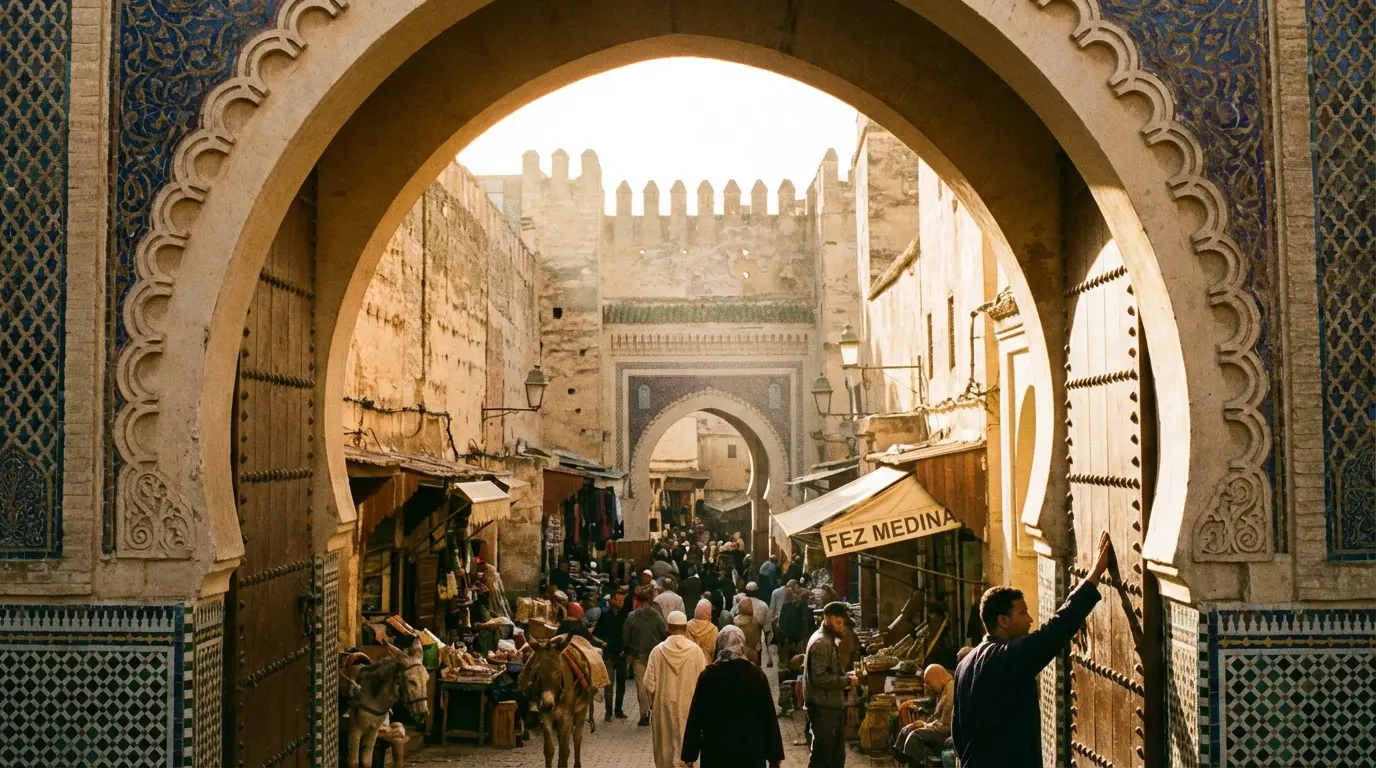
If you’ve never been to Morocco, here’s what I want you to know before you land. It will be louder than you expect. More beautiful than you imagined. And by day three, you’ll wonder why it took you this long to come.
I’ve been bringing first-time heritage travelers to Morocco for over forty years. Some come because they have Moroccan Jewish ancestry and want to see where their family lived. Some come because their pastor organized a trip and they trust the community enough to say yes. Some come because they read about the Fez mellah and couldn’t stop thinking about it.
Whatever brought you here, this guide is the conversation I’d have with you over coffee before you packed your bag.
What Morocco Will Feel Like on Day One
The Medina: Organized Chaos That Becomes Beautiful
A medina is not a shopping mall with old walls. It’s a living neighborhood where people live, work, cook, sell, argue, and pray, all in narrow streets that twist and dead-end without warning.
The first time your group walks into a medina, they’ll hear vendors calling, smell spices and leather and bread baking, see donkeys carrying goods through alleys barely wider than their shoulders. It’s a lot. And that’s normal.
By the second day, the medina makes sense. The noise becomes a rhythm. The alleys feel less random. Your group will start to see the beauty in the chaos, the way light falls through carved lattice screens, the way a mosque’s entrance opens suddenly from a narrow passage.
Tell your group what to expect before they arrive. It removes the shock and lets them get to the wonder faster.
The Hospitality: It’s Real, Not a Performance
Moroccans will offer your group mint tea. They’ll ask where you’re from. They’ll want to talk. This is not a sales tactic. Moroccan hospitality is genuine and deeply rooted in the culture. Accept the tea. Sit down. Let the conversation happen.
For groups accustomed to tourist environments where every interaction is transactional, Morocco’s warmth can be disorienting. It shouldn’t be. It’s one of the best parts of the trip.
What Faith Travelers Should Know Before They Arrive
Understanding Islamic Culture as a Guest
Morocco is a Muslim-majority country, and the rhythm of daily life reflects that. The call to prayer sounds five times a day. Ramadan changes the pace of the entire country. Friday is the holy day.
For non-Muslim visitors, none of this requires anything except awareness and respect. Don’t eat visibly during Ramadan daytime hours in public. Dress modestly when visiting sacred sites. Ask before photographing people at prayer.
Your group isn’t expected to participate. They’re expected to be respectful guests. That’s a standard most faith communities already understand.
What Jewish Travelers Should Prepare Emotionally
If someone in your group has Moroccan Jewish ancestry, this trip may carry more weight than they anticipated. Standing in the mellah where their family once lived, visiting a cemetery where relatives may be buried, seeing the doorways with mezuzah marks still in the stone. These moments can be overwhelming.
I’ve seen travelers break down in the Fez mellah. I’ve watched people touch the walls of a synagogue and go quiet for a long time. This isn’t a bad thing. It’s the trip doing what it was meant to do.
As a group leader, give space for these reactions. Don’t rush through the Jewish heritage sites on a tight schedule. Some moments need room.
Christian Travelers: What Morocco Offers Your Faith Journey
Christian groups often arrive in Morocco not knowing what the country holds for them. The answer is more than you’d think. Volubilis has Roman-era Christian basilica ruins. The relationship between early Christianity and North Africa is deep. And the experience of witnessing Islamic faith practice up close, the devotion, the architecture, the community prayer, gives Christian travelers a broader view of the Abrahamic tradition they belong to.
Morocco won’t challenge your faith. It will expand your understanding of it.
Practical Orientation
Language (Arabic, Berber, French, and English)
Morocco’s official languages are Arabic and Berber. French is widely spoken, especially in cities. English is increasingly common in tourist areas but less so in smaller towns and rural regions.
Your Heritage Tours guide speaks the languages you’ll need. For your group, a few words in Arabic go a long way. “Shukran” (thank you) and “Salam” (hello) are enough to show respect and often open doors.
Currency, Tipping, and Markets
Morocco uses the dirham. ATMs are widely available in cities. Credit cards work in hotels and larger shops but not in medinas or smaller establishments.
Tipping is customary. Small tips (10 to 20 dirhams) for porters, restaurant servers, and local guides at individual sites are appreciated. Heritage Tours can brief your group on appropriate amounts before each situation.
Markets operate on negotiation. Prices are rarely fixed. If your group members want to shop, the guide can help them understand fair pricing. Nobody needs to feel taken advantage of.
Dress Code and Sacred Spaces
Morocco is not strict about dress code for tourists, but modesty matters at sacred sites. For women, shoulders and knees should be covered. A scarf for head covering is helpful when visiting mosques and some synagogues. Men should avoid shorts at religious sites.
Outside of sacred spaces, Moroccan cities are cosmopolitan. Casablanca and Rabat are modern and relaxed. Marrakech is lively. Your group can dress comfortably while being respectful.
What’s Different About Coming with a Group vs. Solo
Why Group Travel Is Actually Easier in Morocco
Morocco’s medinas don’t have street addresses in the way your group is used to. Navigating between cities requires planning. Coordinating meals, hotel check-ins, and site access for 25 people is real work.
When you travel with a group through Heritage Tours, all of that is handled. Hotel pickup and dropoff at every city transition. A guide who knows every unlocked entrance and every schedule change. Meals arranged at places that can actually seat your group.
For a group leader, this matters. You shouldn’t be figuring out restaurant capacity in Fez while your community waits on a street corner. Our private vs. group comparison goes deeper into how the two formats differ.
What Heritage Tours Handles That You Don’t Have To
Transfers between every city. Hotel arrangements. Site access and scheduling. Local guide coordination. Restaurant bookings. The things that make or break a group trip in Morocco are exactly the things our local operators manage daily.
Your job as a group leader is to lead the experience. Our job is to make the experience possible. Our 10-day Morocco itinerary shows what the structure looks like day by day.
Managing Your Community’s Expectations
It Won’t Look Like Israel or Europe
If your group has traveled to Israel or European heritage sites, Morocco will feel different. The infrastructure is different. The sensory intensity is different. The pace is different.
There are no velvet ropes at heritage sites. Synagogues may require a local caretaker to open the door. Streets are not always clean. The medina doesn’t have air conditioning.
That’s Exactly Why It’s Worth It
Morocco’s heritage isn’t packaged. It’s real. The synagogues feel like synagogues, not museums. The sacred sites are embedded in living neighborhoods, not fenced off with entry tickets. That rawness is what makes the experience genuine.
Tell your group: This trip will ask a little more of you. You’ll be less comfortable than in a European city. And you’ll remember it more deeply because of that.
The Question First-Timers Always Ask (And the Honest Answer)
Is Morocco Safe?
Yes. Morocco is safe for heritage group travelers.
Morocco has a strong security infrastructure and a long history of welcoming tourism. The country has made significant investments in traveler safety, and group travel with a professional operator adds another layer of structure.
I’ve been bringing groups to Morocco for decades. In that time, the standard precautions are the same ones you’d take in any major international city: stay with your group, keep valuables secure, follow your guide’s advice in the medina.
Heritage Tours’ local operators know the terrain. They know which routes work for groups, when to avoid crowded areas, and how to move 25 people through a medina without anyone getting separated.
The honest answer is this: your community is safe in Morocco, and they will feel welcome.
If you’re considering Morocco for your group’s next heritage trip and want to talk through what the experience looks like, reach out through our group tour page. No pressure, just a conversation about whether this trip is right for your community.
Frequently Asked Questions
Is Morocco safe for a first-time heritage traveler? Yes. Morocco has strong security infrastructure and a well-established tourism industry. Heritage group travelers are further supported by local operators who manage navigation, site access, and group movement. Standard precautions, staying with the group, securing valuables, and following guide instructions, are all that’s needed.
What should I know before visiting Morocco for the first time? Expect sensory intensity, especially in the medinas. Moroccan hospitality is genuine and generous. The country runs on Arabic, Berber, and French, with growing English in tourist areas. Dress modestly at sacred sites. Carry dirhams for smaller shops and tips. And give yourself permission to be surprised.
What language is spoken in Morocco? Arabic and Berber are the official languages. French is widely spoken in cities and business settings. English is increasingly common in tourist areas but less reliable in rural regions. Your Heritage Tours guide handles all language needs, but learning a few Arabic words like “shukran” (thank you) and “salam” (hello) is appreciated.
What is a medina and what should I expect as a first-time visitor? A medina is a historic walled city center with narrow, winding streets. It’s a living neighborhood where people reside, work, shop, and worship. First-time visitors should expect noise, crowds, strong smells (spices, leather, food), and tight passageways. It can be overwhelming on day one but becomes beautiful and navigable quickly. Heritage Tours guides know every turn.
How do I dress appropriately when visiting sacred sites in Morocco? Cover shoulders and knees at all religious sites, both mosques and synagogues. Women should carry a scarf for head covering when entering mosques. Men should avoid shorts at sacred sites. Outside of religious spaces, Moroccan cities are cosmopolitan, and comfortable modest clothing is perfectly fine.