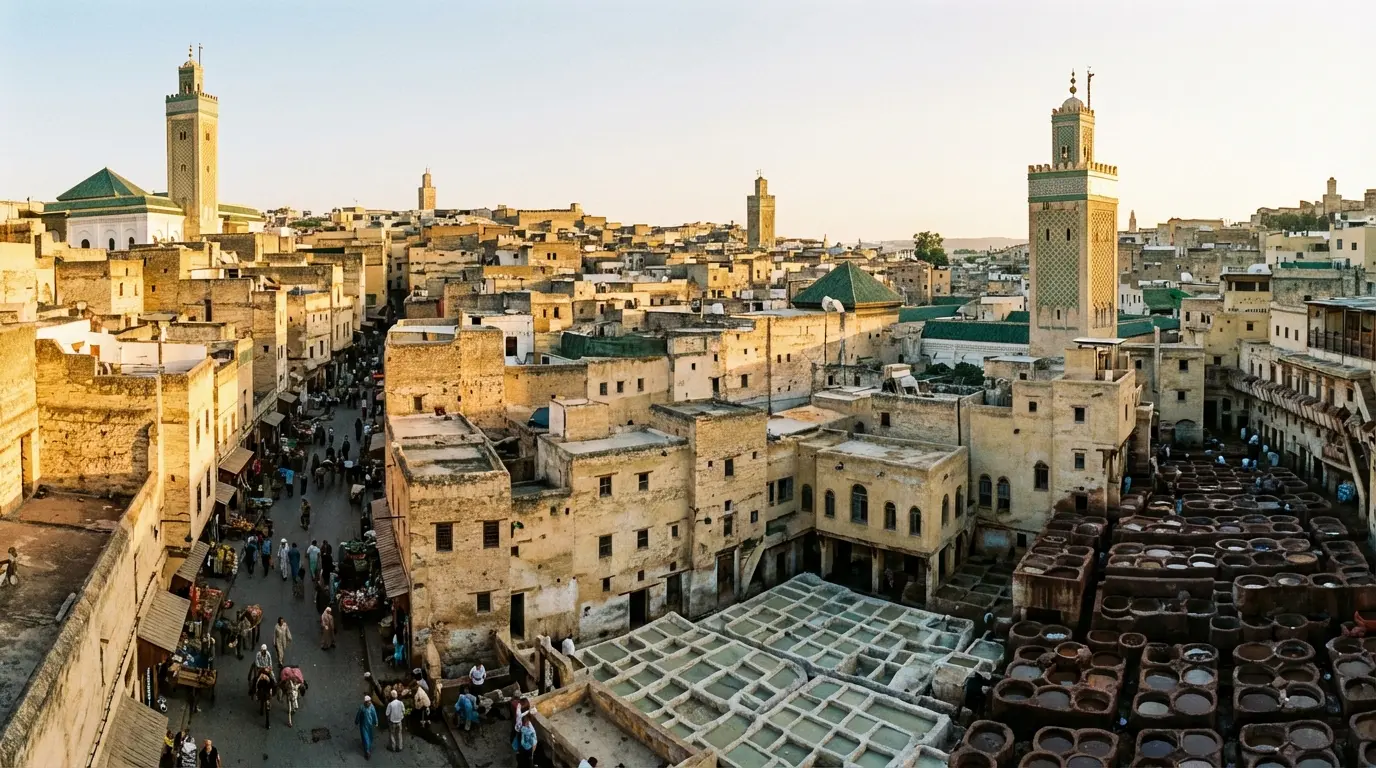
Morocco is not a place you visit for the weather or the food, though both are wonderful. You go to Morocco because something in your community’s story started there. For many Jewish families, Morocco is where their grandparents prayed, married, raised children, and eventually said goodbye. For Christian groups, it’s a place where Islam and Christianity sat side by side for centuries, and you can still feel the imprint of both faiths pressed into the walls and the streets.
If you’re a rabbi or pastor considering this trip for your community, you probably have questions. What is there to see? What will your community actually experience? Is Morocco genuinely a heritage destination, or is it more of a cultural curiosity? This guide answers those questions directly, because the people sitting in your pews or your shul deserve a trip that means something.
Why Morocco Belongs on a Heritage Journey
A Country Where Three Faiths Left Their Mark
Morocco holds over a thousand years of Jewish, Muslim, and Christian history in its walls, literally. In Fez, a medieval synagogue sits a few hundred meters from one of the world’s oldest universities, a center of Islamic scholarship founded in 859 CE. In Casablanca, the Jewish Museum and the Hassan II Mosque share the same city skyline, two expressions of faith standing in the same modern city.
This is not a history lesson from a textbook. When your community walks through the mellah (the Jewish quarter) of Fez, or stands inside a restored synagogue in Marrakech, the connection between faiths is not theoretical. It is built into the architecture, the street names, the cemeteries. In some neighborhoods, the synagogue and the mosque share an alley. That physical proximity tells a story that no lecture can match.
For group leaders, this matters because it gives the trip a narrative your community can hold onto. It is not just “look at this old building.” It is “this is where our people lived, and this is how they lived alongside their neighbors.” That’s the kind of story that travels home with your group and shapes conversations for months afterward.
Morocco’s religious diversity is not an abstract concept either. The country’s constitution recognizes its Jewish heritage as a core part of national identity. Synagogues have been restored with government support. Jewish cemeteries are maintained. This is a country that has chosen to honor its Jewish past, and your community will feel that intentionality when they visit.
Morocco as an Extension of an Israel or Jordan Trip
Many of our groups combine Morocco with Israel. The connection is natural, especially for Jewish communities with Sephardic roots. The families who left Spain in 1492 did not all go to the same place. Some went to the Ottoman Empire, some to Italy, and a large number went to Morocco. Tracing that path, from Jerusalem to Fez, gives your group a fuller picture of the Sephardic story than either destination can tell on its own.
For groups that have already done Israel, Morocco adds a dimension that deepens everything they experienced there. The Western Wall becomes more meaningful when you understand that the families who prayed there also prayed in Moroccan synagogues for centuries before arriving. The Sephardic story is not just a chapter in Jewish history. For many families, it is the whole book.
For Christian groups, Morocco adds an interfaith dimension that deepens an Israel trip in a different way. You go from walking where Jesus walked to standing in a country where Jewish and Muslim communities coexisted for centuries. That’s a conversation worth having with your congregation, and Morocco gives you the physical evidence to ground it in reality rather than theory.
Jewish Heritage Sites You Need to Know
The Mellah of Fez, the Oldest Jewish Quarter in Africa
The Fez mellah was established in 1438. At its peak, it was home to tens of thousands of Jewish residents who built synagogues, schools, workshops, and homes within its walls. The mellah was a self-contained neighborhood, with its own markets, its own rhythms, and its own communal life.
Today, the mellah is quieter. Most of the Jewish families left in the 1950s and 1960s, many to Israel, some to France and Canada. But the Ibn Danan Synagogue has been carefully restored and is open to visitors, and the streets themselves still carry the physical imprint of Jewish life. The doorways, the courtyard layouts, the narrow alleys designed for foot traffic, all of it remains.
Walking through the Fez mellah with a group is a different experience than walking through it alone. There’s a shared silence that settles when your community realizes they’re standing in the place where an entire way of life once thrived. That silence is not empty. It is full of recognition. And for the group leader, that is the kind of moment you brought your people here to have.
For a deeper look at Jewish sites across Morocco, including places most tours never visit, see our full guide to Jewish heritage in Morocco.
Casablanca’s Beth El Synagogue and Jewish Museum
Casablanca is home to the only Jewish museum in the Arab world. The Museum of Moroccan Judaism tells the story of Jewish life in Morocco through photographs, Torah scrolls, textiles, and everyday objects. It is not a large museum, but it is honest, and it treats the Jewish story in Morocco with the weight it deserves. The curators are not trying to impress you. They are trying to tell the truth, and they do it well.
Beth El Synagogue, also in Casablanca, is still active. Services are still held there. Visiting a living synagogue, one that still holds services and still serves a community, changes the tone of a heritage trip. It tells your community that this story is not only in the past tense. There are Jews in Morocco today, fewer than 2,000, but present, and their synagogue is not a museum piece. It is a place of prayer.
For Jewish groups, Beth El can be an emotional stop. For Christian groups, it is a window into living Judaism in a Muslim-majority country, something many American Christians have never witnessed firsthand.
Marrakech’s Mellah and the Lazama Synagogue
The Marrakech mellah is busier and more commercial than the one in Fez, surrounded by the noise and color of the souk. But the Lazama Synagogue, tucked inside the quarter, is one of the most beautiful in Morocco. The blue-and-white tile work, the carved wood, the quiet inner courtyard that feels like stepping into another century. It is a place that invites you to slow down, even when the city outside is doing the opposite.
For groups, Marrakech offers a contrast to Fez. The mellah here sits inside one of the most vibrant market cities in the world, and that juxtaposition of sacred space inside a marketplace is something your community will talk about long after the trip. It raises questions worth discussing as a group: What does it mean to maintain a place of prayer in the middle of commercial life? How did the Jewish community hold onto its identity in a city this loud and this alive?
Meknes Jewish Cemetery, Where Generations Are Buried
Meknes is not on every Morocco itinerary, but it should be on yours. The Jewish cemetery in Meknes holds generations of headstones, some dating back centuries, whitewashed under open sky. For families with Moroccan roots, this is often the most personal stop on the trip. Some families have found the graves of great-grandparents they knew only from stories. That is not sightseeing. That is something else entirely.
For groups without direct Moroccan ancestry, the Meknes cemetery is still powerful. The sheer number of graves, the Hebrew inscriptions, the family names, all of it makes the scale of Jewish life in Morocco real in a way that statistics cannot. Your community will stand there and understand, viscerally, that a quarter of a million Jews once called this country home.
Islamic Sacred Sites Worth Understanding
The Fez Medina (UNESCO), a Living Medieval City
The Fez medina is a UNESCO World Heritage Site and the largest car-free urban area in the world. It is not a museum. People live and work there today, just as they did 1,200 years ago. The tanneries, the mosques, the schools of Islamic law, the narrow alleys where you have to press against the wall to let a donkey pass. It is an experience in sensory overload, but a rewarding one that your group will not forget.
For heritage groups, the medina is more than architecture. It is a living example of how a city organized itself around faith, commerce, and community for over a millennium. The University of al-Qarawiyyin, founded in 859 CE, is the oldest continuously operating degree-granting university in the world. Your group will walk past it.
Your group will need a local guide here, and a good one. Heritage Tours works with operators in Morocco who know these streets by heart, who can navigate the medina without GPS, and who can tell your group the stories behind the doors and the alleys.
Hassan II Mosque, What Faith Travelers Should Know
The Hassan II Mosque in Casablanca is one of the largest mosques in the world and one of the few in Morocco open to non-Muslim visitors. For a faith-based group, this is not just an architectural stop. It’s an opportunity to talk about what Islam and your own tradition share, and where they differ. The mosque sits on the edge of the Atlantic, built partly over the water, and the scale of it is genuinely extraordinary.
The guided tours are well done and respectful. For groups that have spent time in the mellahs and synagogues, visiting Hassan II creates a fuller picture of Morocco’s spiritual landscape. Your community experiences both sides of a centuries-long conversation between faiths, and they experience it not through reading, but through standing in the spaces where that conversation took place.
What Group Leaders Need to Know Before They Book
The Free Leader Program, How It Works
When your group reaches 15 confirmed participants, you as the group leader travel free. That includes flights, hotels, and ground transportation. For a rabbi or pastor who needs to justify the trip to a budget committee or a board of directors, this detail matters more than almost anything else on this page.
You are not asking your community to fund your travel. You are not dipping into the discretionary budget. The program covers it at 15 participants. That’s the threshold, and it’s straightforward.
This is one of the most common questions we get from group leaders in the early planning stages, and the answer is always the same. Fifteen participants, and you’re covered. For more detail on the full planning process, read our guide for pastors and rabbis.
Hotel Pickup, Custom Itineraries, and Local Operators
Heritage Tours does not hand you a fixed itinerary and a departure date. We build the trip around your community’s interests, your calendar, and the sites that matter most to your group. If your congregation has Moroccan roots and wants to visit a specific town or cemetery, we can build that in as a scheduled stop, not a rushed addition.
Hotel pickup and dropoff are included throughout the trip. Your group is picked up each morning and returned each evening. You’re not figuring out taxis or rental cars in a country where most of your group has never been. You’re not standing on a corner in Fez trying to flag down a ride while your group waits.
We work with local operators in Morocco who know the heritage sites, the access points, and the stories behind them. These are not generic tour companies. They are people who have relationships with the communities and the caretakers at these sites, and that makes a real difference in what your group sees and hears.
Morocco Season by Season (Brief Overview)
Spring (March through May) and fall (September through November) are the best times for heritage groups. The weather is comfortable for walking through medinas and outdoor sites, and the religious calendar typically works well for both Jewish and Christian communities.
Summer is hot, especially in Fez and Marrakech where temperatures regularly exceed 100 degrees, and most groups avoid it. Winter is cooler and quieter, which some groups prefer, but daylight hours are shorter and rain is possible in the north.
If your group includes Jewish members, be aware that the High Holidays (September/October) will affect scheduling. Many groups travel in October, right after Sukkot, which has become the single most popular month for Jewish heritage groups in Morocco. For Christian groups, post-Easter spring travel and the October window both work well.
For more detail, see our season-by-season guide for heritage travelers.
Is Morocco Right for Your Group?
Not every destination is right for every community. Morocco is best for groups that want depth, not just sightseeing. If your congregation has Sephardic roots, Morocco is close to essential. If your community is interested in interfaith dialogue, the Jewish-Muslim coexistence story in Morocco is one of the most compelling in the world. If your group has already been to Israel and is looking for the next destination that carries real meaning, Morocco belongs at the top of the list.
Morocco is not a beach trip. It is not an adventure holiday. It is a place where your community will stand in spaces that carry centuries of prayer, loss, coexistence, and memory. That requires a certain readiness from your group, and it rewards that readiness generously.
If any of this sounds like the right fit for your community, we’d welcome a conversation. No pressure, no timeline. Reach out whenever you’re ready, and we’ll talk through what the trip could look like for your people.
Frequently Asked Questions
What Jewish heritage sites can you visit in Morocco?
Morocco is home to some of the oldest Jewish heritage sites in the world. Key stops include the Fez mellah (established 1438), the Ibn Danan Synagogue, the Lazama Synagogue in Marrakech, the Jewish Museum of Casablanca, Beth El Synagogue, and Jewish cemeteries in Meknes and across the Atlas region. Many smaller sites in rural Morocco are accessible through local operators who know the communities and the caretakers.
Is Morocco a good destination for a faith-based group tour?
Yes. Morocco’s history of Jewish-Muslim coexistence, its preserved synagogues and mellahs, and its Islamic sacred architecture make it one of the most meaningful heritage destinations in the world. It works well for both Jewish groups tracing Sephardic roots and Christian groups exploring interfaith history. The country’s intentional preservation of its Jewish heritage adds a layer of depth that many destinations cannot match.
Can Morocco be combined with an Israel heritage trip?
Absolutely. Many groups pair Morocco with Israel, especially Jewish communities with Sephardic ancestry. The historical connection is direct, since many Sephardic Jews who left Spain in 1492 settled in Morocco before later generations moved to Israel. Heritage Tours can build a combined itinerary that tells that full story, connecting Jerusalem to Fez and giving your group the complete picture of the Sephardic journey.
What is a mellah in Morocco?
A mellah is a historic Jewish quarter in a Moroccan city. The word may derive from the Arabic for salt, possibly referring to the salted earth near some of these neighborhoods. Mellahs were designated areas where Jewish communities lived, worked, and worshipped. The most significant mellahs are in Fez (the oldest in Africa, est. 1438), Marrakech, and Meknes. They were not ghettos in the European sense but complex, self-sustaining neighborhoods with their own communal life.
How does the free group leader program work for Morocco tours?
When your group reaches 15 confirmed participants, the group leader travels free. This covers flights, hotels, and ground transportation, the same package your participants receive. The program is designed for rabbis, pastors, and community leaders who are organizing the trip on behalf of their congregation. The threshold is 15 participants, and it holds regardless of how large the group grows beyond that number.