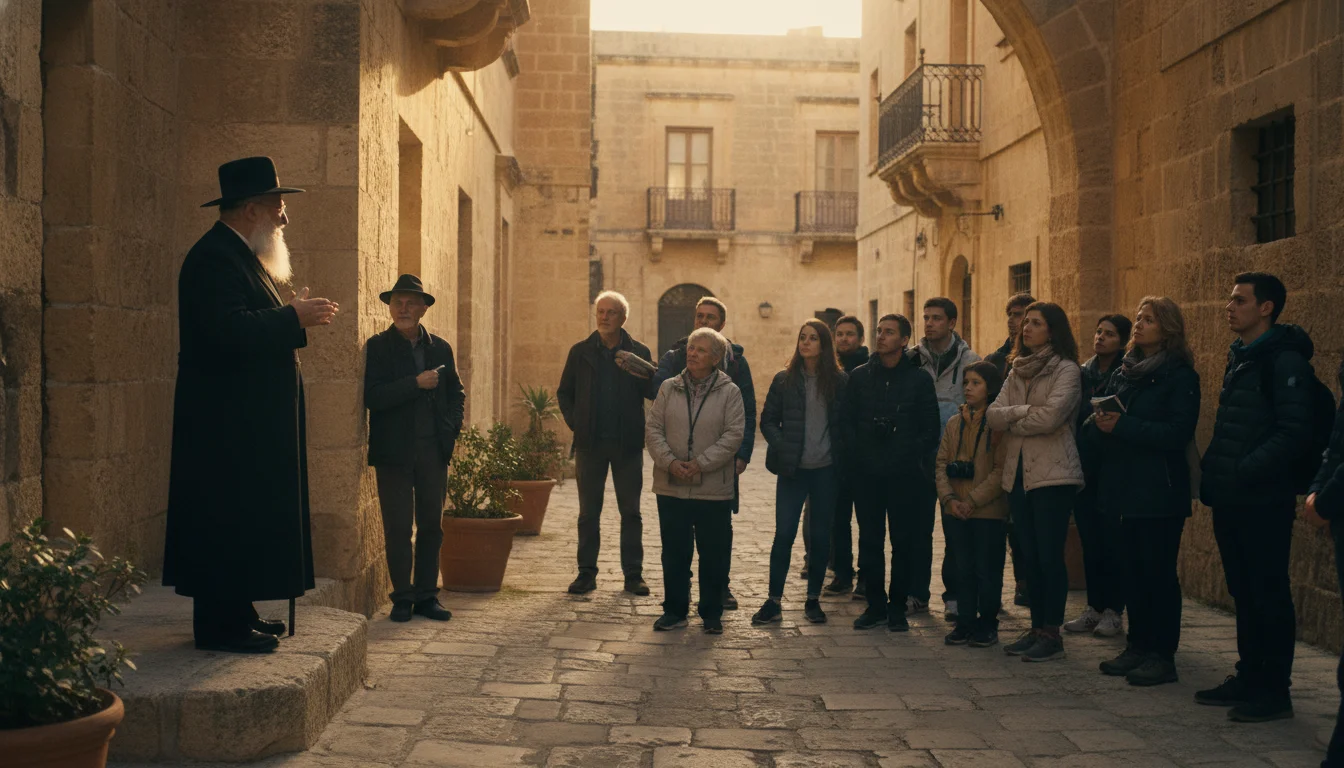
A rabbi once told me she almost skipped Malta entirely when planning her congregation’s Mediterranean heritage tour, because everything she had read described the Jewish history there as minor, a footnote next to Rome or Amsterdam or Prague. Then she stood in the Giudecca, the old Jewish quarter of Mdina, and in the Rabat catacombs where menorahs are carved into the same rock as early Christian burial chambers, and she called me that night to say she had been wrong to think of it as a footnote. It is a small story. It is not a small place.
If you are a rabbi weighing whether Malta belongs on your congregation’s itinerary, here is how I would build the journey, honestly, without overselling what is a genuinely modest but real Jewish heritage.
Start With the Honest Scale of the Story
I always tell rabbis this directly, because it matters for how you frame the trip to your congregation: Malta’s Jewish heritage is not Amsterdam’s or Prague’s. There are no grand seventeenth-century synagogues standing, no large Jewish museum, no continuous large community to visit today. What exists is a community that lived on the island for over 1,500 years, from at least the Roman period through the medieval era, until the 1492 expulsion ended it in the same wave that expelled the Jews of Spain.
That honesty is not a reason to skip Malta. It is the reason the trip works when you frame it correctly: not as a tour of grand monuments, but as a journey into one of the least known chapters of Jewish Mediterranean history, where the physical traces, though limited, are real and can still be walked. Our fuller piece on Malta’s Jewish heritage covers the full 1,500-year arc if you want the complete narrative to draw from when you build your own teaching for the trip.
The Giudecca: Teaching a Quarter With No Plaques
Mdina’s Giudecca is the centerpiece of a Jewish heritage visit to Malta, and it requires a different kind of guiding than most sites, because there are no markers, no plaques, no signage telling visitors what they are looking at. The buildings have been repurposed. The synagogue’s exact location is debated among historians. What remains is the street layout itself, unchanged since the fifteenth century, and a guide who knows the history well enough to make invisible history visible again.
This is where your role as rabbi matters most on the trip. A local guide can describe the quarter’s outline and history. You are the one who can stand your congregation in that unmarked street and connect it to the broader story of Sephardic and Mediterranean Jewish life before 1492, to the fact that this same expulsion swept Spain and Malta in the same year, and to what it means that a community can be erased from a place’s visible landscape while the ground itself still remembers.
The Rabat Catacombs: Where the Rock Does Not Distinguish
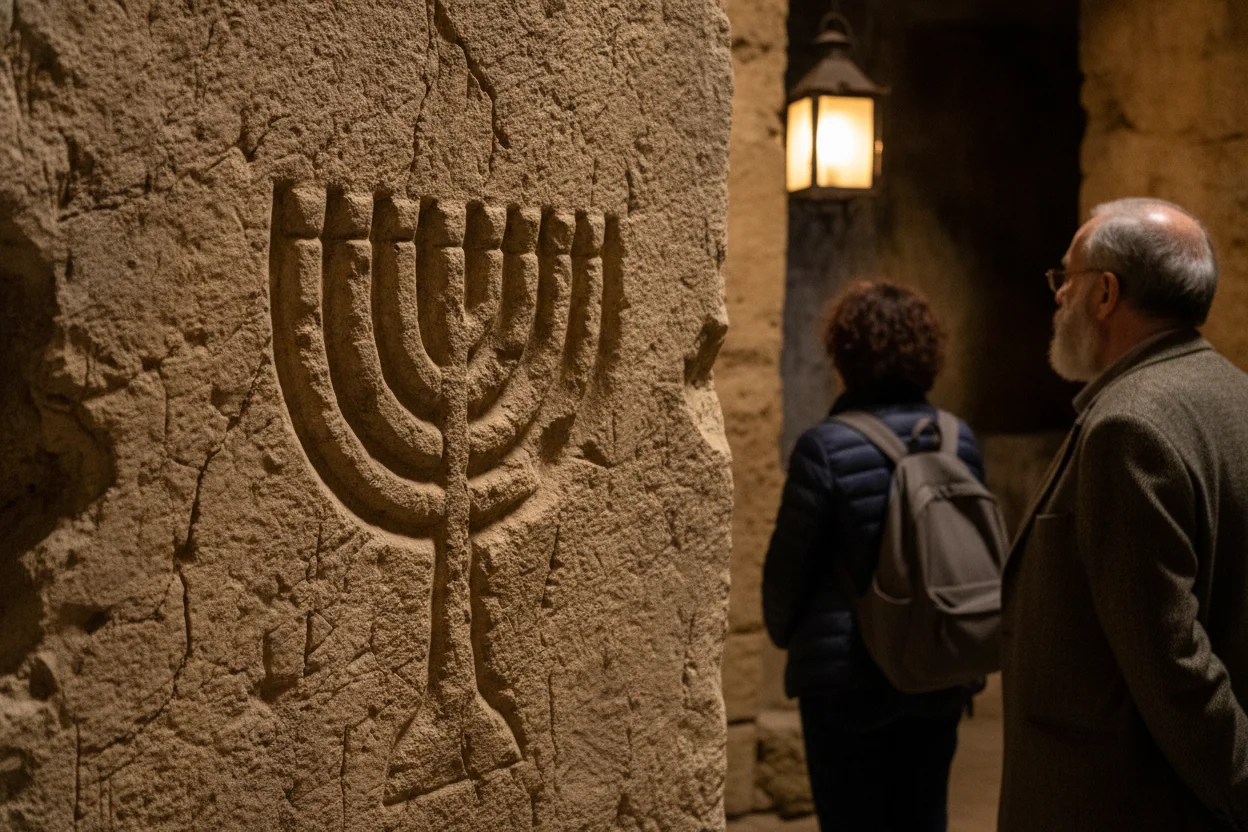
Beneath Rabat, adjacent to Mdina, the catacombs hold one of the few Jewish burial sites in the Mediterranean outside Rome, identifiable by menorahs carved into the rock and the absence of figural imagery found in the neighboring Christian chambers. These date to roughly the fourth century CE, older than the Giudecca itself, and they are, in my experience, the single most affecting stop for Jewish heritage groups in Malta.
What makes the catacombs different from a synagogue visit or a museum stop is the proximity of the burial traditions. Jewish, Christian, and pagan Maltese carved their chambers into the same limestone, buried their dead within meters of each other. Standing in that cool, quiet, hand-carved space, most groups go silent on their own, without needing to be told to. Let that silence sit before you speak.
The New Valletta Synagogue: Ending on Continuation, Not Only Loss
I recommend building the trip toward this stop rather than opening with it, because its meaning depends on everything that came before. A new synagogue is being established in Valletta, the first dedicated Jewish house of worship on the island since the 1492 expulsion. It is a modest project, not a grand restoration, but after five hundred thirty years, it means the Jewish story in Malta is being written again rather than only remembered.
For a congregation that has just walked the Giudecca and descended into the catacombs, ending at this synagogue reframes the whole trip. The story is not only exile. It is also return, however small, however late. Many rabbis choose to hold a brief service or moment of prayer here as the closing act of the Jewish heritage portion of the trip.
Kosher Logistics and Shabbat: Plan Early, Not on the Ground
Kosher food in Malta is limited but workable with real lead time, and I say this to every rabbi planning a trip here: this is not something to sort out after arrival. The new Jewish community in Valletta can help coordinate meal arrangements, and Heritage Tours works with local contacts to arrange kosher meals and Shabbat accommodations, but both require advance planning rather than a same-week request.
If your trip includes a Shabbat, plan for it to fall while your group is based in the Sliema or St. Julian’s area, within reasonable reach of Valletta’s Jewish community, so the day can be built around proper rest rather than travel. Confirm your congregation’s specific standard of kashrut early in planning, whether that means full supervised catering, a vegetarian and fish approach in ordinary restaurants, or something in between, since the right logistics depend entirely on naming that standard up front rather than discovering a mismatch on the ground.
Structuring the Full Trip Around the Jewish Narrative
A Jewish heritage-focused Malta itinerary typically runs two to three focused days within a broader five-day trip, or can anchor a longer Mediterranean circuit if you are combining Malta with Sicily or another regional stop. I generally sequence it as: an orientation day in Valletta, a full day in Mdina and Rabat covering the Giudecca and the catacombs together since they sit close by, and a closing visit to the new synagogue, with the remaining days built around Malta’s broader heritage, including St. Paul’s sites and Gozo’s ancient temples, which give the trip context even for a Jewish-focused group. Our 5-day Malta heritage itinerary shows how these pieces fit into a full week if you are building the complete trip rather than a Jewish-heritage-only version.
Group Size and the Free Leader Policy
With fifteen or more participants, you travel free as the group’s rabbi, a policy that applies to every Heritage Tours destination including Malta. Malta’s overall cost structure runs lower than many Western European circuits, which for a congregation weighing a Jewish heritage trip against, say, a Central European Jewish history tour, often makes Malta the more accessible option financially while still delivering a genuinely rare piece of Mediterranean Jewish history.
FAQ: Building a Rabbi-Led Heritage Journey to Malta
Is Malta’s Jewish heritage substantial enough to justify a dedicated trip?
It is substantial enough to justify a focused two to three day portion within a broader Malta trip, framed honestly as a lesser-known chapter of Jewish Mediterranean history rather than a grand-monument destination. The Giudecca, the Rabat catacombs, and the new Valletta synagogue together tell a real and moving 1,500-year story, even without large surviving synagogues.
How do we arrange kosher food and Shabbat observance in Malta?
Plan early. Kosher options are limited but workable with lead time, and the new Jewish community in Valletta, along with Heritage Tours’ local contacts, can arrange meals and Shabbat accommodations. Confirm your congregation’s specific kashrut standard well before the trip so logistics can be built to match rather than improvised.
What is the Giudecca and why does it need a knowledgeable guide?
The Giudecca is Mdina’s old Jewish quarter, its street layout unchanged since the fifteenth century, but with no plaques or markers identifying what visitors are looking at. A guide, or the rabbi personally, who knows the history well is essential to make the quarter’s significance visible to the group.
Should the trip open or close with the new Valletta synagogue?
I recommend closing with it. Its significance as a sign of continuation after the 1492 expulsion lands more powerfully after a congregation has already walked the Giudecca and the Rabat catacombs and understands what was lost.
Does the group leader free policy apply to a Jewish heritage trip specifically?
Yes, the same as any Heritage Tours group trip: at fifteen or more participants, the rabbi or group leader travels free.
If you are considering Malta for a congregation that wants to learn a Jewish history most of them have never heard, I would welcome the conversation.
Contact us and let’s build a journey that does justice to a small but real story.