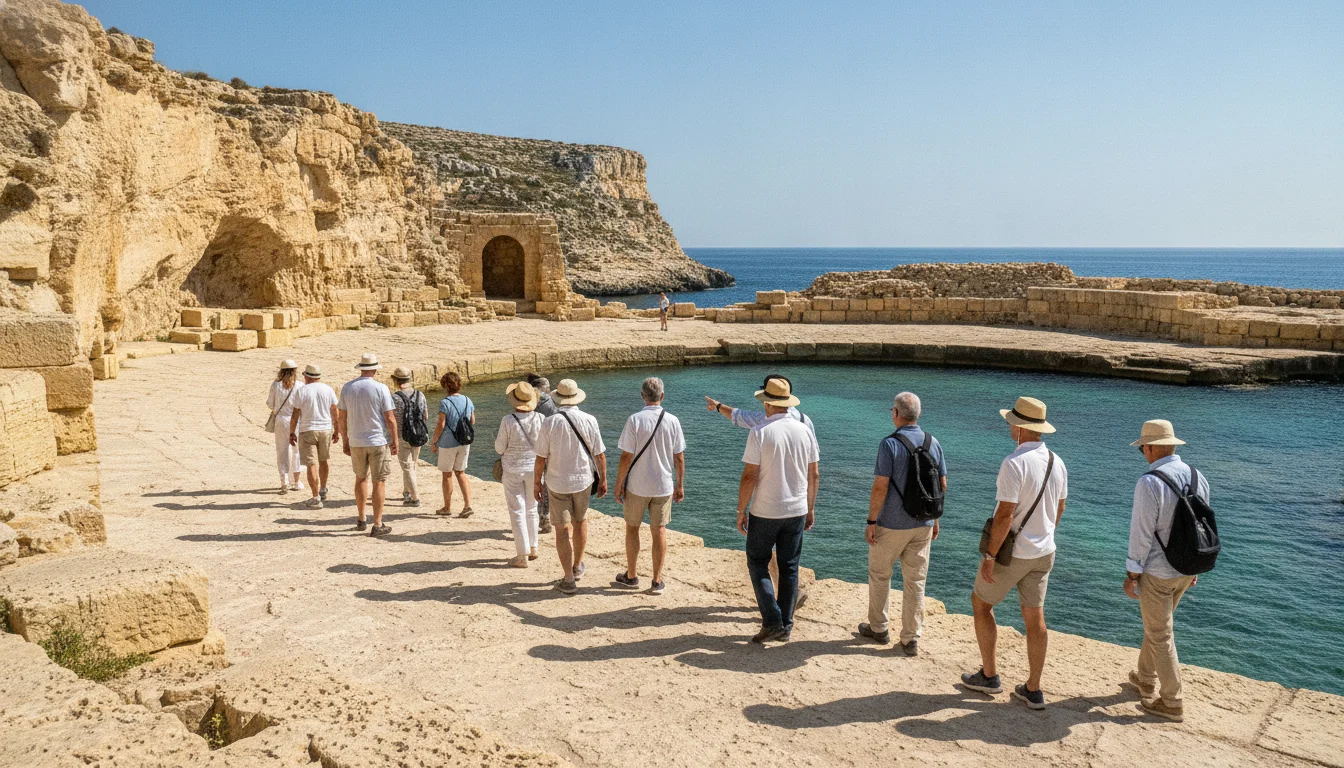
A group leader asked me a version of this question recently, and I have heard it enough times now to know it deserves a straight answer rather than a sales pitch for either country. “We want to follow Paul. Should that mean Greece or Malta?” The honest answer is that it depends on which part of Paul’s story your congregation wants to walk through, because Greece and Malta hold genuinely different pieces of it.
Greece gives you the missionary journeys. Malta gives you one night that nearly ended everything. Both are real, both are biblical, and neither replaces the other.
Greece Holds the Journey. Malta Holds the Moment.
Greece is where Paul’s missionary journeys as recorded in Acts actually unfolded across years and multiple cities. Philippi, where he and Silas were imprisoned and where the first European convert, Lydia, was baptized. Thessaloniki, where he wrote to the church there. Athens, where he stood before the Areopagus and reasoned with Greek philosophers. Corinth, where he lived and worked for over a year and later wrote two of his most significant letters. This is a trail with geography, chronology, and multiple distinct communities, each with its own texture in the New Testament.
Malta holds a single, specific episode: the shipwreck recorded in Acts 27 and 28, on Paul’s forced journey to Rome as a prisoner, not as a missionary. It is dramatic and detailed in Scripture, storm, shipwreck, survival, the islanders’ kindness, snake bite, healing, three months on the island before continuing to Rome. But it is one chapter of one journey, not a multi-year ministry across several cities.
If your congregation wants to walk the actual footsteps of Paul’s missionary work, church by church, letter by letter, Greece is where that lives. Our Greece vs Turkey heritage comparison gives a sense of how extensive that Pauline geography really is once you include Turkey’s Seven Churches as well.
What Makes Malta’s Story Different in Kind, Not Just Size
I want to be precise here rather than just say Malta is smaller, because the difference is really about kind of story, not only scale. Greece’s sites connect to Paul’s teaching and church-planting, the content of his ministry. Malta’s site connects to Paul’s survival and the response of ordinary people to a stranger in crisis. It is a story about hospitality and providence more than about doctrine or church founding, though tradition does credit Paul with converting the Roman governor Publius during his stay.
That makes a Malta visit feel different on the ground. Standing at St. Paul’s Bay is less about tracing an argument Paul made to a specific congregation and more about standing at the site of an event: a storm, a wreck, an unlikely rescue. Groups often experience it as a more contained, reflective stop rather than an intellectual or theological deep dive. The Grotto of St. Paul nearby adds a quieter, more devotional layer to that same story.
Layered on top of the Pauline story, Malta also carries thick Knights of Malta history, visible in Valletta’s St. John’s Co-Cathedral and the Grand Master’s Palace. That is a real and worthwhile heritage layer, but it belongs to a much later era and a different story than the apostolic one, so it should not be mistaken for additional early Christian depth.

Greece Also Carries Byzantine and Orthodox Depth Malta Does Not
One more honest point of difference. Greece’s Christian heritage does not stop with Paul. The country carries centuries of Byzantine Christianity and Orthodox tradition after the apostolic period, visible in Thessaloniki’s Byzantine churches, monastic communities, and a continuous Orthodox Christian culture that runs from antiquity to the present. That gives a Greece trip a second, later layer of Christian heritage beyond the New Testament sites themselves.
Malta does not have an equivalent second layer of specifically Christian depth in the same way. Its story after the apostolic period shifts into the Knights of Malta era, which is a genuinely different historical thread, more military and political than specifically devotional, even though it unfolds inside a deeply Catholic institution.
When to Choose Greece
Choose Greece when your congregation wants to trace Paul’s actual missionary journeys across multiple cities, understand the churches he founded and wrote to, and add a layer of Byzantine and Orthodox Christian history on top of the apostolic sites. Greece rewards a congregation with more time, generally eight to eleven days, given how much ground the Pauline trail covers.
When to Choose Malta
Choose Malta when your congregation is drawn specifically to the shipwreck narrative and wants a focused, intimate trip built around that one dramatic episode, without the demands of a multi-city itinerary. Malta also suits a group with a shorter travel window or a smaller budget, since the island’s compact geography, every site within about thirty minutes of every other, keeps a five or six day trip full without long transit days. Our Malta 5-day heritage itinerary lays out exactly how that time gets spent.
When to Combine Them
Because Paul’s shipwreck happened on the way from his time in the eastern Mediterranean toward his final imprisonment in Rome, some congregations build a trip that connects Greece and Malta directly, following Paul’s actual route rather than treating the two as separate options. This asks more of your calendar and budget, typically twelve days or more, but it lets a congregation trace an unbroken biblical thread from the missionary journeys through the shipwreck to the edge of Rome itself.
The Honest Bottom Line
Neither destination is a lesser version of the other, and neither should be sold that way. Greece is broader, covers more of Paul’s actual ministry, and adds Byzantine depth beyond the New Testament period. Malta is narrower, more focused, and built around a single dramatic and well-documented event plus a separate, later Knights of Malta heritage layer. Choose based on which part of the story your congregation most wants to stand inside, not based on which destination sounds bigger.
FAQ: Malta vs Greece for Early Christian Heritage
Which destination covers more of Paul’s actual ministry, Greece or Malta?
Greece, by a wide margin. Paul’s missionary journeys unfolded across multiple Greek cities, including Philippi, Thessaloniki, Athens, and Corinth, over years of ministry. Malta covers a single episode, the shipwreck in Acts 27 and 28, during a forced journey to Rome as a prisoner, not a missionary stop.
Is Malta worth visiting if my congregation is mainly interested in Paul’s missionary journeys?
It can be, as an add-on rather than the main destination. The shipwreck is a real and moving part of Paul’s story, but a congregation focused specifically on the missionary journeys will find far more of that story in Greece.
Does Greece have anything comparable to Malta’s Knights of Malta history?
Not directly, but Greece carries its own later Christian layer in Byzantine and Orthodox heritage, visible in Thessaloniki and other sites, which spans centuries after the apostolic period. It is a different historical thread than Malta’s Knights era, but it serves a similar role of adding depth beyond the New Testament sites.
Can a group visit both Greece and Malta on Paul’s route in one trip?
Yes. Since the shipwreck occurred on Paul’s journey from the eastern Mediterranean toward Rome, some congregations build a combined itinerary tracing that route, typically needing twelve days or more to do both destinations justice.
How long does a Malta-focused trip need if we are not combining it with Greece?
Five to six days covers Malta’s core Christian and Knights-era heritage sites comfortably, since the island is small enough that every site sits within roughly thirty minutes of every other.
If you are trying to figure out which part of Paul’s story matters most to your congregation, Greece’s missionary trail, Malta’s shipwreck, or both together, I am happy to help you map it out. Contact us or explore our group heritage tours to see how we build these itineraries.