I’ve taken hundreds of groups through Jordan over the years. Synagogue communities from New York. Church congregations from Texas. Interfaith groups from Chicago. Families tracing their roots. Groups of twenty and groups of sixty.
What I’ve learned is this: Jordan has a way of surprising people who think they already know what a heritage journey looks like. Israel tends to be the anchor, the place that people feel they understand and have longed to see. Jordan comes in quieter. And then, usually somewhere between Mount Nebo and the Siq at Petra, it takes hold of something in the group that doesn’t let go.
This seven-day itinerary is what we actually do with faith groups. Not a checklist assembled from a tourism website, but the shape of a real journey, built around the sites that matter most, paced for a mixed-age group, and designed to give your community space to absorb what they’re experiencing rather than race through it.
Most groups who come to Jordan as part of our Jordan heritage destination program combine it with Israel, and I’ll address the entry options for both cases. But even on its own, seven days in Jordan is enough to change how your community understands the biblical world.
Before You Arrive: How Most Groups Enter Jordan
Coming from Israel via the Allenby/King Hussein Bridge
The majority of our faith groups enter Jordan through the Allenby Bridge crossing, also called the King Hussein Bridge, which connects the West Bank to Jordan across the Jordan River. If your group is coming off an Israel itinerary, this is almost certainly your entry point.
A few things worth knowing. The Allenby Bridge crossing is unlike any land border I’ve seen elsewhere. It moves at its own pace, and it requires patience. Budget three to four hours from the time you board the bus on the Israeli side to the time you’re cleared and moving into Jordan. This is normal. Bring snacks, keep the group comfortable, and use the time to shift gears mentally from Israel to Jordan.
The crossing is not open on Jewish holidays or on Yom Kippur. If your Israel trip ends near a holiday, we plan around this carefully. It also closes on Jordanian national holidays, and times can vary by season.
Once you’re through, the drive to Amman is roughly 45 minutes.
Flying into Amman Directly
If your group is doing a Jordan-only trip, or starting in Jordan before crossing to Israel, you’ll fly into Queen Alia International Airport in Amman. The airport is modern, manageable, and about 35 minutes from the city center.
Groups entering this way sometimes stay their first night in Amman and begin the itinerary the following morning, which gives everyone a chance to recover from the flight before the journey begins.
Day 1: Amman: Ancient Citadel and the City’s Roman History
Most groups arrive in Amman and feel slightly disoriented. It’s a large, sprawling city built across hills, modern in its surface but layered with history that goes back to the Bronze Age. I like to start Day 1 with a morning at the Amman Citadel, which sits on the highest hill in the city and gives you a physical orientation to everything around you.
The Citadel, known in ancient texts as Rabbath Ammon, appears in the Hebrew Bible in contexts that will be immediately familiar to anyone in a Jewish or Christian faith community. The view from the top looks out over a city of more than four million people, but the stones beneath your feet connect to a very different world. The Temple of Hercules, the Byzantine church ruins, the Umayyad Palace: each layer of the Citadel represents a civilization that found this hilltop worth holding.
In the afternoon, move down to the Roman Theater, one of the best-preserved in the Middle East, seating six thousand in its time. From there, walk the old city market, the souq, not to shop necessarily but to feel the texture of daily Jordanian life before you move into the more intensely sacred parts of the journey.
Reflection moment for Day 1: At the Citadel, before the group disperses to explore, pause for a moment with 2 Samuel 12, the account of David’s siege of Rabbath Ammon. Standing on the hill itself, the geography of the text comes alive in a way no sermon illustration can replicate.
Day 1 is intentionally a moderately paced orientation day. The group adjusts to Jordan’s rhythm. Walking is moderate. The evening in Amman is relaxed.
Day 2: Madaba, Mount Nebo & the Plains of Moab
This is one of the most spiritually concentrated days in the entire itinerary. Plan for it to move slowly.
The Mosaic Map of the Holy Land
The first stop is Madaba, a predominantly Christian town about 30 kilometers south of Amman. Inside the Church of Saint George is one of the most remarkable artifacts in the biblical world: a sixth-century Byzantine mosaic map of the Holy Land, still visible in the floor of the church. It depicts Jerusalem, the Jordan River, the Dead Sea, and dozens of biblical sites with a cartographic precision that still astonishes scholars.
For a faith group, standing over this map is a powerful experience. You can trace the route your group has taken, or will take, through Israel. You can see Jericho, Gaza, the Nile Delta, the mountains of Moab. The artist who laid these tiles in the 500s CE was making a theological statement as much as a geographical one: this land is sacred, it has always been sacred, and its shape matters.
Standing Where Moses Stood
From Madaba, the drive to Mount Nebo takes about fifteen minutes. And then you are on the mountain where Moses stood at the end of his life and looked across to the Promised Land he would not enter.
I have brought groups to Mount Nebo dozens of times. It never becomes routine. On a clear day, you can see Jerusalem. You can see the Dead Sea below, silver and still. You can see the Jordan Valley, and on the far ridge, the hills of Israel. The text of Deuteronomy 34 is short, only twelve verses, but read aloud at this site it carries an emotional weight that is very hard to prepare for.
The church at Mount Nebo houses some of the finest Byzantine mosaics in Jordan. Walk through them carefully before or after the outdoor terrace. Then give the group time to simply stand and look.
Reflection moment for Day 2: Read Deuteronomy 34:1–5 aloud at the terrace overlook, before commentary. Let the view do the work first. Then talk.
This is a heavy day emotionally and spiritually. The afternoon is lighter by design.
Day 3: Bethany Beyond the Jordan & Wadi Rum
The Baptism Site of Jesus
The site known as Bethany Beyond the Jordan, al-Maghtas in Arabic, was officially recognized by the Vatican in 2000 as the site of Jesus’s baptism by John. It sits on the Jordanian bank of the Jordan River, directly across from the Israeli baptism site of Qasr al-Yahud. For Christian groups, this is among the most significant sites in the entire journey.
The walk through the archaeological excavations brings you past the remains of ancient Byzantine churches, baptismal pools, and the path leading to the river itself. When you reach the water’s edge and look across to the Israeli bank, the narrowness of the river is itself striking. The Jordan is not wide or dramatic here. It is quiet, almost domestic. And somehow that makes the text of Matthew 3 feel more real, not less.
Jewish groups do not hold the same theological weight for this site, though it is historically and archaeologically significant for any group interested in first-century Jewish religious practice.
Reflection moment for Day 3: At the water’s edge, give the group silence before any words. Some will want to touch the water. Some will want to pray. Let the moment happen before structuring it.
The Desert Silence of Wadi Rum
The afternoon drive from Bethany to Wadi Rum is roughly three hours, moving south through the desert. It is not a short drive, and on Day 3 this is a real consideration for groups with older members. Some itineraries move Wadi Rum to a different position, and we’re happy to discuss adjustments.
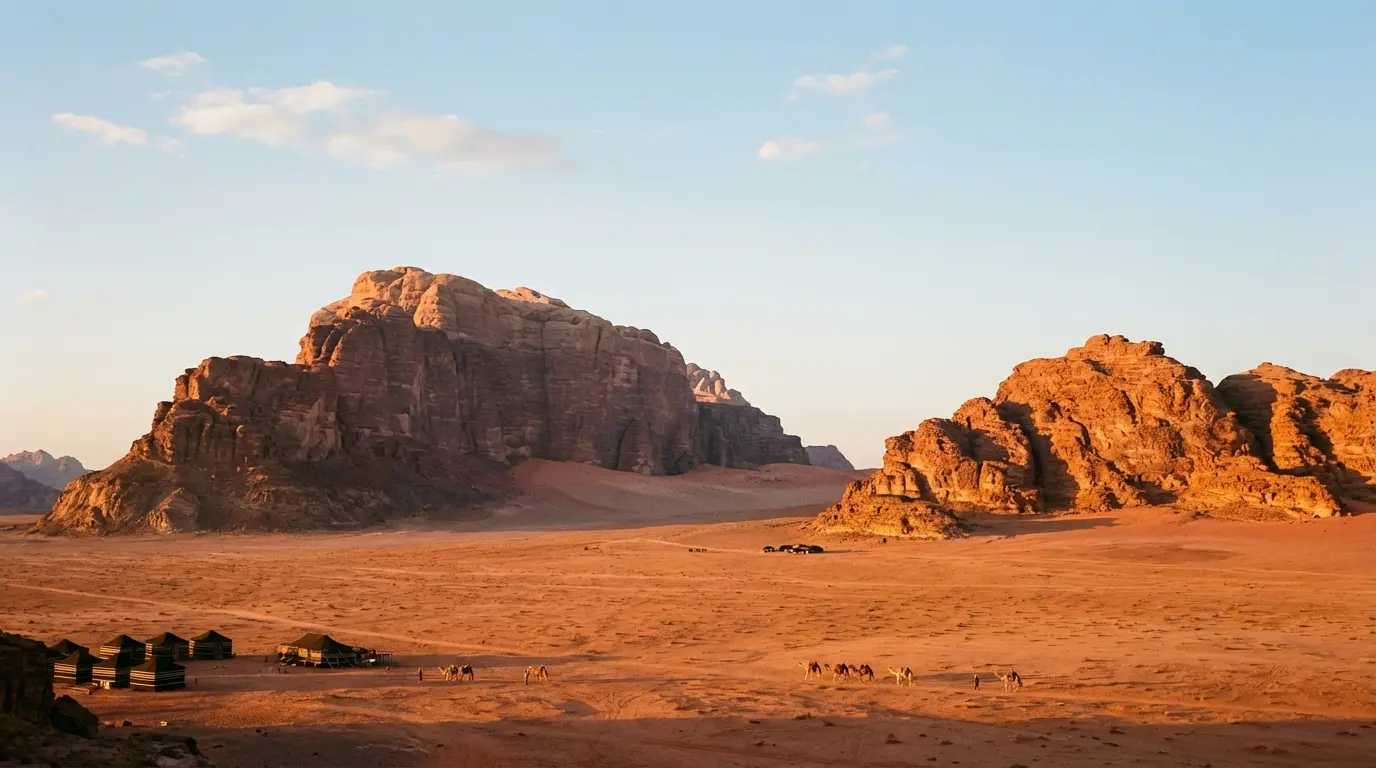
But Wadi Rum in the late afternoon, when the sandstone mountains go red and the desert floor catches the low sun, is unlike anything else in Jordan. For many groups, it is the moment the journey expands from being about specific sacred sites to being about the landscape itself, the same silence that Abraham walked in, the same desert that shaped Moses.
We typically do a short sunset vehicle tour of the main valleys rather than a long trek. This keeps the experience accessible for all fitness levels while still giving the group the full sweep of the landscape.
Evening under the stars in Wadi Rum, if the group is staying overnight, is a memorable close to Day 3.
Day 4: Petra: The Rose-Red City
What the Nabataean City Means for Faith Travelers
Petra is the site most visitors know before they arrive, and it still manages to exceed expectations. The Nabataean capital, carved into rose-red sandstone over centuries, is one of the architectural and archaeological wonders of the world. But for a heritage group, it carries specific biblical resonance that standard tours often miss.
The Nabataeans appear in the Second Temple period and in Hellenistic Jewish sources. The city of Petra is widely associated with the ancient Edomite territory, and some scholars connect it with the biblical Sela. The region around Petra is part of the landscape of the Exodus narrative. Wadi Musa, the valley that leads to Petra, means “Valley of Moses,” and local tradition connects it to the journey of the Israelites.
For Christian groups, the Apostle Paul spent time in the Nabataean Kingdom (Galatians 1:17 refers to Arabia), and early Christian communities established themselves here. The Byzantine churches of Petra contain some of the finest mosaics in the region.
Practical Tips for Groups at Petra
Petra requires walking. The entry from the visitor center to the Treasury through the Siq is about 1.2 kilometers, and reaching the Treasury is just the beginning. A full visit to the main sites, including the Street of Facades, the Royal Tombs, and the Colonnaded Street, covers 4–6 kilometers of varied terrain.
For groups with older members or anyone with mobility challenges, this needs honest planning. The terrain is uneven. There are no shortcuts to the Treasury. Donkeys and carriages are available for part of the route but cannot access everything. Talk to us before the trip about what your specific group can manage, and we’ll build the day accordingly.
Start as early as possible. By 10 AM in spring or fall, the Siq begins to fill. The early morning light on the Treasury is extraordinary, and the quiet of the first hour inside Petra is a gift worth waking up for.
Reflection moment for Day 4: At the Treasury, before the group scatters, read Obadiah 1:3–4 or Isaiah 34:5–8, texts that speak directly to the Edomite people whose territory this was. The carved façade behind you becomes an illustration of every civilization that believed itself permanent.
Day 4 is the most physically demanding day of the itinerary. Plan a lighter dinner and an early night.
Day 5: Kerak, the Crusader Castle & the King’s Highway
The drive north from Petra along the King’s Highway is one of the great drives in this part of the world. The road winds through canyons, past ancient agricultural terraces, through small towns that have been inhabited since the Bronze Age. This is not a highway in the modern sense. It is one of the oldest trade routes in human history, mentioned in the book of Numbers as the path Israel requested to travel through Moab.
The main destination today is Kerak, home to one of the finest Crusader castles in the Middle East. The castle was built in the twelfth century CE by the Crusaders and later captured by Saladin in 1189. It sits dramatically on a plateau over the Dead Sea valley. The layers inside the castle, Crusader, Mamluk, Ottoman, tell the history of this contested region across a thousand years.
For faith groups, Kerak is less a theological site and more a historical one: a powerful reminder of how many empires have moved through this land, and how the biblical world connects to the medieval one. The view from the castle ramparts, on a clear day, extends to the Dead Sea and the hills of Israel.
Today is a moderate walking day, easier than Petra. The King’s Highway drive is long but consistently beautiful. Build in stops for the group to simply stand in the landscape.
Reflection moment for Day 5: On the King’s Highway, at one of the canyon overlooks, read Numbers 20:14–21, Israel’s request to pass through this land, and the refusal that shaped their route. You are on the road they tried to take.
Day 6: Jerash: The Roman City and Its Early Christian Layers
Jerash is one of the best-preserved Roman provincial cities in the world, and it is significantly underappreciated by faith groups who focus exclusively on the southern circuit. A morning at Jerash, followed by an afternoon in Amman, makes for a balanced and historically rich day.
The city’s colonnaded main street, oval plaza, temples, theaters, and triumphal arch give a complete picture of what a Roman city in this region actually looked like in the first and second centuries CE. For Jewish groups, the context of Roman rule over Judea, what your ancestors lived under, becomes physically real here in a way that is hard to replicate. For Christian groups, the early Christian layers are substantial: Jerash had fifteen churches by the fifth century, and several of their mosaic floors are still visible.
The site requires moderate walking on uneven paving stones. It is not as strenuous as Petra, but proper footwear matters.
Afternoon back in Amman is a chance for the group to decompress, do some shopping in the old city, and have a final evening meal together before the last day of the journey.
Reflection moment for Day 6: At the Temple of Artemis, with its enormous columns still standing, ask the group to consider what Paul meant in 1 Corinthians 8 when he wrote about the “gods many” of the Roman world. Standing inside an active temple precinct makes the missionary letters land differently.
Day 7: Ajloun Castle & the Jordan Valley Before Departure
The final day is deliberately quieter than what precedes it. Ajloun Castle, a twelfth-century Muslim fortress built by one of Saladin’s generals, sits in the forested hills north of Jerash and overlooks the Jordan Valley. The forest around Ajloun is one of the few remaining areas of natural oak and pine woodland in this region, and the landscape has a softness that is a gentle counterpoint to the desert zones of the south.
The view from Ajloun looks northwest across the Jordan Valley to the hills of Galilee. If your group has come from Israel, this sight brings the geography of the entire journey into relief. You can trace the whole arc: the Galilee you walked in, the Jordan River you stood beside, the valley that connects them.
Ajloun’s walking requirements are moderate. The castle itself involves some stairs, but nothing close to Petra’s distances.
Departure typically moves from Ajloun to Amman airport, or to the Allenby Bridge if your group is crossing back into Israel for a final Jerusalem night.
Reflection moment for Day 7: Before leaving Ajloun, give the group five minutes of silence with one question: what has this land asked of you? You’ll be surprised by what comes up in the conversation on the bus afterward.
How to Extend This to a 10-Day Israel-Jordan Journey
Most groups we work with don’t choose between Israel and Jordan. They do both, and the combination is what makes the journey complete.
The typical shape is seven to ten days in Israel, including Jerusalem, the Sea of Galilee, and the Judean Desert, followed by a crossing to Jordan for the seven-day itinerary described here. Or the reverse, entering Jordan first and ending in Jerusalem.
For a ten-day combination, the Jordan itinerary can be condensed slightly: Madaba and Mount Nebo on Day 1, Petra on Days 2 and 3, the King’s Highway and Jerash on Days 4 and 5, with arrival or departure via Israel on Days 6 and 7.
We design these combined itineraries regularly and know how to build them around the Allenby Bridge crossing, the flight schedule, and the group’s spiritual priorities. If your community is asking “Israel or Jordan?” the answer is almost always both.
Read more about spiritual highlights of Jordan or visit our Jordan heritage travel guide for the full context behind the sites on this itinerary. When you’re thinking about timing, our guide on the best time to take this itinerary will help you match your community’s calendar to the right season.
FAQ: Jordan Heritage Itinerary
Is 7 days enough to see Jordan’s major heritage sites?
Yes, seven days covers the full sweep of Jordan’s most significant heritage sites, from Amman and Madaba in the north to Petra and Wadi Rum in the south, with Jerash and Ajloun as northern bookends. You won’t see everything Jordan offers, but you’ll see everything that matters most for a faith-based heritage journey. Groups who want to go deeper into a specific region, Petra for two full days, or additional time along the King’s Highway, can extend to nine or ten days.
What is the best order to visit heritage sites in Jordan?
The order in this itinerary, Amman, then Madaba and Mount Nebo, then Bethany and Wadi Rum, then Petra, then north through Kerak and Jerash to Ajloun, follows a geographical arc that minimizes unnecessary backtracking and builds in a natural emotional rhythm. The spiritually heavier sites (Mount Nebo, the Baptism Site) come in the middle of the journey when the group has settled in. Petra, the most physically demanding site, comes after a day of relative recovery at Wadi Rum.
Can you combine Jordan and Israel in one heritage trip?
Absolutely, and most of our groups do exactly that. The combination typically runs fourteen to seventeen days total and can be structured either direction: Israel first, then Jordan, or Jordan first, then Israel. The crossing point is either the Allenby Bridge (King Hussein Bridge) between the West Bank and Jordan, or the northern Sheikh Hussein crossing near Beit She’an. We plan these combined journeys regularly and handle all the coordination between the two countries.
How do faith groups cross from Israel to Jordan?
Most groups crossing from Israel to Jordan use the Allenby Bridge (also called the King Hussein Bridge), which connects the Palestinian Authority-administered area near Jericho to Jordan. The crossing is open Sunday through Thursday and most Fridays, with reduced hours and closures on Jewish and Jordanian holidays. Plan three to four hours for the crossing itself, which includes passport control on both sides and luggage handling. Groups are accompanied by our team throughout the process. The northern Sheikh Hussein crossing near Beit She’an is faster and more straightforward but requires a longer drive from Jerusalem.
What is the most important site to include in a Jordan heritage itinerary?
If I could only bring a group to one site in Jordan, it would be Mount Nebo. Not because it is the most spectacular (Petra is more dramatic) or the most historically rich (Jerash offers more archaeologically) but because of what it does to a group. Standing where Moses stood, looking at the land he was promised and could not enter, is a moment of biblical weight that I have seen move people who rarely cry, who are not easily moved, who have read Deuteronomy many times. The site itself is not enormous. The mosaics are beautiful but not the reason to go. You go to stand in that particular place and feel the gravity of what happened there.
If this itinerary speaks to what you’re hoping to give your community, we’d love to talk about how to make it yours. Every group is different, and every group leader brings something unique to the journey. Reach out to us when you’re ready, and we’ll start from where you are.
Our group heritage tours page gives you more detail on how we support group leaders from the first conversation through the final day.