I’ve been helping faith groups plan their journeys through Jordan for more than twenty years. And the question I hear most often, after “Is Jordan safe?” is this: “When should we go?”
My honest answer is: it depends. Not on the weather charts, but on your community. Who are you bringing? What does your congregation carry into this trip? Are you a synagogue group observing the High Holidays? A church group anchored to the Easter season? A mixed interfaith community that moves by school schedules and sabbatical timing? The answer changes everything.
What I want to do in this guide is give you two calendars at once. Jordan’s climate calendar, which every travel site will tell you about, and the faith calendar, which almost none of them touch. When you layer those two together, the right season usually becomes clear.
The Two Calendars Every Faith Traveler Should Consult
Jordan’s Climate Calendar
Jordan has a Mediterranean climate in the north and west, and a desert climate as you move south toward Petra and Wadi Rum. The temperature swings between those two zones are real and worth knowing before you book.
The most comfortable months for walking heritage sites are March through May and October through November. You’ll have moderate temperatures, manageable crowds at the major sites, and reliable sunshine without the kind of heat that exhausts a group. Winters in Amman and the northern highlands can be cold and sometimes rainy. Summers in Petra can push past 35°C (95°F) by mid-afternoon.
That said, climate alone should never drive your decision. I’ve led groups to Petra in July and it was profound. I’ve watched groups freeze in Amman in January and come home changed. The spirit of the journey doesn’t depend on perfect weather.
The Jewish and Christian Calendar Overlay
Here is what the standard travel guides miss entirely. Your group is not just choosing between spring and fall weather. You’re choosing between seasons that carry very different spiritual weight, and very different logistical realities, depending on where your community stands in its calendar year.
For synagogue groups, the High Holidays (Rosh Hashanah and Yom Kippur, typically September or October) create a natural constraint. Almost no rabbi wants to be leading a heritage journey in late September. The weeks just after Sukkot, on the other hand, often open up beautifully. October and early November become a genuine window.
For church groups, the Easter and Holy Week season is the most spiritually charged time to be in this region. But it is also the most complex. I’ll talk about both sides of that shortly.
Understanding both calendars before you fix your dates is the foundation of good planning. Everything else builds on it.
Spring (March–May): The Season Most Heritage Groups Choose
Why Passover and Easter Season Shapes Jordan Travel
If you ask me which season draws the most faith-based travelers to Jordan, the answer is spring. And that’s not an accident. The Passover and Easter seasons pull Jewish and Christian groups toward this part of the world at the same time every year, for reasons that go much deeper than weather.
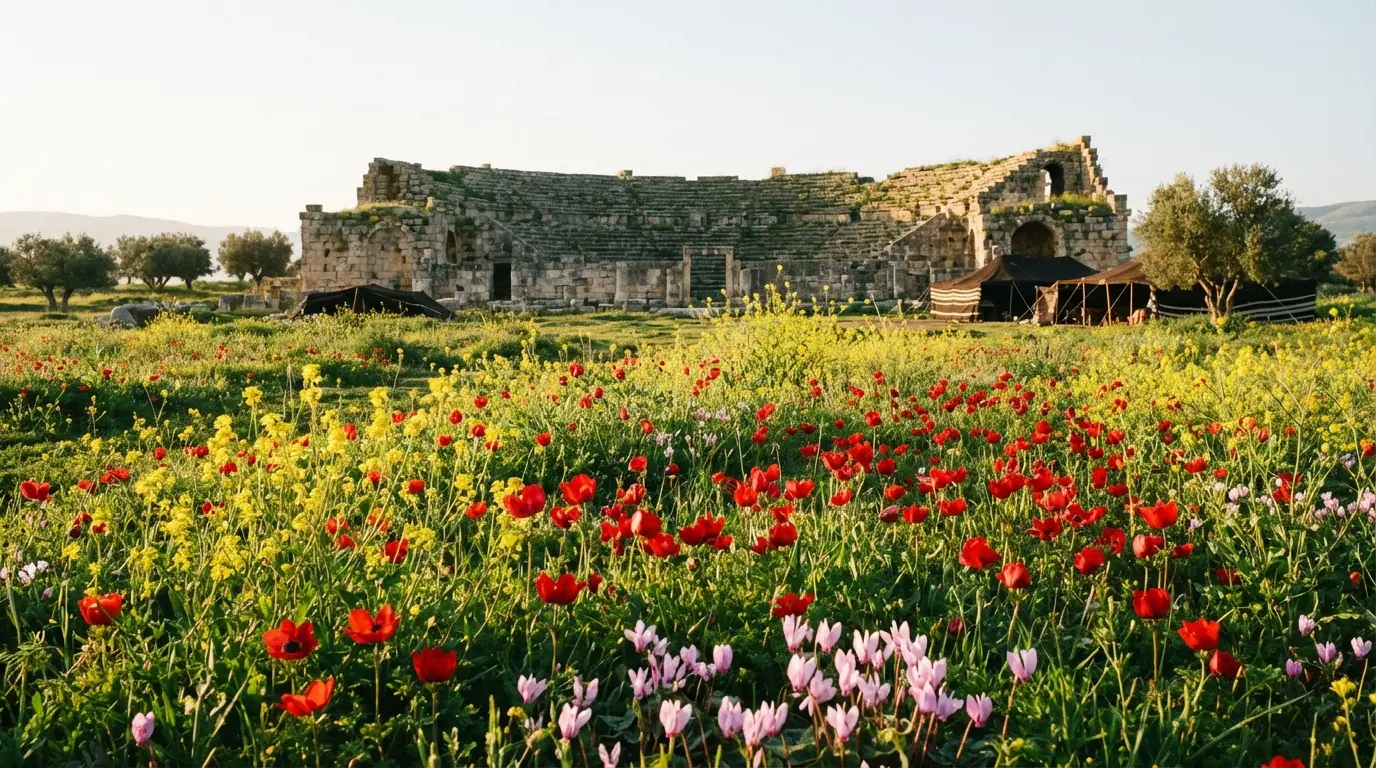
Standing at Mount Nebo in April, looking across the Jordan Valley to the hills of Israel while the wildflowers are still out, is something I cannot fully describe in a guide like this. The landscape is alive in a way it simply isn’t in summer. The air has softened. The sky is clear. For a group that has just come through Passover or Holy Week spiritually prepared, the land feels like it’s meeting them where they are.
March through May is also when Jordan is genuinely beautiful. The northern highlands around Ajloun are green. The desert at Wadi Rum hasn’t yet turned brutal. The King’s Highway is accessible and unhurried.
What to Know About Crowds and Availability
Here is the honest side. Spring is also the most popular season, and that creates real pressure on availability.
Petra during Easter week sees crowds that are significant by any measure. The major sacred sites, including the Baptism Site at Bethany Beyond the Jordan, fill with pilgrimage groups from around the world. Hotels in Amman and near Petra book up months in advance for the weeks around Easter and Passover.
If your group is targeting spring, and especially if you’re thinking about the Passover or Easter window, you need to be planning at least nine to twelve months out. I tell this to every rabbi and pastor I speak with. Not to pressure them, but because the later you start, the fewer options you have, and the harder it becomes to serve your community well.
For synagogue groups, the weeks immediately after Passover, in late April or early May, can actually be the sweet spot. The spiritual preparation of Pesach is still present in the room, the holiday crowds have thinned, and the weather is still ideal.
Fall (September–November): The Hidden Peak Season
After the High Holidays: A Natural Window
Fall is, in many ways, the best-kept secret of Jordan travel. And I think the reason is simple: most travel articles are written by people who aren’t thinking about the Jewish calendar.
For observant and traditional Jewish communities, the weeks between Rosh Hashanah and Sukkot are completely unavailable for major travel. But the window that opens after Simchat Torah, roughly from mid-October onward, is one of the finest times of year to be in Jordan.
Temperatures have dropped to a comfortable range. Summer’s intensity has passed. The sites are less crowded than during spring. And there is something about returning from the High Holidays season that primes a group spiritually for a journey like this. You’ve just been through the Days of Awe. You’ve asked the hard questions about the year ahead. A heritage journey in this spirit carries a particular kind of weight.
Why October Is Often the Best Jordan Month
If I had to pick one month across the entire year, I’d often say October. The light is extraordinary, especially in the late afternoon at Wadi Rum and along the King’s Highway. The weather across every zone, from Amman in the north to Aqaba in the south, is genuinely pleasant. Groups move well. No one is wilting in the heat or bundled against cold rain.
October also works for church groups not anchored to the spring liturgical calendar. Presbyterians, Methodists, Lutherans, many Episcopal and non-denominational communities find that fall travel fits their congregational year very naturally, after the summer programs have ended and before Advent begins.
Summer (June–August): Hot but Not Impossible
I’ll be direct with you: summer is not the ideal time for most heritage groups. The heat in Petra and Wadi Rum is intense, and a group with older members or anyone with health concerns needs to plan very carefully around midday hours.
That said, summer has its own logic. If your congregation is tied to a school calendar, and if your primary audience is families with children who are free only in July and August, then summer becomes a real option. We build those itineraries differently, with earlier starts, extended midday rest, and sites selected to minimize exposure during the hottest hours.
The Dead Sea, as a point of interest, is actually quite manageable in summer for a short visit, since people aren’t walking long distances. And Jerash and Amman, with shade and access to indoor sites, hold up better than the open desert of the south.
If summer is your only window, don’t let anyone tell you the trip isn’t worth doing. It just needs a different shape.
Winter (December–February): Quiet, Cool, and Underrated
Christmas Season and the Holy Land Circuit
Winter is the quietest time in Jordan, and for some groups, that is exactly what they want. Petra without the spring crowds has a completely different feeling. The site breathes. Your group can linger at Qasr al-Bint or climb to the High Place of Sacrifice without navigating around other tour groups.
Temperatures in December and January in Amman can drop to single digits Celsius overnight, and rain is possible in the north. Petra is cooler but rarely cold enough to interfere with a visit. Wadi Rum in winter has a stark beauty that some groups find even more moving than in summer.
For Christian groups, the Christmas season creates a natural draw toward Israel and Jordan together. Groups combining a Bethlehem and Jerusalem experience with a Jordan extension often travel in December, and the winter atmosphere, quiet and reflective, suits the Advent spirit well.
The main limitation of winter travel is operational. Some smaller hotels and regional services run on reduced schedules. A few sites have shorter visiting hours. And the risk of a rainy day in the north is real, though rarely trip-altering.
Key Religious Dates That Affect Travel to Jordan
A few specific dates and periods to know as you plan:
Ramadan: Jordan is a majority-Muslim country, and Ramadan affects the rhythm of daily life. Restaurant hours shift, some services operate on reduced schedules, and the daytime atmosphere in markets and public spaces changes. Traveling during Ramadan is entirely feasible and can be culturally fascinating, but it requires awareness and some flexibility. Iftar, the breaking of the fast at sunset, is a beautiful moment to witness if you’re invited. Ask me about this before you decide.
Easter Sunday in Jerusalem: If your group’s journey includes crossing into Israel, Easter Sunday at the Church of the Holy Sepulchre involves very significant crowds. Plan for this.
Jewish holidays: Beyond the High Holidays already mentioned, Passover week means most Israeli Jewish tourists are also traveling, which affects the Allenby Bridge crossing and Israeli-side accommodations if you’re combining trips.
Jordanian national holidays: Relatively minor for most travelers, but worth checking against your dates.
How Far in Advance Should You Book a Group Jordan Trip?
I want to be honest with you here, because I see this mistake often. Group leaders who come to us in March wanting to travel in April are almost always looking at a compromised trip. Not because we can’t help them, but because the best hotels, the best guides, and the most flexible itinerary options are gone.
Here is the general rule:
Spring travel (March–May): Plan 10–12 months in advance, minimum. Fall travel (September–November): Plan 6–9 months in advance. Summer travel (June–August): Plan 4–6 months in advance (fewer competing bookings). Winter travel (December–February): Plan 4–6 months in advance, except for Christmas/New Year’s week, which requires 8–10 months.
The other reason to start early is your group itself. A rabbi or pastor presenting a proposed trip to their community needs time to generate interest, answer questions, collect deposits, and manage the inevitable changes to the list. That process takes three to four months on its own, before the travel planning even begins.
If your group includes 15 or more participants, your group leader travels at no cost. But filling 15 seats takes time, especially for a first-time heritage trip. Starting the conversation with your congregation early is the single biggest factor in making that happen.
FAQ: Best Time to Visit Jordan
What is the best month to visit Jordan for heritage travel?
October is often the ideal single month. Temperatures are comfortable across every region of Jordan, from Amman to Petra to Wadi Rum. Crowds are lighter than in spring. And for Jewish communities, October typically falls just after the High Holidays, opening a natural travel window. For general faith groups without a specific calendar constraint, October and early November are consistently strong.
Is it safe to travel to Jordan during Ramadan?
Yes, Jordan is safe to visit during Ramadan. The country is politically stable and welcoming to international visitors year-round, including during Ramadan. What changes is the rhythm of daily life: restaurants may be closed during daytime hours, the pace in markets slows, and evenings become more festive. Groups who understand and respect the spirit of Ramadan often find it a uniquely meaningful time to be in an Islamic country. If this is your situation, we’ll help you plan around it.
How does the Jewish calendar affect Jordan heritage tour timing?
Significantly. Observant and traditional Jewish communities cannot realistically travel during the High Holiday season (typically late September). Major holidays like Sukkot also create constraints. The practical windows for synagogue groups are: late April to mid-May (after Passover), mid-October to November (after Sukkot and Simchat Torah), and December through early February. The weeks immediately after Simchat Torah are a particularly strong option for groups that want fall weather and post-High Holiday spiritual momentum.
What is the weather like in Petra in October?
October in Petra is genuinely pleasant. Daytime temperatures typically range from 20–25°C (68–77°F), with cooler evenings. The intense summer heat has passed, and rain is rare. Walking the Siq and the main trail is comfortable for most ages and fitness levels. October light in Petra, especially in the late afternoon, is among the most beautiful I’ve seen in twenty years of bringing groups here.
How far ahead do I need to book a group heritage trip to Jordan?
For spring travel, especially around Passover or Easter, plan 10–12 months in advance. For fall, 6–9 months. For summer and winter (outside the Christmas week), 4–6 months. The earlier you begin, the more options you have for hotels, guides, and itinerary flexibility. More practically, starting early gives your community time to commit, which is what makes the group financially viable in the first place.
The truth is, there is no bad time to take your community to Jordan. There are only times that fit your calendar and times that don’t, seasons that match your spiritual objectives and seasons that don’t. What I’ve tried to do here is give you enough information to make that decision well.
When you’re ready to talk through what timing looks like for your specific group, reach out to us. We’d be glad to think through it with you, with no pressure and no script, just a real conversation about what your community needs.
Learn more about what a Jordan heritage destination journey looks like from arrival to departure, or explore our group heritage tours to understand what it means to bring your community here. If you’re still in the planning phase, our group planning guide for Jordan walks through the full picture.