Standing at the edge of Mount Nebo, you can see exactly what Moses saw. The Jordan River valley stretching below you. The hills of the Promised Land in the distance. On a clear morning, you can see Jerusalem from where he stood. And for the group leaders I’ve brought to this spot over the last twenty years, the silence that follows is always the same. No one needs me to say anything. The land speaks.
That is what Jordan does to a faith community. It doesn’t explain the Bible. It makes the Bible feel like memory.
I was born in Jerusalem, and I spent two decades working with the Israel Ministry of Tourism before helping build Heritage Tours. People ask me sometimes why we include Jordan in so many of our Israel journeys. My honest answer is: because the story doesn’t stop at the border. Moses died on Jordanian soil. John baptized Jesus in Jordanian water. The ancient Nabataeans carved their temples into Jordanian rock. If you’re leading a group into the biblical world, you owe it to them to cross the river.
This guide is for you, the pastor or rabbi standing at the beginning of that planning process. I want to give you an honest picture of what Jordan holds for a faith community, what to expect on the ground, and how we think about building this into a meaningful journey.
Why Jordan Belongs on Every Faith Traveler’s Map
Most faith communities think of Israel / The Holy Land as the destination, and that’s right. But Jordan is almost never just Jordan in our experience. It’s an extension of the same story. The same geography. The same ancient world.
The biblical narrative moves back and forth across the Jordan River constantly. The Israelites came through Moab, which is modern Jordan. The tribe of Gad and half the tribe of Manasseh settled on the Jordanian side of the Jordan. Elijah was taken up near the Jordan, in what is today the Jordanian wilderness. And of course, Moses spent his final days here, within sight of the land he would never enter.
For Christian groups, Jordan holds the baptism site of Jesus, the cities of the Decapolis where he healed and taught, and the ancient Nabataean routes that early Christian communities traveled. For Jewish groups, the connections to the Exodus, to the conquest narrative, and to the eastern tribes are just as profound.
What Jordan offers that Israel sometimes can’t is space. Quietness. Sites where you can stand with your group and have the place to yourselves. No crowds pressing in. Just the ground, the sky, and the scripture you’ve been carrying with you.
The Biblical Landscape You Can Still Walk Today
One thing that moves me every time is how much has remained. Jordan hasn’t been built over the way so many ancient sites have been. The Roman city of Jerash still has its columns standing. The mosaic floors of Madaba are still under your feet. The wilderness where Elijah walked is still wilderness.
When you bring your group here, they won’t be imagining the ancient world. They’ll be standing in it.
The Sacred Sites That Define a Jordan Heritage Tour
Mount Nebo: Where Moses Saw the Promised Land
This is the site I return to most, emotionally. The church here, run by Franciscan monks, has mosaics that date to the 4th and 6th centuries. The views are extraordinary on any day, and on a clear winter morning, you can make out the skyline of Jerusalem across the valley.
What matters for a faith group isn’t the monument. It’s the moment. Deuteronomy 34 tells us Moses climbed this mountain and looked out over the land God had promised, and then he died. For a group that has spent a week walking through that promise from the other side, standing on Mount Nebo is a deeply affecting close.
Plan time here. Don’t rush it. Let your group sit with what they’re seeing.
Bethany Beyond the Jordan: Where Jesus Was Baptized
The official baptism site of Jesus, recognized by the Vatican and the World Council of Churches, sits on the Jordanian side of the Jordan River. It is known as Al-Maghtas, and UNESCO designated it a World Heritage Site in 2015.
I’ll be honest with you: this site sometimes surprises group leaders. It doesn’t look like what they expected. The Jordan River here is narrow, muddy in places, quiet. But that’s exactly what makes it powerful. This is the real place. The gospels say the Spirit descended like a dove over this water, and standing on the bank with your community, reading those words aloud, is something you won’t forget.
There is space here for ceremonies, for prayer, for immersion if your community observes baptismal practices. We can arrange that.
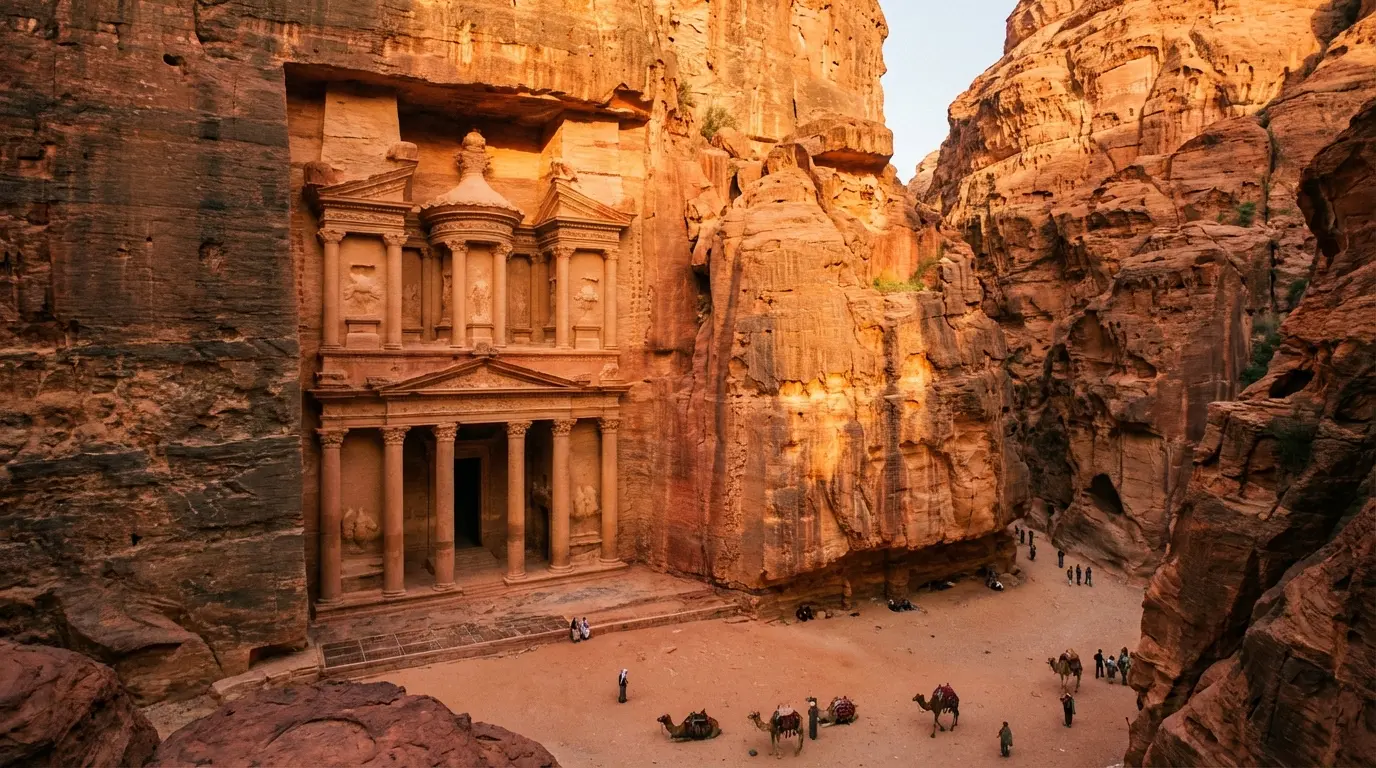
Petra: The Rose-Red City and Its Ancient Connections
Petra needs no introduction as a wonder, but it’s worth saying what it means for a faith community specifically. The Nabataeans who built Petra controlled the ancient trade routes that ran through the biblical world. Paul, in his letter to the Galatians, mentions time in Arabia. Some scholars believe that time was spent in Nabataean territory, possibly near Petra.
Beyond the theological connections, Petra is simply one of the most extraordinary places on earth. Walking through the Siq, that narrow canyon that opens suddenly into the facade of the Treasury, is a genuinely humbling experience. Your group will feel small in the best possible way.
We build Petra into our Jordan itineraries with enough time to go deep, not just the Treasury but the High Place of Sacrifice and the Byzantine church with its extraordinary floor mosaics. There is real biblical and early Christian heritage here that most day visitors never reach.
Madaba and the Mosaic Map of the Holy Land
Madaba is a small city about thirty kilometers south of Amman, and inside the Greek Orthodox Church of Saint George, embedded in the floor, is something remarkable: a 6th-century Byzantine mosaic map of the Holy Land. It’s the oldest surviving cartographic depiction of Jerusalem and the surrounding region.
For a faith community that has been walking through these landscapes, standing over this ancient map and recognizing the places you’ve just visited is a profound experience. The map shows the Jordan River, the Dead Sea, Jerusalem, and dozens of cities mentioned in scripture. It was made by Byzantine Christians who wanted to record the sacred geography of their faith.
Madaba is also a living Christian community today. The town has a significant Christian population, and visiting here adds a dimension that many groups find meaningful: this is not just an ancient heritage site. These are people who have held faith in this region for centuries.
Jerash: A Roman City Frozen in Time
Jerash is one of the best-preserved Roman cities anywhere in the world. Its colonnaded streets, temples, theaters, and forums are intact in a way that Rome itself no longer is. And for faith groups, its significance is direct: Jerash was one of the cities of the Decapolis, the league of ten Greco-Roman cities that appears in the New Testament.
When Jesus healed the Gadarene demoniacs, the account places him in the region of the Decapolis. When he returned there and fed the four thousand, Mark’s gospel tells us the crowds were Gentiles, people from these very cities. Understanding the Roman world of Jerash helps you understand what it meant that Jesus moved into Gentile territory, and why those encounters mattered.
We typically spend a morning in Jerash. It’s genuinely beautiful, and it rewards time.
Lot’s Cave: Where Abraham’s Nephew Found Shelter
This is a site that often doesn’t appear on standard itineraries, and I think that’s a shame. Above the eastern shore of the Dead Sea, there is a Byzantine monastery built into the hillside, and inside it, a cave believed since ancient times to be where Lot and his daughters took refuge after fleeing Sodom. There are early mosaic floors, a small church, and a museum that displays the archaeological finds from the site.
The story of Lot is one of the strangest and most human in Genesis. Standing in the cave where tradition says he sheltered, looking out over the sea that covers the plain where Sodom stood, is a strange and quiet experience. Groups that include it tend to remember it.
Jewish Heritage in Jordan: A Quieter but Real Story
I want to speak honestly to the rabbis reading this, because Jewish heritage in Jordan is a story that doesn’t often get told.
The connections are ancient and real. The tribes of Reuben, Gad, and Manasseh settled in what is today Jordan. The Exodus route passed through Moab and Edom, through this landscape. The book of Ruth is set partly in Moab, which is modern Jordan. Elimelech and Naomi’s story begins here.
In more recent history, there was a Jewish community in Transjordan during the early 20th century, and there are archaeological traces that speak to that presence. The Wadi Musa area near Petra has connections to the water that Moses struck from the rock at Meribah-Kadesh.
There are also practical considerations I want to address. Kosher food is not widely available in Jordan. We handle this through our network of partners and prepare accordingly, with packaged kosher meals and careful planning at hotels. It’s not an obstacle; it just requires preparation, and that’s something we take seriously. Shabbat observance is accommodable with the right itinerary structure, and we build that in for groups where it matters.
Jordan is a Muslim-majority country that has maintained formal peace with Israel since 1994. In my experience, Jordanians are warm and hospitable toward Jewish groups. The welcome is genuine. But this is something we discuss honestly with every group leader before departure, so you can speak to your congregation with confidence.
Combining Jordan with Israel: What Group Leaders Need to Know
Almost no one comes to Jordan alone. In our experience, Jordan almost always pairs with Israel, either as a pre-trip extension, a post-trip extension, or a midpoint in a longer journey. And that combination is exactly right, because the story flows that way. You enter the land from the east, as the ancient Israelites did. Or you close a week in Israel by crossing over to see where Moses stood.
Our most popular combination is Israel followed by Jordan, with the crossing at the Sheikh Hussein Bridge in the north or the Allenby/King Hussein Bridge near Jericho. The crossing you use depends on your itinerary and your group’s logistical situation, and we handle all of that planning.
The practical benefit for group leaders: when you travel with fifteen or more participants, you travel free. That makes a Jordan extension genuinely affordable for congregations that might otherwise think it’s out of reach. And because we handle the hotel pickup and dropoff, the transfer between countries, and the guide coordination on both sides, you don’t have to manage any of it. You focus on your group. We handle the movement.
For a suggested route, our Jordan heritage destination page gives you the framework, and we also offer a complete seven-day Jordan heritage itinerary for groups who want to plan a dedicated Jordan experience.
Practical Realities for Faith Groups Visiting Jordan
Entry, Visas & Border Crossings
Most visitors from North America, the UK, Australia, and European countries can enter Jordan with a visa on arrival or through the Jordan Pass, which is an online pre-purchase that covers the entry visa and Petra admission. We recommend the Jordan Pass for most groups, and we handle the coordination.
If your group is coming from Israel, the entry situation depends on which crossing you use. The Wadi Araba crossing near Eilat/Aqaba is the southern option. The Sheikh Hussein Bridge in the north serves groups traveling from the Galilee region. The Allenby Bridge near Jericho requires a bit more coordination because it’s not a standard international crossing, but it’s very commonly used for Israel-Jordan combinations and we have years of experience with it.
Passports with Israeli stamps are accepted at all Jordanian border crossings. That has been the case since the 1994 peace treaty. Your group members with Israeli stamps, Israeli passports, or dual citizenship should have no difficulty entering Jordan.
What to Expect on the Ground
Jordan is a safe country for faith group travel. The U.S. State Department’s current advisory levels, which we monitor consistently, have generally placed Jordan at Level 1 or 2, comparable to many European destinations. The Jordanian tourism infrastructure is well developed, the guides are professional, and the hotel options in Amman, Petra, and the Dead Sea region are excellent.
A few things worth knowing: Jordan is a conservative Muslim country, and modest dress is appreciated at religious sites and in smaller towns. This is not a burden; it’s a sign of respect, and our group leaders always brief their communities before departure. Women should plan to cover their shoulders and knees at mosques and certain historical sites.
The food is excellent and the hospitality is genuine. Mansaf, Jordan’s national dish of lamb in fermented yogurt sauce, is something your group will talk about for years. The mezze spreads, the fresh bread, the strong tea, these are not incidental. They are part of what makes Jordan feel like a living place, not just a museum.
FAQ: Jordan Heritage Travel
What are the most important biblical sites in Jordan?
The sites I consider essential for a faith group are Mount Nebo, Bethany Beyond the Jordan (the baptism site), Madaba and its mosaic map, Petra, Jerash, and the region of the Dead Sea including Lot’s Cave. A dedicated Jordan heritage tour can include all of these in five to seven days.
Can you combine a Jordan heritage tour with an Israel trip?
Yes, and this is how most of our groups travel. The two countries share a border and the historical and spiritual narrative flows naturally between them. We regularly build combined Israel-Jordan itineraries that use one of three border crossings. The combination feels like a complete story rather than two separate trips.
Is Jordan safe for faith group travel?
In our experience, absolutely yes. We have been bringing faith communities to Jordan for more than twenty years. Jordan maintains peace with Israel, has a stable government, and a Jordanian tourism sector that takes the safety and comfort of international visitors seriously. We monitor conditions and stay in close contact with our local partners. No destination is entirely without risk, but Jordan consistently ranks among the safer countries in the region for international travel.
What is the best way to cross the border between Israel and Jordan?
The right crossing depends on your itinerary. For groups starting or ending in Tel Aviv or Jerusalem, the Allenby Bridge (King Hussein Bridge) near Jericho is most commonly used. For groups in the north, near the Sea of Galilee, the Sheikh Hussein Bridge is more practical. For groups finishing in Eilat, the Wadi Araba crossing connects to Aqaba in the south. We plan the crossing logistics as part of every combined itinerary.
Do Heritage Tours handle all the planning for Jordan group trips?
Yes, completely. Hotel pickup and dropoff, border crossing coordination, guides on both sides, accommodations, and the day-by-day itinerary are all handled by our team. Group leaders have one point of contact throughout. Your job is to be present for your community, spiritually, pastorally, in every way that counts. The movement and logistics are ours to carry.
I don’t think there’s a better way to close a Holy Land journey than standing where Moses stood, looking at the land he was promised and never entered. There’s something in that view that touches every faith community differently, but it touches everyone. If you’re considering adding Jordan to your group’s journey, I’d love to talk through what that could look like for your congregation specifically.
Reach out and let’s have a conversation. There’s no pressure. Just two people talking about a place that deserves to be experienced.