I’ve been bringing groups to Jordan for over twenty years, and the question I hear most before every trip isn’t “what will we see?” It’s “will it feel like something?” That question tells me everything I need to know about the people I’m traveling with. They’re not looking for another site on a checklist. They’re looking for a moment where the Scripture they’ve read their whole lives suddenly becomes three-dimensional. Where the ground under their feet is the same ground the prophets walked.
Jordan does that. Quietly, powerfully, and in ways that still catch me off guard even now.
What I want to do in this post is walk you through the sites that matter most, not just as historical locations, but as places where something spiritual is still available to you and your group if you come with intention. I’ll tell you what the text says about each place, and I’ll tell you what I’ve actually watched happen when a congregation stands there together.
Jordan as Sacred Geography, Not Just a Neighboring Country
Most people think of Jordan as the place you pass through on the way to somewhere else. Even among faith travelers, Israel gets the headlines while Jordan sits quietly in the margins. That’s a mistake, and one I want to help you correct before you plan anything.
The Jordan River forms the eastern boundary of the Promised Land in both the Torah and the Gospels. The tribes of Reuben, Gad, and half of Manasseh received their inheritance on the Transjordan plateau. Moses died here. Elijah ascended to heaven near here. John the Baptist ministered on this side of the river. The early Christian communities built churches in what is now southern Jordan long before the Byzantine era reached its peak.
Jordan isn’t the background to the biblical story. In many moments, it’s where the story happened.
When I take a group to our Jordan heritage destination, I always spend time on the first evening simply orienting people to the geography. East of the river. That phrase alone carries enormous theological weight for anyone who knows the text. Once groups understand where they are in relation to the biblical narrative, everything they encounter in the days that follow lands differently.
Mount Nebo: The Mountain of Moses’ Final Vision
What the Torah Says About This Place
The account in Deuteronomy 34 is one of the most moving passages in all of Scripture. Moses climbs Nebo, and God shows him the entire Promised Land in a panoramic vision he will never enter. Every direction has a name. Every hill and valley is identified. And then Moses dies there on the mountain, and no one knows the place of his burial to this day.
Mount Nebo isn’t mentioned once in that passage. It’s where Moses ends. That’s what this mountain is.
When you stand on the summit on a clear morning, you can see the Dead Sea directly below you. Across the water, the hills of Judea. On the best days, you can see as far as Jerusalem. I’ve stood there dozens of times and it still does something to me. The view Moses saw, or something close to it, is still there.
What Groups Do Here That Changes Them
The groups that simply look at the view and move on miss most of what this place offers. The groups that stay, that open the Torah or the Bible and read Deuteronomy 34 aloud on the summit together, those groups leave different.
I’ve watched a congregation of eighty people fall completely silent after their rabbi finished reading. Not a performance. Not theater. Just the weight of where they were settling in.
We allow time for prayer here, for a moment of silence, for groups to hold a short service if that fits their tradition. There’s a small Byzantine church on the summit that has a remarkable mosaic floor depicting hunting and pastoral scenes from the 6th century. The combination of the ancient site, the view, and the text creates something that no guided lecture can manufacture. You simply have to be there.
Bethany Beyond the Jordan: The Baptism Site of Jesus
Its Significance for Christian Pilgrims
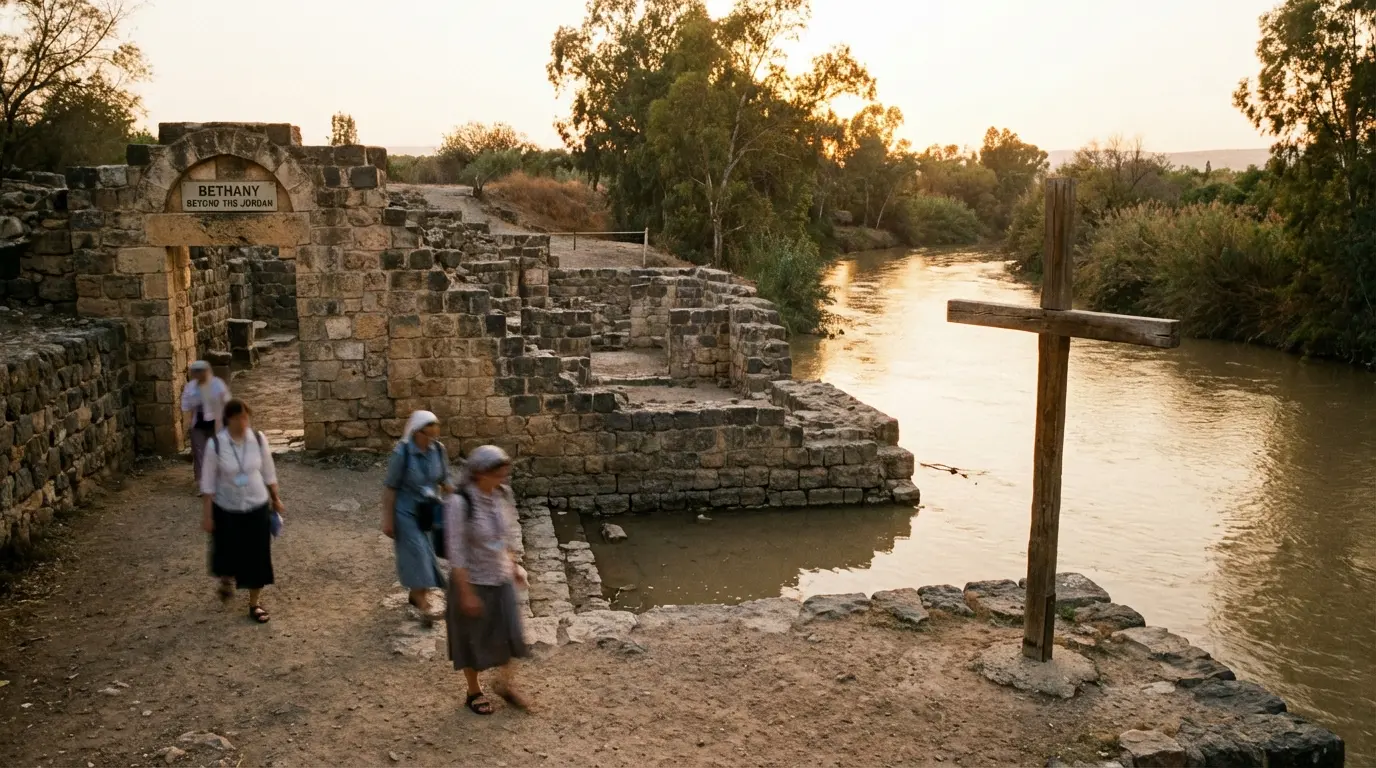
The Gospel of John identifies the place where John the Baptist was baptizing as “Bethany beyond the Jordan.” For centuries the exact location was debated, but archaeological work since the 1990s has established the site with strong scholarly consensus. Today it is a UNESCO World Heritage Site, and it is one of the most spiritually charged places I have ever brought a Christian group.
The Jordan River at this point is narrow and quiet, nothing like the dramatic crossing the Israelites made in Joshua’s account. But that modesty is part of what moves people. Jesus came here as an ordinary man, stood in the same river, and walked into the next chapter of everything.
For pastors bringing a congregation, this site opens up conversations about baptism, about calling, about the moment when ordinary life tips into something larger. Many groups arrange to hold a baptismal renewal ceremony at the water’s edge. The Jordanian authorities accommodate this, and Heritage Tours can coordinate it as part of your itinerary.
The site also includes the ruins of ancient Byzantine churches and baptismal pools from the early Christian centuries, along with the cave traditionally identified as John the Baptist’s dwelling. Walking through the archaeological layers, you’re moving through two thousand years of pilgrimage. Other Christians came here before us and left their prayers in stone.
Its Significance for Jewish Heritage Travelers
The Jordan River crossing was the defining moment of Israelite identity. Joshua 3 describes the priests carrying the Ark of the Covenant into the river, the waters stopping, the entire nation crossing on dry ground. It echoes the Red Sea directly and deliberately. This is the people arriving, finally, in the land that was promised.
Bethany Beyond the Jordan sits within miles of that crossing point. For a Jewish heritage group, standing at the Jordan is standing at the threshold. The wilderness is behind you. The land is ahead. Whatever each person carries in their own life, there’s something about physically standing at that boundary that speaks.
I’ve brought Jewish groups here who weren’t expecting it to affect them and were surprised when it did. The landscape does the work. Your job is just to be present for it.
Machaerus: The Fortress of Herod and John the Baptist
Machaerus doesn’t appear in many Jordan itineraries, and that’s a loss. This hilltop fortress on the eastern edge of the Dead Sea region is where, according to the Gospels, John the Baptist was imprisoned and executed. Josephus confirms the location in his historical writings.
What strikes most groups when they arrive is the isolation. Machaerus sits on a dramatic ridge with views stretching in every direction. It was a place designed to be inescapable. And in a strange way, it’s also a place where the story of John the Baptist becomes fully human. A prophet, imprisoned. A king, uncomfortable with the truth but unwilling to act on it until the pressure of a banquet made the decision for him.
This is a site for reading the Gospel account aloud and sitting with the discomfort. It’s not a site for easy answers. The best moments I’ve had here with groups are the ones where nobody says anything for a while after the reading. That silence is itself a form of prayer.
Madaba: The Byzantine Church and the Mosaic Map
The town of Madaba, about thirty kilometers south of Amman, holds one of the most extraordinary objects in the entire Holy Land. Inside the Church of Saint George, set into the floor as it has been for fifteen centuries, is a large Byzantine mosaic map of the entire biblical world. Jerusalem appears at the center. The Jordan River, the Dead Sea, the major cities of ancient Judea, Egypt’s Nile delta. All of it is there, rendered in hundreds of thousands of tiny colored tiles.
This map was made by people for whom the geography of Scripture was not abstract. They knew where everything was and they wanted to record it. Standing over it, you’re looking at the ancient world’s understanding of sacred geography.
Madaba also has other beautiful Byzantine churches with exceptional mosaic floors, and the town itself is a living Christian community with roots in the early church. For any group interested in the history of Christianity in the Middle East, Madaba is irreplaceable.
The Desert of Wadi Rum: Where Silence Speaks
I want to be honest about Wadi Rum. It is not a biblical site with a chapter and verse attached to it. But I include it in almost every spiritual itinerary because silence is itself a spiritual experience, and Wadi Rum is one of the few places left on earth where you can find it completely.
The Nabataean people who carved Petra also moved through Wadi Rum. The ancient trade routes that connected Arabia to the Mediterranean ran through this desert. The landscape is vast, red, and profoundly still.
Many faith traditions include silence and desert as core disciplines. The prophet Elijah fled to the wilderness. Moses spent forty years there. Jesus fasted in the desert for forty days. When groups spend even one evening in Wadi Rum, around a fire, under a sky that has more stars than most of them have ever seen, something opens in people that no lecture can create.
I don’t usually structure the Wadi Rum evening. I let it be what it is. People pray, talk, write, or just sit. Every group uses the silence differently, and every group is grateful for it.
Petra’s Spiritual Layers Beneath the Archaeology
Most visitors come to Petra for the architecture, and the architecture is genuinely extraordinary. The Treasury, the Monastery, the Royal Tombs carved directly into the rose-red sandstone cliffs. But for a faith group, Petra has layers that most tourists never reach.
The Nabataeans were a sophisticated theological culture. Their sacred sites are woven throughout the city. The high places, the open-air altars, the carved niches that held images of their gods. Walking through Petra with an understanding of ancient Near Eastern religion opens up the Israelite prophets in ways you can’t get from a classroom.
Amos, Isaiah, Jeremiah, all of them knew about Edom, the territory that includes this region. The prophetic warnings about Edom’s pride are sometimes about exactly the kind of wealth and power that Petra represented at its height. Walking the colonnaded street with that text in your mind is a very different experience from just being impressed by the carvings.
We also arrange for groups to access the lesser-visited areas of Petra where you can sit quietly among the ancient tombs and read or pray without crowds. The early morning hours in Petra, before the tourist groups arrive, are some of the holiest feeling I’ve experienced anywhere.
Lot’s Cave: The Genesis Story Made Physical
On the eastern shore of the Dead Sea, near the town of Ghor as-Safi, is a site associated with the story of Lot and his daughters from Genesis 19. The cave itself, and the remains of a Byzantine church built around it, mark the place where ancient tradition located the family’s shelter after the destruction of Sodom.
This is not a comfortable site spiritually, and I don’t pretend it is. The Genesis story is complex, disturbing in places, and raises questions that have kept readers wrestling for three thousand years. But that’s exactly why it belongs in a serious faith itinerary. The Bible isn’t only beautiful moments. It’s also human failure, difficult choices, and consequences.
Groups that are willing to sit with a hard text at a hard site often find that this is where the most real conversations happen. I’ve had groups arrive at Lot’s Cave having barely spoken to each other and leave having talked about things they’d never addressed before. The ancient texts are good at that.
Jerash’s Early Christian Churches
The Roman city of Jerash, in northern Jordan, is one of the best-preserved Greco-Roman provincial cities anywhere in the Middle East. Its colonnaded streets, temples, and amphitheaters are remarkable for their completeness.
But for Christian groups, what matters most in Jerash are the Byzantine churches built within the Roman city during the 4th through 7th centuries. There are more than a dozen of them, many with surviving mosaic floors. The Cathedral, the churches of Saints Cosmas and Damianus, the Church of Saint Theodore, together they tell the story of a community that turned a pagan city into a Christian one and then built their faith into the ground itself.
Walking through Jerash with that lens, watching how a Roman city was transformed by a community’s beliefs, is a conversation starter about what faith communities can build and what they leave behind.
How to Build a Spiritually Intentional Jordan Itinerary
After twenty years of doing this, I’ve learned that the difference between a good Jordan itinerary and a transformative one comes down to a few things.
First, space. Don’t fill every hour. The sites themselves need time to breathe, and so do the people visiting them. A rushed visit to Mount Nebo is almost worse than not going, because you get the view but miss the weight.
Second, text. Bring your congregation’s sacred texts with you and use them on location. Read the Deuteronomy passage on Nebo. Read the baptism account at Bethany. Read the Isaiah passages about Edom in Petra. The archaeology and the text together create something neither can do alone.
Third, intention. Talk to your group before each site about what you’re looking for. Not just facts, but meaning. Ask them to come to each place with a question, something personal they’re carrying, and see what the site says back to them.
Heritage Tours builds all of this into the journey. Our local guides understand the religious layers of each site as well as the archaeological ones. We make time for prayer, for devotionals, for readings. We know which places are appropriate for a full congregational service and which call for silence.
If you’re thinking about bringing a group to Jordan, I’d be glad to talk through what a custom itinerary built around your community’s specific spiritual focus might look like. There is no template for this. Every community has its own questions, and Jordan has enough depth to answer all of them.
FAQ: Spiritual Travel to Jordan
What is the most sacred site in Jordan for Christians?
For most Christian travelers, Bethany Beyond the Jordan carries the deepest significance. It is the site identified in the Gospel of John as the place where Jesus was baptized, now a UNESCO World Heritage Site with active archaeological excavation. Mount Nebo, associated with Moses, and Machaerus, associated with John the Baptist, are close seconds. The answer often depends on what aspect of faith a group is centering its journey around.
What is the most sacred site in Jordan for Jewish travelers?
Mount Nebo is the site most Jewish travelers respond to most deeply. It is where Moses died and was buried, and where, according to Deuteronomy 34, God showed him the full extent of the Promised Land. The Jordan River crossing sites also carry enormous significance for groups who approach Jordan through the lens of the Exodus narrative and the books of Joshua and Deuteronomy.
Can you pray or hold a worship service at Jordan’s spiritual sites?
Yes, in most cases. Jordan’s approach to religious tourism is genuinely welcoming. Groups can arrange devotional readings, prayer, and short worship services at many sites, including the Baptism Site (Bethany Beyond the Jordan), Mount Nebo, Petra, and Wadi Rum. Some sites have specific protocols, and Heritage Tours handles all coordination in advance so that your group’s time at each location is prepared rather than improvised.
Is the Baptism Site (Bethany Beyond the Jordan) worth visiting?
Without question. The site has been authenticated by extensive archaeological work and recognized by UNESCO. It includes the area along the Jordan River identified in the Gospel of John, ancient baptismal pools, ruins of Byzantine churches, and the cave traditionally associated with John the Baptist. Many Christian groups arrange a baptismal renewal ceremony here. For Jewish heritage groups, the Jordan River crossing holds independent significance connected to the book of Joshua.
What makes Jordan spiritually significant for people of faith?
Jordan contains some of the most important sites in both the Hebrew Bible and the New Testament, yet it receives far less pilgrimage attention than Israel. The territory east of the Jordan River, the ancient Transjordan, is where Moses died, where Elijah ministered, where John the Baptist preached, where Jesus was baptized, and where some of the earliest Christian communities built their churches. For any person whose faith is rooted in Scripture, Jordan is not a secondary destination. It is part of the same sacred geography.
Jordan has been giving faith travelers something they didn’t know they needed for thousands of years. If you’re considering bringing your congregation, or coming for the first time yourself, we’d be glad to help you plan a journey that serves the spiritual purpose you have in mind. Reach out to us at Heritage Tours, and let’s talk about what your group is looking for.