I’ve been working in this region for over twenty years, and one thing I’ve learned is that the people who are most nervous before a first Jordan trip are almost always the people who love it most once they arrive. The anticipation builds it up into something complicated. But Jordan is not complicated. It is close, it is welcoming, and it is deeply, genuinely significant for anyone who cares about where the stories of our faith took place.
If you’re a rabbi or pastor thinking about bringing your congregation here for the first time, this guide is for you. I want to give you the honest picture, not the polished brochure version, so you can make this decision with real information in front of you.
What Nobody Prepares You For (And What You Don’t Need to Worry About)
Most people arrive in Jordan expecting it to feel foreign in a way that requires constant vigilance. And then they land, and they realize it doesn’t feel that way at all.
Amman is a modern, functioning city with good hotels, reliable roads, and people who are used to hosting international visitors, including faith groups, including Jewish groups, including large congregations carrying Torah scrolls for a ceremony at the Jordan River. I have seen all of this. Jordanian hospitality toward visitors is not a marketing phrase. It is cultural, it runs deep, and you will feel it.
What surprises people most is how calm it feels. Jordan has a long tradition of being one of the most stable countries in a complicated neighborhood, and daily life in Amman reflects that. The coffee shops are full. The markets are busy. Nobody is watching you suspiciously. You are a guest in a country that takes the tradition of hosting guests seriously.
What you should not worry about: looking like an outsider. What you should pack appropriately for: visiting sacred sites, which means modest dress. More on that below.
Is Jordan Safe for Faith Travelers?
Let me answer this directly, because I know it is often the first thing a group leader is asking, even if they are not saying it out loud.
The Reality of Jordan’s Stability
Jordan has maintained a peace treaty with Israel since 1994 and has been a consistent partner for cross-border heritage travel ever since. The country is governed by a monarchy with strong institutions and a long-standing tradition of religious tolerance. It is home to Christian communities, has been a destination for Jewish heritage travelers for decades, and receives millions of international tourists every year.
The U.S. State Department currently classifies Jordan as Level 2 (exercise normal precautions), the same classification as France, Germany, and much of Western Europe. I do not say this to be dismissive of real-world complexity. I say it because “is Jordan safe” sometimes gets filtered through a general anxiety about “the Middle East” as a monolithic concept, and Jordan is not that story.
What Faith Groups Should Be Aware Of
There are things worth knowing. Jordan is a Muslim-majority country, and that shapes the rhythm of daily life in ways you will notice. The call to prayer five times a day is part of the ambient sound. During Ramadan, the daytime atmosphere shifts, restaurants may have different hours, and the evenings come alive in a different way. None of this is a problem for faith travelers. In fact, many groups find the visible practice of faith in public life quietly meaningful.
There is no political tension around visiting sites sacred to Judaism or Christianity. Petra, Mount Nebo, Madaba’s mosaic church, the baptism site at Bethany Beyond the Jordan, these are not contested. They are protected, staffed, and welcoming to international visitors of all faiths.
The only real safety consideration I give groups is this: stay with your guide, trust your itinerary, and don’t make impulsive decisions about wandering into unfamiliar areas independently. This is the same advice I give in any country.
Getting Into Jordan: Visas, Borders & Entry
Flying Into Amman
Queen Alia International Airport outside Amman is a modern, well-run international airport. Most visitors from North America connect through European hubs. The airport is efficient. Customs and passport control are straightforward. Jordan offers a visa on arrival for citizens of most Western countries, including the United States, Canada, and the UK. The cost is approximately 40 Jordanian dinars, paid at the border.
If you purchase the Jordan Pass before arrival, the visa fee is included in the pass cost, which also covers entry to Petra and over 40 other attractions. For a heritage trip, the Jordan Pass almost always makes financial sense and we help every group sort this out in advance.
Crossing from Israel
This is the route that many of our groups take, and it is the one that generates the most questions. If you are combining a Jordan portion with time in Israel, you will cross at the King Hussein Bridge (also called the Allenby Bridge). This crossing connects the West Bank to Jordan and is the primary crossing for faith travelers doing a combined Holy Land itinerary.
A few things to know. The crossing is not run like a standard international airport border, and it can take time. The pace is unpredictable. Some groups move through in 90 minutes. Some wait longer. We build our Jordan itineraries to account for this, so nobody is rushing from the crossing to an afternoon site visit. The crossing is manageable, it is just not something to rush.
You do not need to fly to travel from Israel to Jordan. Many of our groups drive from Jerusalem to the crossing, move through border control, and are in Amman by early afternoon. This continuity between the two countries is one of the things that makes the combined Israel-Jordan heritage journey so powerful. The Jordan River, Mount Nebo, the Promised Land as seen from the east, these are not add-ons to a Holy Land trip. They are the other side of the same story.
For more on what that full experience looks like, see our Jordan heritage destination page.
Navigating Jordan as a Faith Group
What to Wear and How to Present at Sacred Sites
At Islamic sites, including mosques and the major shrines, both men and women should dress modestly. For women, this means covering shoulders, arms, and legs. A scarf or shawl to cover hair is expected when entering mosque spaces. At Christian sites like the baptism site or Madaba’s churches, modest dress is expected but the requirements are somewhat less strict. When in doubt, err toward more coverage, not less.
I always tell groups: pack a light layer you can put on quickly. Not because Jordan will shame you if you forget, but because arriving dressed thoughtfully is a form of respect that the people you meet will notice and appreciate. It changes the quality of your interactions.
Cultural Respect at Muslim, Christian and Jewish Sites
Jordan has Muslim, Christian, and Jewish heritage sites, and each calls for a slightly different kind of engagement. At Muslim sites, remove shoes before entering prayer spaces. Speak quietly. Do not photograph without checking whether it is appropriate. At Christian sites, the same general reverence applies. At sites like Mount Nebo, where Moses stood to see the Promised Land before his death, the significance is multi-layered and the atmosphere is often unexpectedly moving.
One thing I want to flag specifically for Jewish groups: you are welcome. Jordan’s relationship with Jewish visitors has grown steadily since the peace treaty. There are sites of direct relevance to Jewish heritage, and we have taken countless Jewish congregations through them without incident. The warmth you receive from Jordanian staff at these sites is genuine.
Money, Language & Getting Around
The Jordanian dinar is the currency, and one dinar is worth roughly $1.40 USD. ATMs are widely available in Amman and at tourist sites. Cash is preferred at smaller merchants and for tips. Credit cards work at most hotels and larger restaurants.
Arabic is the official language, but English is widely spoken in tourist areas, hotels, and anywhere you are likely to be as part of a heritage itinerary. You will not struggle to communicate. That said, a few words of Arabic greeting go a long way. “Marhaba” (hello) and “shukran” (thank you) will earn you smiles everywhere.
Getting around Jordan as a group is not something you figure out on arrival. We arrange all ground transportation, the bus is there when you land, the driver knows the route, and you move through the country as a group without anyone having to navigate independently. I mention this not to sound corporate about it, but because this is genuinely one of the things that makes a first Jordan trip feel manageable. You are never standing at a corner wondering how to get your 20 congregants somewhere.
The Sacred Sites That Matter Most for a First Visit
For a first heritage trip to Jordan, there are a handful of sites that I consider essential, and they are not all Petra.
Bethany Beyond the Jordan (the Baptism Site): This is where John baptized Jesus, according to the Gospels. The site is beautifully preserved, clearly authenticated by archaeological evidence, and spiritually significant for Christian groups in a way that is hard to describe until you are standing there. For many pastors leading a group here, this becomes the emotional center of the entire journey.
Mount Nebo: Moses looked out from this hill and saw the Promised Land he would not enter. The view across the Jordan Valley toward Israel, the Dead Sea below, the haze of Jerusalem in the distance on a clear morning, I have stood here hundreds of times and it is still something. For Jewish groups especially, this is profound ground.
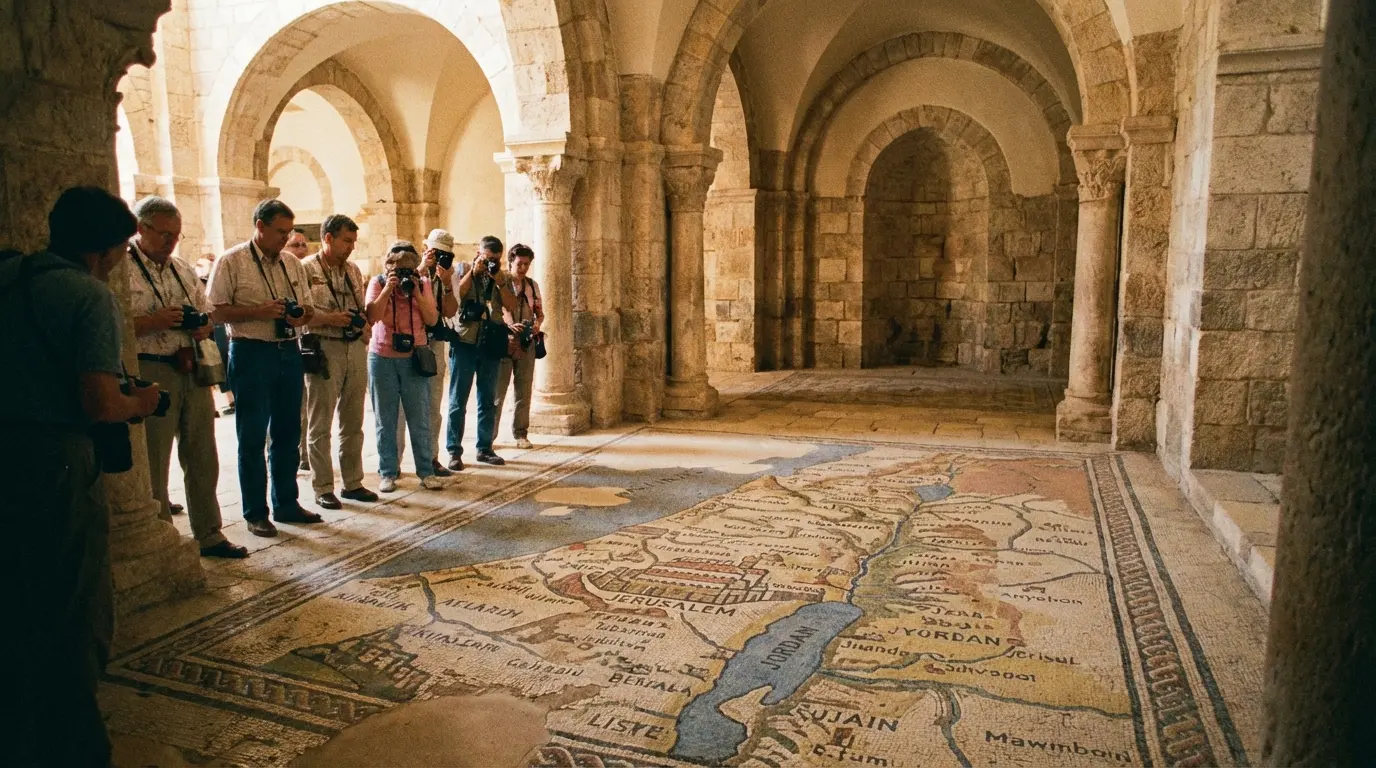
Madaba: The mosaic church of St. George contains one of the oldest maps of the Holy Land in existence, rendered in floor tiles in the sixth century. It is a remarkable thing to see and gives your group a visual anchor for everything they have read in Scripture.
Petra: Yes, Petra is on the list. Not because it is a spectacle (though it is), but because it is Nabataean heritage, it is ancient, and it sits in the landscape of the biblical Negev in a way that connects to the larger story of the region. Be aware that Petra is large and the walk through the Siq is substantial. We pace it correctly for heritage groups, not adventure hikers.
The Jordan River: For any group doing a combined Israel-Jordan itinerary, standing at the Jordan River on the Jordanian side is a different experience than the Israeli side. Both matter. Both are moving. They are the same river and two very different perspectives on the same story.
What Surprises First-Time Visitors About Jordan
The food. Every time. Groups expect something foreign and unfamiliar and instead find fresh bread, roasted meats, mezze that goes on and on, and hospitality that keeps filling your plate. Jordanian food is genuinely wonderful and plentiful.
The scale of Petra surprises people who expected a postcard. The site is enormous, the colors of the rock are extraordinary, and the walk into the treasury through the Siq, that narrow canyon of rose-red stone, is an experience that does not translate in photographs.
The Jordanian people surprise people. The warmth is real. The curiosity about where visitors are from and why they are there is genuine. I have watched many group members come home with friendships, or at least with the memory of a conversation at a tea stall in Petra that they did not expect to have.
And honestly, the spiritual weight surprises people. They expected beautiful landscapes and heritage. They did not always expect to feel moved at Mount Nebo, or quietly undone at the baptism site, or to understand the geography of the biblical narrative in a way they could not from a map. Jordan does this. It opens up the text.
How to Make Your First Jordan Trip Count: Even for a Group Leader
If you have never been to Jordan and you are considering leading your congregation here, I want to say something directly: this is not a liability. Group leaders who lead their first Jordan trip alongside their congregation often describe it as one of the most meaningful shared experiences of their leadership. You are not pretending expertise you do not have. You are being genuinely present with your people.
What helps is having a team behind you that has done this hundreds of times. When the guide knows exactly which spot at Mount Nebo catches the morning light, when the hotel is already briefed on the group’s Shabbat schedule, when the border crossing timing is built into the itinerary correctly, you are free to be the spiritual leader your group needs. Not the travel coordinator.
That is the job we take so you don’t have to.
If this is your first time thinking seriously about Jordan, our complete Jordan heritage travel guide is a good next step. And if you want to talk through what the right pacing looks like for a first-timer, we are here for that conversation.
FAQ: First-Time Travel to Jordan
Is Jordan safe for first-time visitors?
Yes. Jordan is classified by the U.S. State Department as Level 2 (exercise normal precautions), the same as most of Western Europe. It is a politically stable country with a long history of hosting international faith travelers, including Jewish and Christian groups. The team at Heritage Tours has operated there for over twenty years without incident.
Do I need a visa to visit Jordan?
Most Western travelers, including U.S., Canadian, and UK citizens, receive a visa on arrival at Amman’s Queen Alia International Airport. The cost is approximately 40 Jordanian dinars. If you purchase the Jordan Pass in advance, the visa cost is included and the pass also covers entry to Petra and dozens of other heritage sites.
Can you travel from Israel to Jordan without flying?
Yes. The King Hussein Bridge (also called the Allenby Bridge) connects the West Bank to Jordan and is the standard crossing point for faith travelers doing a combined Israel-Jordan heritage trip. It can take time, so building buffer into the itinerary on crossing days is important. We do this automatically for all our groups.
What should first-time heritage travelers wear in Jordan?
Modest dress is appropriate throughout the country and required at sacred sites. For both men and women, this means covered shoulders and legs. Women should bring a scarf or shawl for mosque visits where head covering is expected. Comfortable walking shoes are essential, especially for Petra.
How should a group leader prepare for their first Jordan trip?
Start by trusting your team more than your anxiety. The practical details, border crossings, hotel arrangements, site access, pacing, kosher or dietary accommodations, are things an experienced operator handles. Your preparation is spiritual and communal: know the sites, know why they matter to your congregation, and be ready to be present with your group in a way that a first-time visitor to any meaningful place gets to be. The uncertainty is part of the gift.
If you are ready to start planning, or just want to understand what a first Jordan itinerary might look like for your congregation, we would love to talk. Reach out and let’s find what’s right for your group.