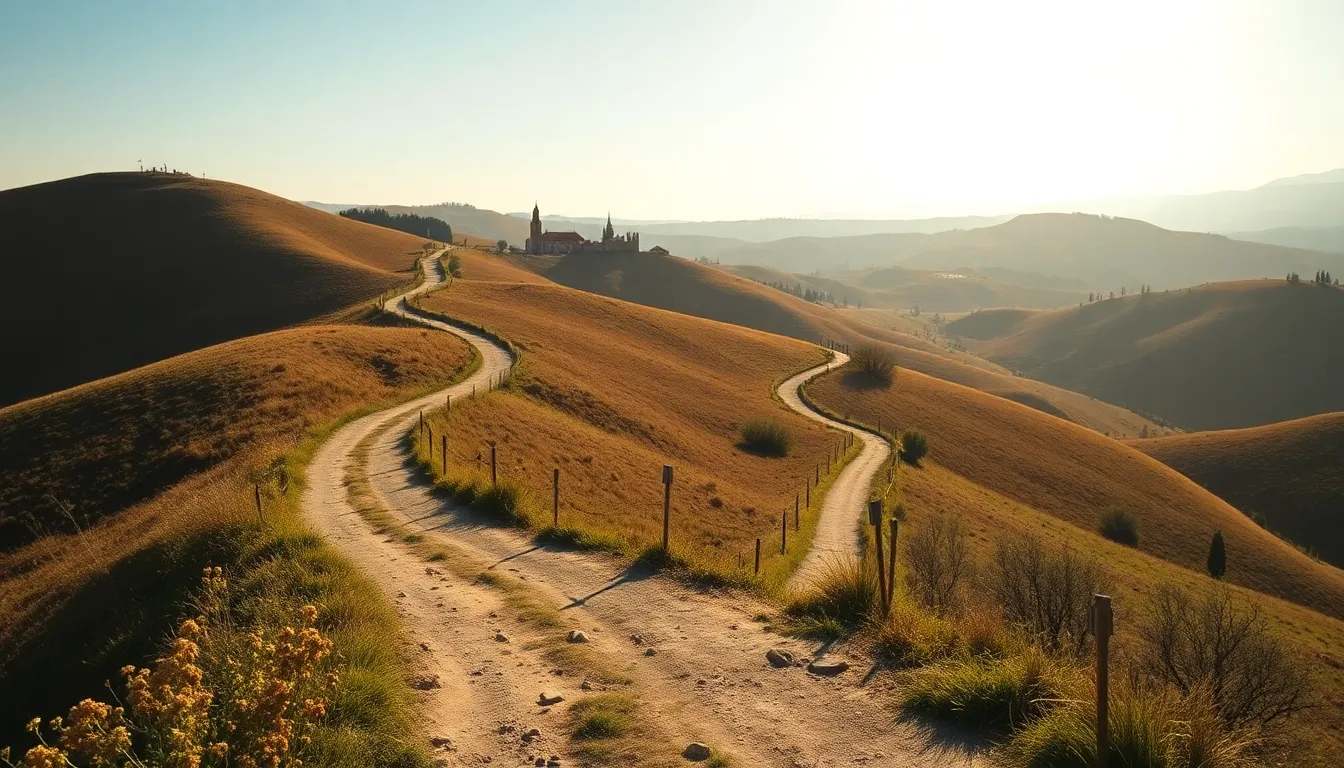
I remember the afternoon a group of mine, mostly retired, none of them athletes, walked the last few miles into a small Tuscan hill town on a stretch of the Via Francigena. They had spent the week in churches and museums, and they had been moved. But that walk was different. By the time we crested the final rise and the town came into view, half of them were in tears. One woman said she finally understood what the word pilgrim meant. Not someone who visits holy places. Someone who travels toward them on foot, the way people had on that exact path for over a thousand years.
That is what the Via Francigena offers a faith group that the basilicas alone cannot. It is the ancient road to Rome, and you do not have to walk all of it, or even most of it, to feel what it was. You just have to walk a piece. Let me tell you what this road is, and how a group can sample it without becoming long-distance hikers.
What the Via Francigena Actually Is
The Via Francigena is the great medieval pilgrim road that ran from Canterbury, in England, across France and Switzerland, over the Alps, and down through Italy to Rome. The name means roughly “the road that comes from the land of the Franks,” and it was the main artery by which northern European pilgrims reached the tombs of Peter and Paul.
We know its route in unusual detail because of one document. Around the year 990, Sigeric, the Archbishop of Canterbury, traveled to Rome to receive the pallium, the woolen band that confirmed his office, from the pope. On his way home he, or a member of his party, recorded the stages of the journey, listing the overnight stops one by one. Sigeric’s itinerary, with its roughly eighty stages from Rome back to the English Channel, is the backbone of what we now call the Via Francigena. A thousand years later, it is still used to plot the modern route.
For three centuries, alongside the roads to Jerusalem and to Santiago de Compostela in Spain, this was one of the three great pilgrimages of medieval Christendom. To reach Rome was to reach the center of the Western church, to stand at the graves of the apostles, and to receive the indulgences attached to that journey. Kings, bishops, merchants, and ordinary believers walked it, and the towns, churches, and hospices along the way grew up to serve them.
Why the Road Mattered, and Still Does
It is worth pausing on what a medieval pilgrimage cost a person, because it changes how a modern group walks even a short stretch.
There were no easy options. A pilgrim from England faced months on foot, a crossing of the Alps at the Great St. Bernard Pass that could kill in bad weather, rivers without bridges, bandits, illness, and the simple grind of walking day after day in all conditions. People made wills before they left, because many did not come back. The journey was an act of devotion precisely because it was hard, and the hardship was understood as part of the prayer.
When your group walks even a few miles of the original path, that history is under your feet. You pass the same churches where pilgrims gave thanks for surviving the mountains. You walk into the same towns that built hospices to shelter the road-weary. The physical act of arriving, tired, on foot, connects a modern believer to a thousand years of people who did the same thing for the same reason. That is something no bus can deliver.
The road faded after the medieval centuries, as pilgrimage patterns changed and travel modernized. But in recent decades it has been revived, waymarked, and recognized as a Council of Europe cultural route, and today thousands walk parts of it every year. The infrastructure for pilgrims, hostels, stamps in a pilgrim passport, welcoming parishes, exists again.
The Tuscan Stretch: Where Groups Walk
If a faith group is going to sample the Via Francigena, the stretch through southern Tuscany is almost always where I take them, and for good reason. It is the most beautiful, the best preserved, and the easiest to fold into a pilgrimage that is otherwise centered on Rome.
This section runs through the rolling hills south of Siena, a landscape of cypress lines, vineyards, and stone hill towns that looks exactly the way you imagine medieval Italy. Several towns along it are gems in their own right.
San Gimignano, with its cluster of medieval towers, sits on the route and is one of the most recognizable hill towns in Italy. Monteriggioni, a tiny walled village mentioned by Dante, was a fortified stop on the road. San Quirico d’Orcia and the surrounding Val d’Orcia, a protected landscape, offer some of the loveliest walking anywhere on the route. And the road eventually passes through Bolsena and down toward Rome itself.
The beauty of this stretch for a group is that you can walk a well-chosen segment, three or four miles, gentle enough for a mixed-age group, between two of these towns, with your bus meeting you at the end. You taste the pilgrimage without committing to weeks on the trail.
How to Sample the Road as a Group
I want to be honest about what a group can and cannot do here, because expectations matter.
Walking the entire Via Francigena from Canterbury to Rome takes the better part of three months. Walking the full Italian section takes around a month. No standard faith group is doing that. What groups do, and what works beautifully, is a “sample walk”: one or two carefully chosen segments built into a wider Italy pilgrimage.
Here is how I structure it. We pick a scenic, manageable stretch in Tuscany, often two to four miles on relatively gentle ground. The group walks it in the cool of the morning, at a contemplative pace, with stops for reading and prayer along the way. The bus and luggage go ahead to the destination town, so no one carries more than a daypack and water. We arrive on foot, the way pilgrims always did, and that arrival becomes the emotional high point of the day.
A few practical notes. Footwear matters even for a short walk, so I tell groups to bring real walking shoes, broken in. Tuscan summers are hot, so morning walks are essential and plenty of water is non-negotiable. The terrain has some unevenness, so anyone with serious mobility limits may need to ride ahead and meet the group, which is perfectly fine and takes nothing away from them. And a pilgrim passport, stamped along the way, makes a meaningful keepsake for those who want one.
The walk pairs naturally with the rest of a pilgrimage. We cover how to build the whole journey in our guide to planning a Christian pilgrimage to Italy, and the Francigena slots in as a day or half-day that gives the trip a different texture from the city-and-basilica days. It also connects to the broader spiritual sites of Italy that a group will see along the way.
Ending Where the Pilgrims Ended
There is a particular power in the way the Via Francigena ends. For a thousand years, every pilgrim on this road was walking toward one place: the tomb of St. Peter in Rome. The medieval traveler crossing the Alps, fording rivers, sleeping in hospices, was aiming at that single destination the entire way.
When I build the Francigena into a pilgrimage, I try to honor that arc. We walk our stretch of the ancient road earlier in the trip, and then, when we reach Rome and stand at last before St. Peter’s, I remind the group that they are standing where the whole road was always leading. The pilgrims who walked the Via Francigena for centuries were walking here, to this spot. Connecting your group’s few miles of trail to that final destination gives the entire pilgrimage a sense of completion that lands deep.
You can see how the Francigena and Rome fit together in a full program on our Italy destination page, and learn how the group leader experience works, including the leader traveling free with fifteen or more, on our group heritage tours page.
FAQ: The Via Francigena
What is the Via Francigena?
It is the great medieval pilgrim road that ran from Canterbury in England, across France and Switzerland, over the Alps, and down through Italy to Rome. Along with the routes to Jerusalem and Santiago de Compostela, it was one of the three major pilgrimages of medieval Christendom. Pilgrims walked it to reach the tombs of Peter and Paul. The route is documented in unusual detail thanks to a record left by Archbishop Sigeric of Canterbury around 990.
Do you have to walk the whole Via Francigena?
No, and almost no faith group does. Walking the entire route from Canterbury to Rome takes about three months, and even the Italian section alone takes around a month. Most groups walk a short, scenic segment, often three or four miles through the Tuscan hills, built into a wider pilgrimage centered on Rome. You taste the experience of the pilgrim road without committing to weeks of long-distance hiking.
Where is the best stretch to walk as a group?
The stretch through southern Tuscany, south of Siena, is the most popular and the most beautiful. It passes through the Val d’Orcia and near hill towns like San Gimignano, Monteriggioni, and San Quirico d’Orcia. The landscape of cypress trees, vineyards, and stone villages is exactly what people picture when they imagine medieval Italy, and the terrain is gentle enough for a mixed-age group walking a chosen segment.
Is the Via Francigena suitable for older travelers?
A short, well-chosen segment is, yes. Groups walk a manageable stretch in the cool of the morning at a contemplative pace, with the bus carrying the luggage and meeting them at the destination town. Anyone with serious mobility limits can ride ahead and rejoin the group, which takes nothing away from the experience. Real walking shoes, an early start, and plenty of water make even a few miles comfortable for most travelers.
How does the Via Francigena connect to a Rome pilgrimage?
It connects directly, because for a thousand years the road’s entire purpose was to bring pilgrims to the tomb of St. Peter in Rome. Walking a stretch of the original path earlier in a trip, and then arriving at St. Peter’s later, gives a pilgrimage a powerful sense of completion. Your group’s few miles of trail become part of the same journey medieval pilgrims made, ending exactly where they were always headed.
The Via Francigena adds something to an Italy pilgrimage that the churches alone cannot, the experience of arriving on foot, the way pilgrims always have. I would be glad to help you build a stretch of the ancient road into your group’s journey.
Contact us to start planning your pilgrimage to Rome.