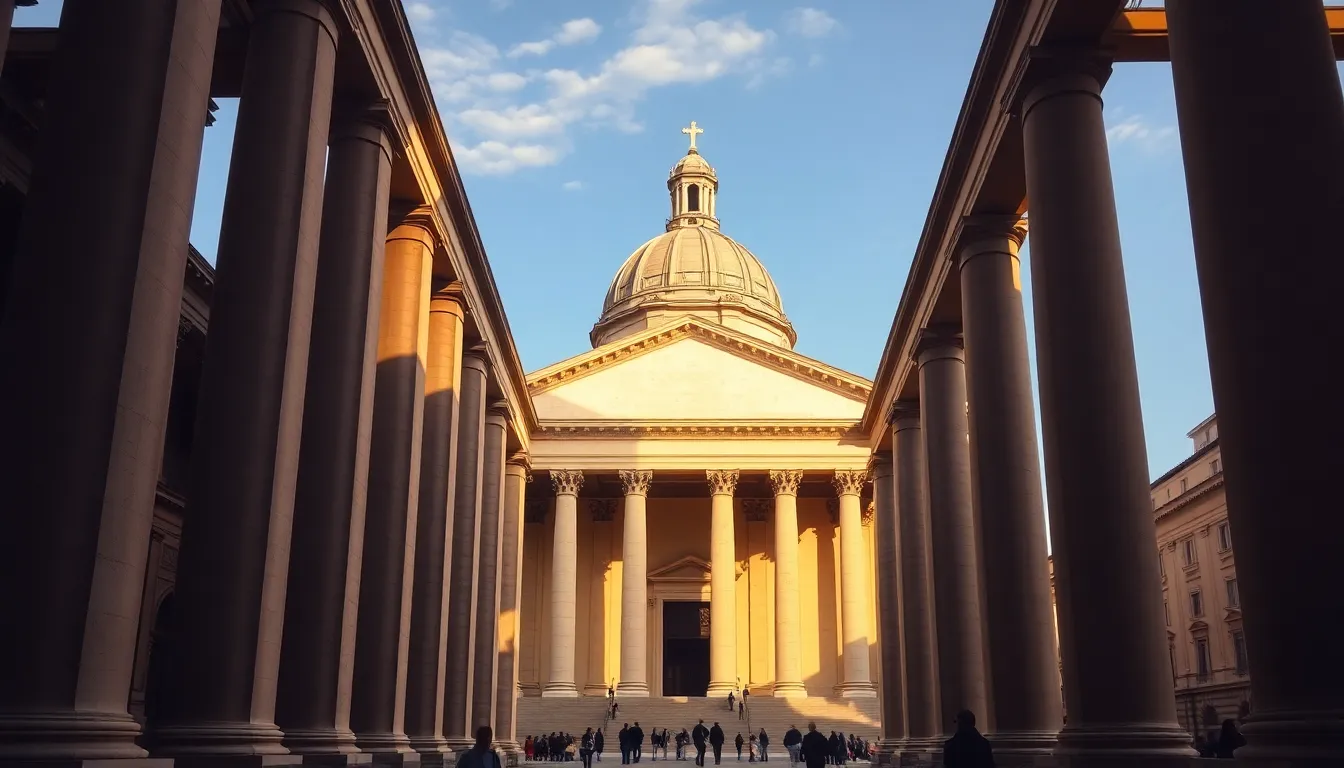
There is a moment I wait for every time I bring a group to St. Paul Outside the Walls. We walk into that long, gleaming nave, eighty columns marching toward the altar, and people instinctively look up. Running around the entire space, just above the columns, is a band of round portraits. Pope after pope after pope, every one of them, from Peter to the man in the chair today. Someone in the group always asks how far they go, and I tell them about the empty medallions and the old tradition, and the whole room gets quiet.
This basilica does not get the crowds of St. Peter’s. That is part of why I love bringing groups here. It sits a little outside the center, beyond the ancient walls, and the people who make the trip tend to be the ones who actually care about the apostle buried beneath the altar. For a faith group focused on Paul, on his letters, on his journeys, on his death in this city, there is no more important place in Rome.
Let me tell you what it holds and why it belongs on your itinerary.
Why It Stands Outside the Walls
The name is not poetic. It is geographic and it is historical. Paul was buried outside the city, because Roman law required it, and the basilica was built directly over his grave.
Paul came to Rome as a prisoner, having appealed to Caesar as was his right as a Roman citizen. The Book of Acts leaves him under house arrest in the city, still preaching. Christian tradition holds that he was executed during the persecution under Nero in the 60s AD. Because he was a citizen, he was spared crucifixion and beheaded instead, traditionally at a spot now marked by the Tre Fontane abbey not far away. His followers buried him along the road to Ostia, the road that ran from Rome to its port, and that burial site is where this basilica stands.
When the emperor Constantine legalized Christianity in the fourth century, he raised a church over the grave, as he did over Peter’s on the Vatican hill. So the location is not a later guess. It marks the place his community remembered as his tomb from the very beginning, set outside the walls exactly where Roman burial custom put it.
The Fire of 1823 and the Rebuilding
I always prepare groups for one honest fact about this church. Most of what you see is not ancient. On a night in July 1823, a workman repairing the roof left a fire smoldering, and it spread. The basilica that Constantine had founded and that had stood, expanded and adorned, for nearly fifteen hundred years, was largely destroyed. It was one of the great losses of Christian heritage in Europe.
What followed was a remarkable effort. The church was rebuilt through the nineteenth century on the original plan, faithfully, and reconsecrated in 1854. Catholic communities and even rulers from around the world contributed. The malachite and lapis lazuli around the altars were a gift from the Tsar of Russia. The result is a building that is technically modern but holds the proportions, and crucially the tomb, of the original.
I tell groups this plainly because it matters for honesty, and because it does not diminish the site. The grave beneath the altar is the real thing. The fire took the walls. It did not take Paul.
The Tomb of the Apostle
The reason to come is beneath the high altar. There, behind a grille, you can see a stone sarcophagus, and on a marble slab above it an ancient inscription in Latin: Paulo Apostolo Mart, to Paul, Apostle and Martyr. That slab dates to the fourth century, the era of Constantine’s basilica.
In the years around 2006 to 2009, the Vatican conducted an excavation and examination of the sarcophagus, which had been hidden from full view under the altar for centuries. Without opening it, they confirmed it was a single, unbroken ancient coffin in the spot tradition had always marked, and radiocarbon testing of bone fragments drawn from inside through a small probe dated the remains to the first or second century. The pope at the time announced the results. None of this proves identity in a laboratory sense, and I am careful not to overstate it to groups. But the convergence of ancient inscription, continuous tradition, and a first-century burial in precisely the expected place is striking, and groups feel the weight of it.
Standing at that grille, I usually read a few lines from one of Paul’s letters. The man who wrote those words to the churches at Rome, Corinth, Philippi, is right there. For a group that has spent a trip walking through his theology, it lands like nothing else.
The Papal Portraits and the Tradition of the Medallions
Now back to the portraits that stop every group in their tracks. Running in an unbroken band around the nave and transept are mosaic medallions, one for each pope, beginning with Peter and continuing in order to the present day. It is the most complete visual record of papal succession anywhere, and walking its length is like reading the table of contents of church history on the walls.
There is a long-standing tradition, more folklore than doctrine, that there is only room for a certain number of medallions, and that when the last empty space is filled, the world will end. Every pope’s portrait added brings the empty slots a little lower. The basilica’s caretakers tend to find room as needed, so I would not have your group lose sleep over it. But as a teaching image, it is unmatched. The line from the apostle in the tomb below to the living church above is laid out in gold around the room, and you can trace it with your finger.
The basilica also keeps other treasures worth pointing out: a twelfth-century mosaic in the apse, an exquisitely carved marble canopy over the altar dating to the 1280s that survived the fire, and a peaceful medieval cloister with twisted, mosaic-inlaid columns, one of the loveliest quiet spaces in Rome and a good place to gather a group for a few words.
Fitting It Into a Rome Itinerary
St. Paul Outside the Walls is one of the four major papal basilicas of Rome, and I would not visit the others without including this one. We lay out all four together in our guide to the four major basilicas of Rome, and it connects naturally to the story of early Christian Rome and the persecutions that claimed Paul’s life.
Practically, the basilica sits south of the historic center and is easy to reach by metro, which makes it simple to pair with a catacomb visit on the Via Appia or with the Tre Fontane abbey nearby. Allow an hour to an hour and a half. The usual dress code applies, shoulders and knees covered, and because the church is less crowded than St. Peter’s, it is an ideal place to give your group time to sit, read, and pray without being rushed along by the crowds.
You can see how this fits a full Rome program on our Italy destination page, and how the leader-travels-free arrangement works for groups of fifteen or more on our group heritage tours page.
FAQ: St Paul Outside the Walls
Is St. Paul really buried at St. Paul Outside the Walls?
Christian tradition has held since the earliest centuries that Paul was buried at this spot along the road to Ostia, and Constantine built the first basilica over the grave in the fourth century. A Vatican examination in the 2000s confirmed an unbroken ancient sarcophagus beneath the altar, with bone fragments inside dated to the first or second century, exactly where the tradition placed the tomb. It is not proof in a forensic sense, but the historical, archaeological, and traditional evidence all point to the same place.
Why is the church called “Outside the Walls”?
Because it literally stands outside the ancient Aurelian Walls of Rome. Roman law required burials to take place outside the city, so Paul was buried along the road to the port of Ostia, beyond the walls. The basilica was raised over that grave, and the name distinguishes it from churches inside the city. The companion phrase appears in other Roman church names too, such as St. Agnes Outside the Walls.
What are the papal portraits in the basilica?
A continuous band of round mosaic medallions runs around the nave and transept, one portrait for every pope from Peter to the current pope, in order. It is the most complete visual record of papal succession in the world. A popular tradition says the world will end when the last empty medallion is filled, though the church has always managed to find room. Walking its full length is one of the most memorable things a group can do here.
Did the basilica burn down?
Largely, yes. A fire in July 1823 destroyed most of the basilica that Constantine had founded and that had stood for nearly fifteen hundred years. It was rebuilt faithfully on the original plan through the nineteenth century and reconsecrated in 1854, with contributions from around the world. The tomb beneath the altar and a few elements like the medieval marble canopy survived. What you see is a faithful reconstruction over an original grave.
How does this basilica fit into a group tour of Rome?
It is one of the four major papal basilicas and belongs in any serious Rome pilgrimage. Because it sits south of the center and draws fewer crowds, it is an excellent place to slow down. I usually pair it with a catacomb visit on the Via Appia or the nearby Tre Fontane abbey where Paul is said to have been martyred. Allow about ninety minutes, mind the dress code, and use the quiet to let your group read and pray.
If your group’s heart is in Paul’s letters and his journeys, this basilica is where that story finds its resting place. I would be glad to help you give it the time and the reverence it deserves in your Rome itinerary.
Contact us to begin planning your group’s pilgrimage.