The first time I brought a group to Rome, I made the mistake almost every leader makes. We spent the first full day inside St. Peter’s, gold and marble in every direction, and by the time we got to the early Christian sites later in the week, the contrast was almost too jarring to absorb. People couldn’t reconcile the wealth above ground with the fear underground.
Now I do it the other way around. I take groups to the early church first, before they have seen any of the grandeur. We start with the people who met in borrowed rooms, who buried their dead in tunnels, who worshipped knowing that a knock at the door could mean death. When you understand that church first, everything you see afterward in Rome lands differently. The basilicas stop being museums and start being the answer to a question that took three centuries to settle.
This is a guide to that earlier Rome. The church before Constantine. The one most groups walk straight past.
Why the Early Church in Rome Went Underground
It helps to be clear about what early Christians were and were not facing. The popular picture is of constant, empire-wide persecution from the start. The reality was more uneven. For long stretches, Roman authorities mostly ignored the Christians. Then a wave would come, often tied to a particular emperor or a local crisis, and believers would be arrested, pressured to sacrifice to the emperor, and executed if they refused.
The first major Roman persecution came under Nero in 64 AD, after the great fire. The historian Tacitus, no friend of the Christians, records that Nero blamed them and put them to death in cruel and public ways. Tradition holds that both Peter and Paul died in Rome during this period. Later waves came under Domitian, Decius, Valerian, and finally Diocletian, whose Great Persecution beginning in 303 was the most systematic of all.
Between those waves, the church grew. It met in homes. It buried its dead outside the city walls, as Roman law required, in the tunnel systems we call the catacombs. None of this was secret in the sense of being invisible. Rome knew the Christians were there. But the church kept a low profile because the alternative could be fatal, and that posture shaped where and how they gathered.
The House Churches: Worship Before Cathedrals
For the first three hundred years, there were no church buildings in Rome as we picture them. Christians met in private homes, in the dining rooms and courtyards of believers wealthy enough to have space. We call these the tituli, after the name of the owner that was attached to each property. A congregation would gather at the house of, say, Pudens or Clement, and over generations that address became a fixed center of Christian life in its district.
What moves me about this is the continuity. Several of Rome’s most ancient churches sit directly on top of these house-church sites, and you can sometimes go down beneath the current building and stand in the original rooms.
San Clemente: Three Churches in One
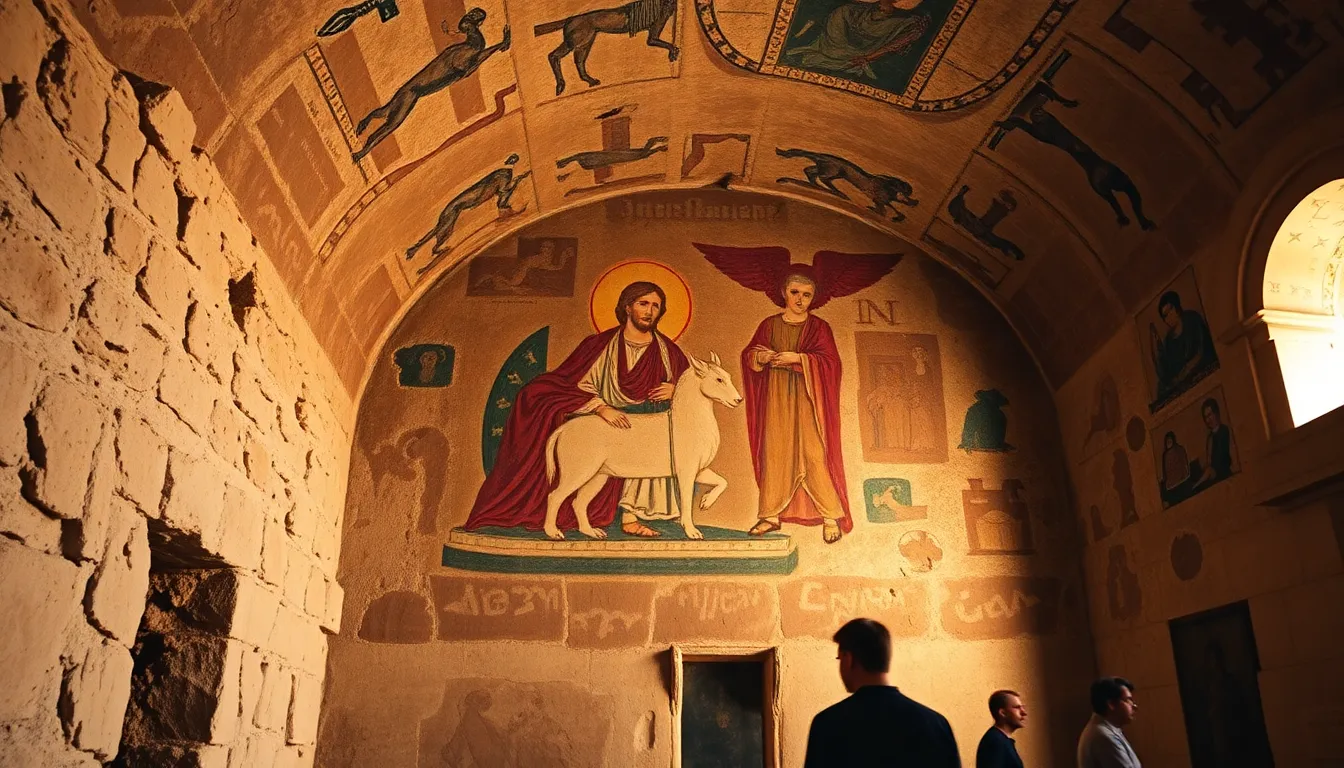
If I could take a group to a single building to explain the early church, it would be the Basilica of San Clemente, a short walk from the Colosseum. What you enter at street level is a twelfth-century church. Beneath it lies a fourth-century basilica with faded frescoes. And beneath that, deeper still, are first-century Roman buildings, including a house that served as an early Christian meeting place and, oddly enough, a temple to the pagan god Mithras right next door.
Descending through those three levels is one of the most effective teaching experiences I know. You physically travel back in time, from the medieval church down to the world of the first believers, with the sound of an ancient underground stream still running through the lowest level. Groups go quiet down there. The persecution stops being an abstraction.
Santa Pudenziana and Santa Prassede
Two more house-church sites are worth the detour for groups with time. Santa Pudenziana, built over the home of a Roman senator named Pudens where tradition says Peter himself stayed, holds one of the oldest Christian mosaics in Rome, a fourth-century image of Christ enthroned among the apostles. Nearby Santa Prassede preserves a small chapel glittering with ninth-century mosaics that feel almost Byzantine. Both connect to the earliest layer of Roman Christian memory, and both are quiet enough that a group can actually pray there.
The Catacombs: Where the Persecuted Buried Their Dead
I have written before about the catacombs in our overview of spiritual sites in Italy, and they deserve a place in any early-church itinerary. Here I want to focus on what they tell us specifically about life under persecution.
The catacombs were not hiding places, despite the legend. They were cemeteries, dug into the soft volcanic rock outside the walls along the great roads like the Via Appia. Roman law forbade burial inside the city, and it also generally protected burial grounds as sacred, which gave the Christians a measure of legal cover. Over time these tunnels stretched for miles, layer upon layer, holding hundreds of thousands of graves.
What you see on the walls is the faith of ordinary believers. There are no grand theological statements. There is a fish, because the Greek word ichthys spelled out a confession of Christ. There is an anchor, for hope. There is the Good Shepherd carrying a lamb, painted again and again, because that image of being carried was what these people held onto. The Catacombs of San Callisto on the Via Appia hold the Crypt of the Popes, where nine third-century bishops of Rome were buried, several of them martyrs. Standing there, you are at the literal grave of church leaders who died for the same faith your group professes.
A practical word, the same one I give every group. The catacombs stay cool year-round, so bring a layer. And book group access well ahead. This is not a walk-in for a busload of fifteen or more.
The Martyrs: Names on the Map of Rome
Rome is built over its martyrs in a way no other city is. Once you start looking, you see them everywhere.
The Mamertine Prison, at the foot of the Capitoline Hill, is traditionally held to be where Peter and Paul were held before their executions. It is a grim, cramped cell, and that grimness is the point. Just outside the city, the Basilica of San Paolo Fuori le Mura rises over the spot where Paul, as a Roman citizen, was beheaded. We cover that site in depth in our guide to the Basilica of St. Paul Outside the Walls. At the Tre Fontane abbey nearby, tradition marks the place of his death itself.
Then there are the women and the young. Saint Agnes, executed as a teenager during the Diocletian persecution, is remembered at Sant’Agnese fuori le Mura. Saint Cecilia, a noblewoman martyred for her faith, is honored in Trastevere at the church that bears her name, built over what tradition holds was her house. These were not distant legends to the early church. They were neighbors, recently killed, whose courage held the community together.
When I walk a group through these sites in sequence, something shifts. The map of Rome stops being a list of attractions and becomes a record of people who refused to deny what they believed. That is a heritage worth standing in.
Constantine and the End of the Underground Church
The story has a turning point, and it is worth marking clearly so your group understands what changed. In 312, the emperor Constantine won the Battle of the Milvian Bridge, just north of Rome, after what he described as a vision of the cross. The following year, the Edict of Milan granted Christians legal toleration. Within a generation, the faith that had met in borrowed rooms was building basilicas with imperial money.
That is why I take groups to the early sites first. Once you have stood in the house church and the catacomb, you can walk into the great basilicas of Constantine’s era and after, and you understand the cost behind the gold. The persecuted church did not vanish when Constantine arrived. It surfaced. The same faith carved into a catacomb wall is the one celebrated under the dome of St. Peter’s. Holding both in view, the humble and the grand, is the whole point of a heritage journey to Rome.
You can see how these early sites fit into a full Rome program on our Italy destination page, and learn how the group leader experience works on our group heritage tours page.
FAQ: Early Christian Rome
Where did the first Christians in Rome actually worship?
In private homes. For the first three centuries there were no dedicated church buildings in Rome. Believers gathered in the houses of wealthier members, in spaces we now call the tituli or house churches. Several of Rome’s oldest basilicas, including San Clemente, Santa Pudenziana, and Santa Cecilia, are built directly over these original house-church sites, and at San Clemente you can descend and stand in the first-century rooms themselves.
Were the catacombs hiding places during persecution?
This is a common misconception. The catacombs were cemeteries, not refuges. Roman law required burial outside the city walls and generally treated burial grounds as protected, which is why Christians dug these tunnel systems along the roads leading out of Rome. They did gather there for funeral meals and to honor the martyrs, but they did not live in them to escape arrest. The hiding-place legend grew up much later.
Who were the most important martyrs in early Christian Rome?
Peter and Paul are the central figures, both traditionally martyred in Rome during the persecution under Nero in the 60s AD. Beyond the apostles, Rome honors many others: the third-century popes buried in the Catacombs of San Callisto, the young Saint Agnes and the noblewoman Saint Cecilia killed during later persecutions, and countless unnamed believers. Their burial sites and the churches built over them form a map of the city’s earliest faith.
When did Christianity stop being persecuted in Rome?
The turning point was the Edict of Milan in 313, issued after Constantine’s victory at the Milvian Bridge in 312. It granted Christians legal toleration across the empire. Within a few decades Christianity moved from a tolerated faith to the favored religion of the state, and the church that had met underground began building public basilicas. The era of the underground church effectively ended within a generation.
How much time should a group set aside for early Christian Rome?
I usually build a full day around it: San Clemente in the morning, a catacomb visit on the Via Appia, and a martyr church or two in the afternoon, such as Santa Cecilia in Trastevere. If your group has more time, add Santa Pudenziana and the Mamertine Prison. Doing it early in the trip, before the great basilicas, gives the whole Rome experience its proper emotional shape.
If you want your group to encounter the church that existed before the cathedrals, I would be glad to help you build that into your Rome itinerary. It is one of the most meaningful sequences I lead, and it changes how people see everything else in the city.
Contact us when you are ready to start planning.