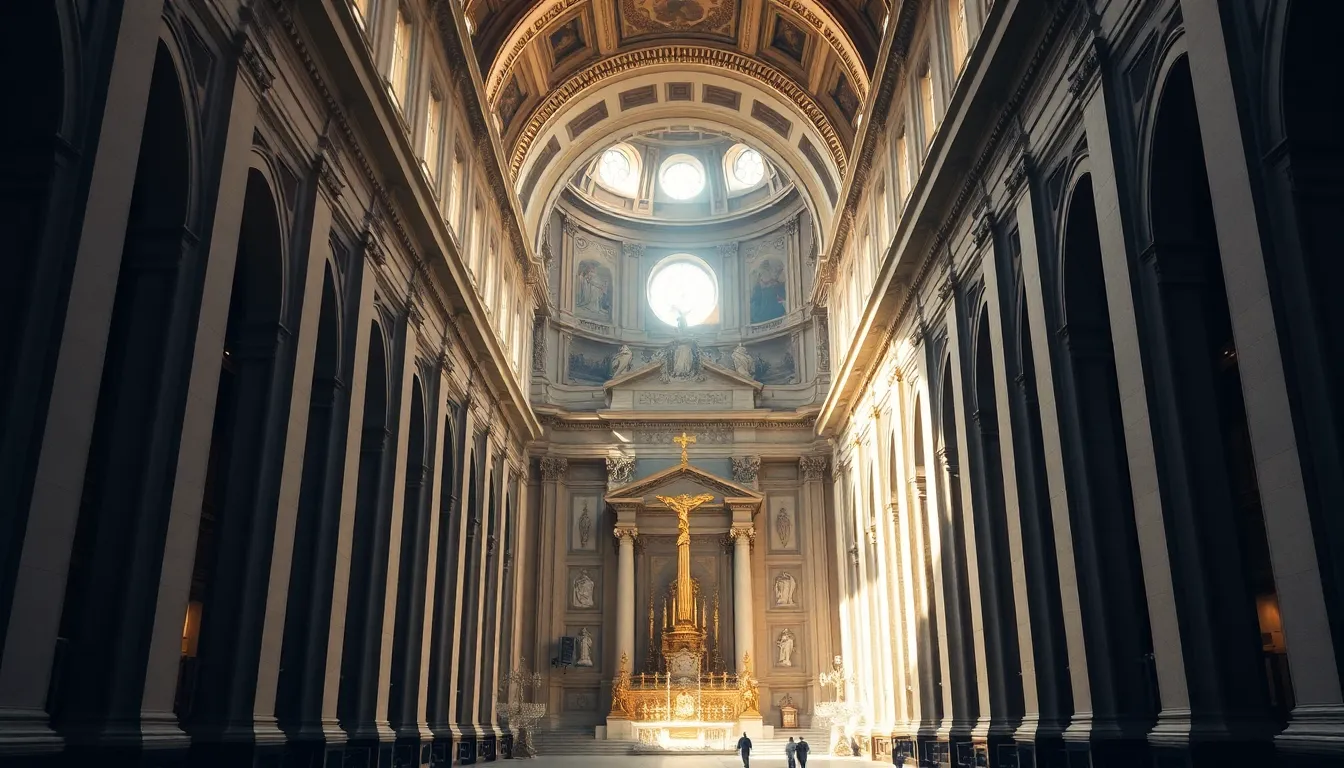
Most groups arrive in Rome thinking there is one great church to see, St. Peter’s, and everything else is secondary. I understand why. St. Peter’s is the one on the postcards. But after years of leading faith groups through this city, I have learned that the four major basilicas, taken together, tell a story that no single church can. Each one carries a distinct piece of Christian heritage, and visiting all four turns a sightseeing day into something closer to a pilgrimage.
The four are St. Peter’s, St. John Lateran, St. Mary Major, and St. Paul Outside the Walls. In Catholic tradition these are the papal or major basilicas, the four churches in Rome that hold a special rank above all others in the world. Pilgrims have walked between them for centuries, especially in Holy Years, and a group that visits all four gains a sense of the city’s spiritual architecture that the typical day-trip never reaches.
Let me walk you through each one, what it actually holds, and how to fit them together without exhausting your people.
St. John Lateran: The Cathedral of Rome
I always start groups here, and it surprises them. Most assume St. Peter’s is the seat of the pope. It is not. The Archbasilica of St. John Lateran is the cathedral of the Bishop of Rome, which is to say, the pope’s own cathedral. An inscription on the facade calls it the mother and head of all the churches of the city and the world. For a faith group trying to understand the structure of the early and medieval church, that one fact reorders everything.
The Lateran was the first great church built after Constantine granted Christians their freedom, founded in the fourth century on land given by the emperor himself. For roughly a thousand years, before the papacy moved to the Vatican, this was the center of the Western church. Popes lived in the adjoining palace. Councils met here.
Inside, the nave is lined with towering statues of the twelve apostles, and the high altar holds what tradition says are relics of the heads of Peter and Paul. Across the street stands the Scala Sancta, the Holy Stairs, believed by tradition to be the steps Jesus climbed before Pilate, brought to Rome from Jerusalem. Pilgrims ascend them on their knees. Whatever your group’s tradition, watching that devotion, and explaining where the stairs are said to come from, opens a real conversation about the relationship between history and faith.
St. Peter’s Basilica: The Heart of the Vatican
St. Peter’s is the largest church in the world and the one your group will most want to see, so it deserves its own block of time. I cover the inside in detail in our piece on spiritual sites in Italy, but here is what matters for understanding it as one of the four.
The basilica stands over the tomb of Peter. That is the entire reason it is here. According to ancient tradition, Peter was martyred in Nero’s circus nearby and buried on this hill, and excavations beneath the church in the twentieth century uncovered a first-century burial that the Vatican identifies as his. The high altar sits directly above that spot. When you stand at the Confessio, the sunken area before the altar, you are looking down toward the grave of the apostle.
The current building is a Renaissance and Baroque masterpiece, the work of Bramante, Michelangelo, who designed the dome, and Bernini, whose great bronze canopy rises over the altar and whose colonnade embraces the square outside. Michelangelo’s Pieta sits just inside the entrance. The Vatican Grottoes below hold the tombs of many popes.
My practical advice has not changed in years. Give St. Peter’s its own morning, arrive at opening before the tour groups assemble, and go straight to the Confessio while the church is still quiet. A faith group standing there in the early light experiences something the afternoon crowd never will.
St. Mary Major: The Oldest Church of the Virgin
St. Mary Major, Santa Maria Maggiore, is the one most groups have never heard of, and it is often my own favorite of the four. It is the largest church in Rome dedicated to Mary and the best preserved of the early basilicas, with fifth-century mosaics still running along the top of the nave that depict scenes from the Hebrew Scriptures.
The church was built in the 430s, shortly after the Council of Ephesus affirmed Mary as Theotokos, the God-bearer. There is a legend attached to its founding, that Mary appeared and asked for a church to be built where snow would fall in August, and snow duly fell on the Esquiline Hill in the heat of summer, marking the outline of the building. The story is commemorated every August 5 with a shower of white petals released from the ceiling.
Inside, the coffered ceiling is said to be gilded with some of the first gold brought from the Americas. The basilica also holds a relic venerated as wood from the manger of Bethlehem, kept in the Crypt of the Nativity beneath the high altar. For a group, the combination of the oldest Marian heritage in Rome and the quiet, less-crowded atmosphere makes this a place where people can actually slow down and pray.
St. Paul Outside the Walls: The Tomb of the Apostle
The fourth basilica sits beyond the ancient city walls, which is exactly why it carries its name, and it rises over the burial place of Paul. We give it a full treatment in our dedicated guide to the Basilica of St. Paul Outside the Walls, so I will keep this brief and focus on its place among the four.
Paul, as a Roman citizen, was beheaded rather than crucified, and his body was buried along the road to Ostia. Constantine raised the first basilica over the grave in the fourth century. A devastating fire in 1823 destroyed most of the ancient building, and what stands today is a faithful nineteenth-century reconstruction, but the tomb beneath the high altar is original, and a sarcophagus inscribed Paulo Apostolo Mart, Paul, Apostle and Martyr, has been identified there.
The basilica’s most striking feature is the band of papal portraits, medallions of every pope from Peter to the present, running around the entire nave above the columns. There is a famous tradition, however unprovable, that when the empty medallions run out, the world will end. Whether or not your group takes that seriously, walking the full circuit of papal faces is a vivid way to feel the unbroken line of church history from the apostles to today.
How to Visit All Four as a Group
Four major churches in one trip sounds heavy, and it can be if you do it wrong. Here is how I structure it.
I almost never do all four in a single day. Two days is far more humane. A common pattern is St. Peter’s and the Vatican on one morning, given the security lines and the sheer scale, then the Lateran and St. Mary Major together on another, since they sit relatively close on the Esquiline and Caelian hills. St. Paul Outside the Walls sits to the south and is easily reached by metro; I often pair it with a catacomb visit on the same side of the city.
A few practical notes for group leaders. Dress code is enforced at all four: shoulders and knees covered, no exceptions, and it is worth telling your people before they pack. The basilicas are active places of worship, so check Mass schedules to avoid arriving during a service unless you intend to attend one. And book St. Peter’s early-morning entry ahead if you can, because by mid-morning the experience changes completely.
One more thing worth saying to anyone weighing the cost of bringing a group. With Heritage Tours, the group leader travels free with fifteen or more participants, which makes the pastor’s or rabbi’s own pilgrimage part of the package rather than an added expense. You can see how that works on our group heritage tours page, and how Rome fits into a wider itinerary on our Italy destination page.
FAQ: The Four Major Basilicas of Rome
What are the four major basilicas of Rome?
They are St. John Lateran, St. Peter’s, St. Mary Major, and St. Paul Outside the Walls. In Catholic tradition these four churches in Rome hold the rank of papal or major basilica, a status above every other church in the world. Pilgrims have visited all four for centuries, particularly during Holy Years, and together they map out the spiritual structure of the city.
Which basilica is the pope’s cathedral?
St. John Lateran, not St. Peter’s. The Lateran is the cathedral of the Bishop of Rome, which is the pope’s role, and an inscription on its facade calls it the mother and head of all churches. It was the first major church built after Constantine legalized Christianity and served as the center of the Western church for about a thousand years before the papacy moved to the Vatican.
Can a group visit all four basilicas in one day?
It is possible but I do not recommend it. The pace becomes rushed and the meaning gets lost. I prefer to spread the four across two days: St. Peter’s and the Vatican on one, the Lateran and St. Mary Major together on another, and St. Paul Outside the Walls paired with a nearby site like the catacombs. That rhythm lets people absorb each church rather than checking boxes.
Is there a dress code at the Roman basilicas?
Yes, and it is enforced. All four require shoulders and knees to be covered for both men and women. Visitors in shorts, short skirts, or sleeveless tops are turned away or asked to cover up. Tell your group before they pack so no one is caught out at the door. A light scarf or shawl is the easiest fix for anyone who forgets.
What makes St. Mary Major special among the four?
It is the oldest and best-preserved major basilica dedicated to the Virgin Mary, built in the 430s right after the Council of Ephesus affirmed Mary as the God-bearer. It holds fifth-century mosaics, a relic venerated as wood from the manger of Bethlehem, and a founding legend about a miraculous August snowfall, commemorated each year with falling white petals. It is also far less crowded than St. Peter’s, which makes it a place where groups can genuinely pray.
The four basilicas are the backbone of a Rome pilgrimage, and how you sequence them shapes the whole experience. I would be glad to help you build a Rome itinerary that gives each one its proper weight without wearing your group out.
Contact us to start planning your group’s journey.