Most people who know the name Benedict know Monte Cassino. Fewer know that the story really begins two places earlier, in a small mountain town called Norcia and in a cluster of caves above a village called Subiaco. I take groups to both, and I tell them honestly: this is where you meet the man before he became a monument.
Benedict did not set out to reshape Europe. He set out to be left alone with God. What happened between the cave at Subiaco and the rule he eventually wrote is one of the quietest, most consequential stories in the history of the Western church. If your group wants to understand not just what Benedictine monasticism is but where it came from, these two towns are the answer.
Norcia: Where Benedict Was Born
Benedict was born around the year 480 in Norcia, a town in the mountains of Umbria, east of Spoleto. He and his twin sister, Scholastica, came from a family of some standing, and Benedict was sent to Rome as a young man to be educated.
What he found in Rome unsettled him. The empire was collapsing, the city was in moral disarray, and the young Benedict wanted no part of it. He left his studies and withdrew from the city to seek a different kind of life. That decision, a young man walking away from the center of power to look for God in the wilderness, is the seed of everything that followed.
Norcia today honors its most famous son. The Basilica of San Benedetto stood for centuries over the traditional site of the house where Benedict and Scholastica were born. A devastating earthquake in 2016 brought much of the basilica down, and reconstruction has been a long, careful process. The monastic community in Norcia has continued through it, and the town remains a meaningful stop. For a faith group, Norcia offers something Monte Cassino cannot: the beginning, the ordinary mountain town that produced an extraordinary life. It pairs naturally with a visit to Monte Cassino, where that same life reached its end.
Subiaco: The Caves Where It Began
After leaving Rome, Benedict traveled into the rugged hills around Subiaco and found a cave in the cliffside above the Anio valley. There he lived as a hermit for three years, in solitude, fed by a monk named Romanus who lowered bread to him on a rope. This cave, the Sacro Speco, the “holy grotto,” is the spiritual heart of the whole Benedictine story.
Word of the holy man in the cave spread. Other seekers came to him. Eventually, communities of monks gathered around Benedict in the Subiaco valley, and he organized them into twelve small monasteries of twelve monks each. This was his first experiment in communal monastic life, the laboratory where he learned what worked and what did not. The lessons he gathered here he would later distill into the Rule.
The Monastery of Sacro Speco
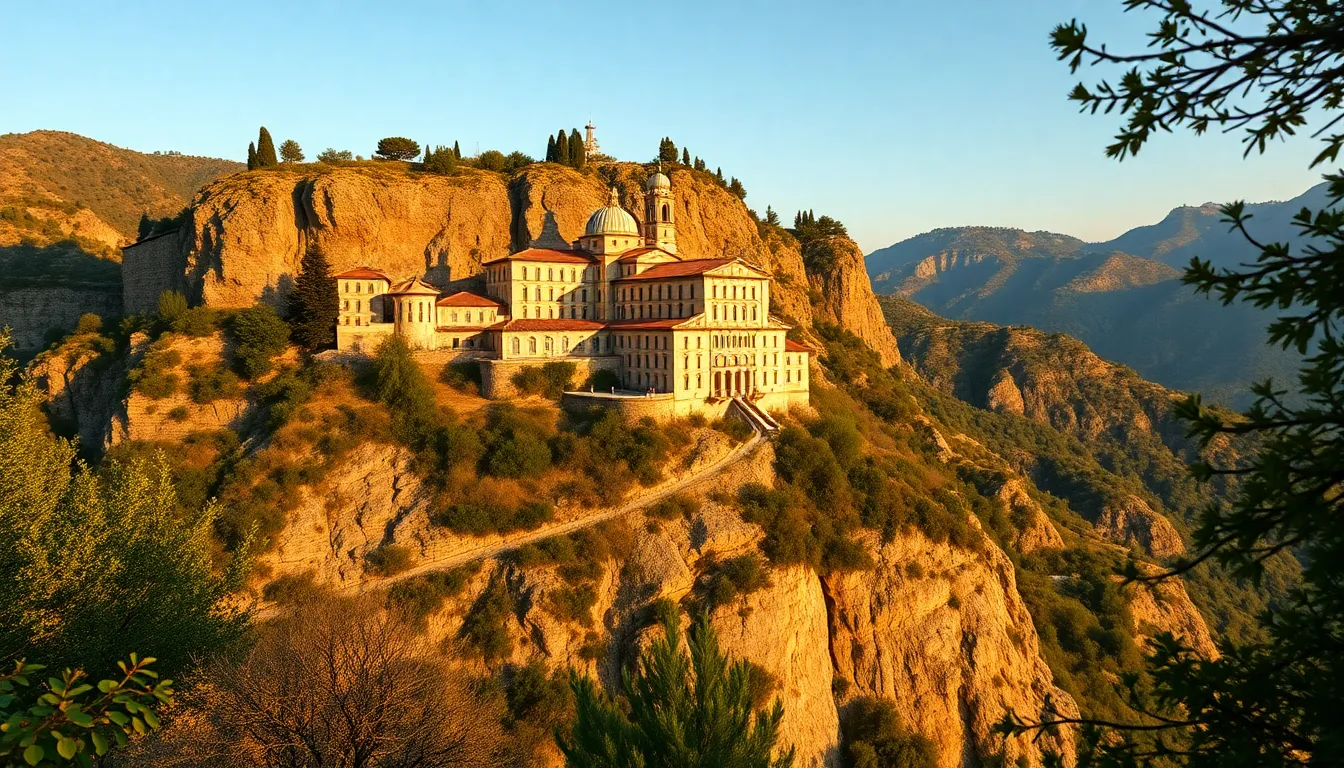
Built directly into the cliff face above Subiaco, the monastery of Sacro Speco is one of the most striking sights in central Italy. It clings to the rock over the original cave, and its walls are covered in medieval frescoes, some of the finest in the region. One of them is the earliest known portrait of Saint Francis of Assisi, painted from life during a visit, before he bore the marks of the stigmata and before he was canonized.
Walking through Sacro Speco, you descend through layers of chapels carved into the mountain until you reach the grotto itself, the cave where Benedict lived alone. There is a stillness in that grotto that groups feel immediately. This is the place. This is where a young man’s solitude became the foundation of European monasticism.
Below Sacro Speco sits the monastery of Santa Scolastica, named for Benedict’s sister, the only one of his original twelve Subiaco monasteries to survive continuously to the present day. Together the two sites tell the Subiaco chapter completely.
The Rule That Shaped Europe
Benedict eventually left Subiaco and moved south to Monte Cassino, and it was there, near the end of his life, that he wrote the document he is remembered for: the Rule of Saint Benedict.
It is worth understanding why this short book mattered so much. The Rule is not a work of grand theology. It is a practical handbook for running a monastery, seventy-three short chapters covering everything from how the monks should pray the hours, to how they should eat, to how a new member should be admitted, to how the abbot should lead. Its tone is moderate. Benedict called it “a little rule for beginners.” He rejected the extreme self-punishment of some earlier monasticism in favor of a sustainable, humane rhythm of prayer, work, and rest.
That moderation is exactly why it spread. The Rule was workable. A community could actually live by it for generations, and thousands did. Through the chaotic centuries after Rome fell, Benedictine monasteries became islands of stability across Europe. They cleared land and farmed it. They copied and preserved manuscripts, classical and Christian alike, keeping literacy alive when little else did. They cared for the sick and sheltered travelers. The monasteries that followed the Rule of Saint Benedict became, almost by accident, the institutions that carried Western civilization through its hardest stretch.
When historians call Benedict the patron of Europe, this is what they mean. Not a king, not a general, but a man who wrote a quiet rule for living together, and a network of communities that lived by it. To see where that book of order and balance fits into the broader heritage map, our guide to Italy’s spiritual sites sets the full picture.
Planning Subiaco and Norcia for a Group
Both sites are in the mountains east of Rome, and both reward groups willing to leave the standard itinerary. Subiaco is the more accessible of the two, roughly an hour and a half from Rome by road, and the monastery of Sacro Speco can be reached with a short walk up from the parking area. The path involves some stairs and uneven ground, so plan for the mobility level of your group.
Norcia is further, deeper into the Umbrian mountains, and works best as part of a wider Umbria itinerary, often combined with Assisi, which lies in the same region. Be aware that earthquake reconstruction is ongoing in Norcia, so check current access before building it in.
I always encourage group leaders to treat these as contemplative stops rather than checklist sites. Sacro Speco in particular is a place to slow down. A guided walk through the frescoed chapels down to the grotto, with time to simply sit in the cave, does more for a group than any amount of rushing. For congregations weaving this into a fuller journey, Italy as a heritage destination connects Subiaco and Norcia to the rest, and our group tour structure makes a deliberate pace easy to build in.
FAQ: Saint Benedict in Subiaco and Norcia
Where was Saint Benedict born?
Benedict was born around the year 480 in Norcia, a town in the Umbrian mountains of central Italy, east of Spoleto. He and his twin sister, Scholastica, came from a family of some standing. Norcia honors him with the Basilica of San Benedetto, traditionally built over the site of his birthplace, which is currently being reconstructed after the 2016 earthquake.
What is the Sacro Speco at Subiaco?
The Sacro Speco, or “holy grotto,” is the cliffside cave above Subiaco where Benedict lived as a hermit for three years before founding his first monastic communities. A medieval monastery was built directly into the rock above it, covered in frescoes, including the earliest known portrait of Saint Francis of Assisi. Visitors descend through chapels carved into the cliff to reach the original grotto.
What is the Rule of Saint Benedict?
The Rule is a short, practical handbook Benedict wrote near the end of his life at Monte Cassino, seventy-three chapters covering how a monastic community should pray, work, eat, and govern itself. Its balanced, humane approach, summarized as “pray and work,” made it sustainable across generations and became the template for nearly all Western monasticism.
Can groups visit both Subiaco and Norcia in one trip?
Yes, though they are in different parts of central Italy. Subiaco is about ninety minutes east of Rome and works well as a day trip. Norcia is deeper in the Umbrian mountains and pairs better with a wider Umbria itinerary that often includes Assisi. Because Norcia is still rebuilding after the 2016 earthquake, it is worth checking current access before planning.
Is the Subiaco monastery accessible for older travelers?
Reaching Sacro Speco involves a short uphill walk from the parking area and stairs within the cliffside monastery itself, with some uneven ground. Many groups manage it well, but it does require reasonable mobility. Let us know the makeup of your group and we will assess the route and plan accordingly.
If the story of Benedict speaks to your community, I would love to help you walk it from Norcia to Subiaco to Monte Cassino in the right order. Get in touch and we will build the journey together.