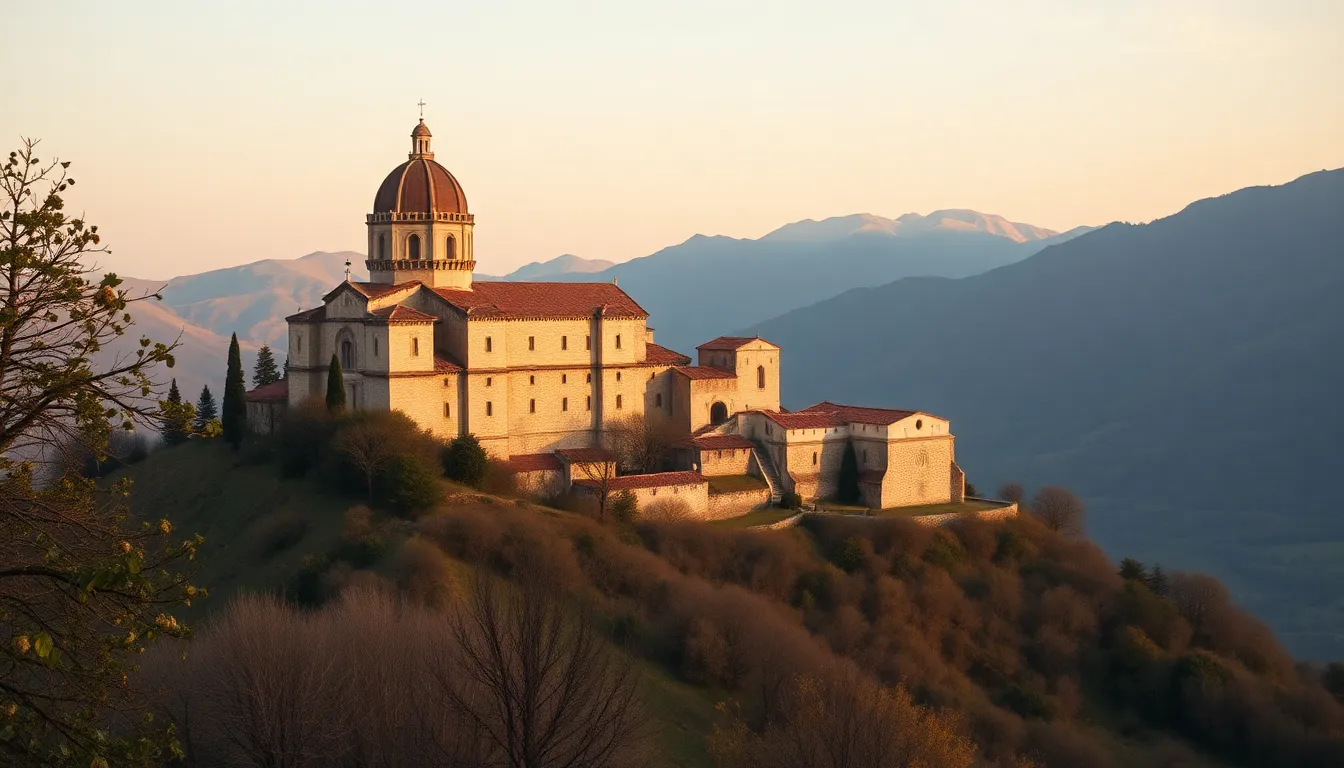
The first time I brought a group up the mountain to Monte Cassino, a pastor in the front of the bus said something I have never forgotten. He looked out the window at the abbey on the summit and said, “So this is where the whole thing started.” He meant Western monasticism. He was right, and the weight of that sentence stayed with the group all day.
Monte Cassino is one of those places that asks more of you than a quick photo stop. It sits on a mountaintop above the town of Cassino, halfway between Rome and Naples, and it carries two stories at once. One is the story of how a single monk founded a way of life that would shape Europe for fifteen hundred years. The other is the story of how that same hill was reduced to rubble in 1944 and then built back, stone by stone, exactly as it was. For a faith group, holding both of those stories together is the point of the visit.
Where Benedict Founded Western Monasticism
Around the year 529, Benedict of Nursia climbed this mountain and founded a monastery on the site of a pagan temple to Apollo. He was not the first Christian to live a monastic life. The desert fathers of Egypt had been doing it for two centuries. But Benedict did something different. He wrote a rule, a practical document for how a community of monks should actually live together day to day, and that rule became the template for nearly all of Western monasticism that followed.
The genius of what Benedict built at Monte Cassino was its balance. He divided the day into prayer, work, and study, and he insisted that none of the three swallow the others. The motto people often attach to his communities, “ora et labora,” pray and work, captures it well. Monks were not to escape the world into pure contemplation, nor lose themselves in pure labor. They were to do both, in rhythm, in community, under a shared rule.
Benedict died at Monte Cassino, and tradition holds that he is buried here alongside his sister, Scholastica, who founded the women’s side of the movement. Standing in the abbey, you are standing at the source. The Benedictine order, the Cistercians, the Trappists, the entire monastic architecture of medieval Europe, the monasteries that copied manuscripts and kept literacy alive through the dark centuries, all of it traces back to this hill.
If you want to understand how this site fits into the wider map of Italian Christian heritage, our overview of Italy’s spiritual sites lays out how Monte Cassino connects to Subiaco, Assisi, and the rest.
Destruction and Rebuilding: The 1944 Story
Here is the part that surprises most groups. The abbey you visit today is not medieval. It is younger than most of the people reading this would guess.
In early 1944, during the Italian campaign of the Second World War, Monte Cassino sat directly on the German defensive line that blocked the Allied advance toward Rome. On February 15, 1944, Allied bombers dropped over a thousand tons of explosives on the abbey, convinced German troops were using it as an observation post. They were not occupying it at the time. The monastery, which had survived for fourteen centuries, was flattened in a single morning. The battle that followed, fought over the ruins for months, was one of the bloodiest of the entire Italian campaign.
What happened next is the part worth telling your group. The decision was made to rebuild Monte Cassino exactly as it had been, “where it was and as it was,” using the original plans. The reconstruction took years. The abbey was reconsecrated in 1964. When you walk through it today, you are walking through a faithful resurrection of the seventeenth-century baroque monastery that the bombs destroyed, raised again on the same foundations Benedict’s followers first laid.
There is something fitting about that. A community built on a rule of endurance, prayer, and continuity was destroyed and then continued. The monks came back. The abbey holds Benedict’s tomb again. For a faith group, the rebuilding is not a footnote. It is the sermon.
The War Cemeteries Below
On the slopes around the abbey lie the war cemeteries, Polish, German, Commonwealth, and others, holding the dead from the months of fighting. The Polish cemetery in particular draws visitors, because Polish forces finally took the summit in May 1944. Many groups find that a short, quiet stop at one of these cemeteries deepens the day. The abbey above speaks of fifteen centuries of prayer. The graves below speak of the cost of one terrible year. Both belong to the story of this mountain.
What a Group Actually Sees at the Abbey
The abbey is large, but the heart of a visit comes down to a handful of spaces.
- The cloisters and the central courtyard. The baroque architecture, all clean lines and open sky, gives the place its calm. Take time here. It is where the rhythm of the place reveals itself.
- The basilica. Rebuilt in baroque splendor with marble, gilding, and restored frescoes. It is grand in a way Benedict himself might have found excessive, but it honors the continuity of the site.
- The crypt and Benedict’s tomb. The spiritual center. The tomb of Benedict and Scholastica sits beneath the high altar. For most faith groups, this is the moment the visit lands.
- The museum. Holds manuscripts, relics, and material that survived or was recovered, and tells the story of the bombing and reconstruction in detail.
A thorough visit takes about two hours. The views from the summit alone, across the Liri valley, are worth the climb up.
Planning the Visit with a Group
Monte Cassino is roughly halfway between Rome and Naples, which makes it a natural stop on a route between the two, or a day trip out of Rome. The drive up the mountain is steep and winding, and a good coach driver matters here. The site is a working monastery, so dress is modest, shoulders and knees covered, the same standard you would keep at any active church in Italy.
I always tell group leaders to build in more time than they think they need. Monte Cassino is not a place to rush. The combination of Benedict’s tomb, the baroque basilica, and the war story rewards groups who slow down and let it settle. For congregations pairing this with related sites, it sits naturally alongside Subiaco and Norcia, where Benedict’s story begins, and the wider arc of Italy as a heritage destination holds it all together.
One thing worth knowing as you plan: with Heritage Tours, the group leader travels free when you bring fifteen or more participants. That changes the math when you are presenting a trip to your congregation, and it makes a deliberate, unhurried itinerary like this one easier to justify.
FAQ: Visiting Monte Cassino Abbey
Who founded Monte Cassino and when?
Benedict of Nursia founded the abbey around the year 529, building it on the site of a former pagan temple on the mountaintop above the town of Cassino. There he wrote the Rule of Saint Benedict, the document that shaped Western monastic life for the next fifteen centuries. Benedict is believed to be buried at the abbey alongside his sister, Scholastica.
Is Monte Cassino the original ancient building?
No, and this surprises many visitors. The abbey was completely destroyed by Allied bombing in February 1944 during the Battle of Monte Cassino. It was rebuilt afterward, “where it was and as it was,” following the original plans, and reconsecrated in 1964. What you see today is a faithful reconstruction of the baroque monastery on Benedict’s original foundations.
How long should a group plan to spend at Monte Cassino?
Plan for about two hours at the abbey itself to see the cloisters, the basilica, the crypt with Benedict’s tomb, and the museum without rushing. Groups who want to include a stop at one of the war cemeteries on the slopes below should add another thirty to forty-five minutes. The mountain drive up and back also takes time, so a half day is realistic.
Is there a dress code, and is the abbey wheelchair accessible?
Monte Cassino is a working monastery, so modest dress is expected, shoulders and knees covered for everyone. The main levels of the abbey and basilica are largely accessible, though the mountaintop location and some stairs to the crypt can present challenges. Tell us about any mobility needs in your group and we will plan the route accordingly.
How do groups get to Monte Cassino?
The abbey sits roughly halfway between Rome and Naples, about ninety minutes by road from Rome. Most groups visit it by private coach, either as a day trip from Rome or as a stop on the route south toward Naples. The drive up the mountain is steep and winding, so an experienced coach driver is important.
If Monte Cassino is calling your community, I would be glad to help you build it into a journey that does it justice. Reach out to us and we will start mapping the route together.