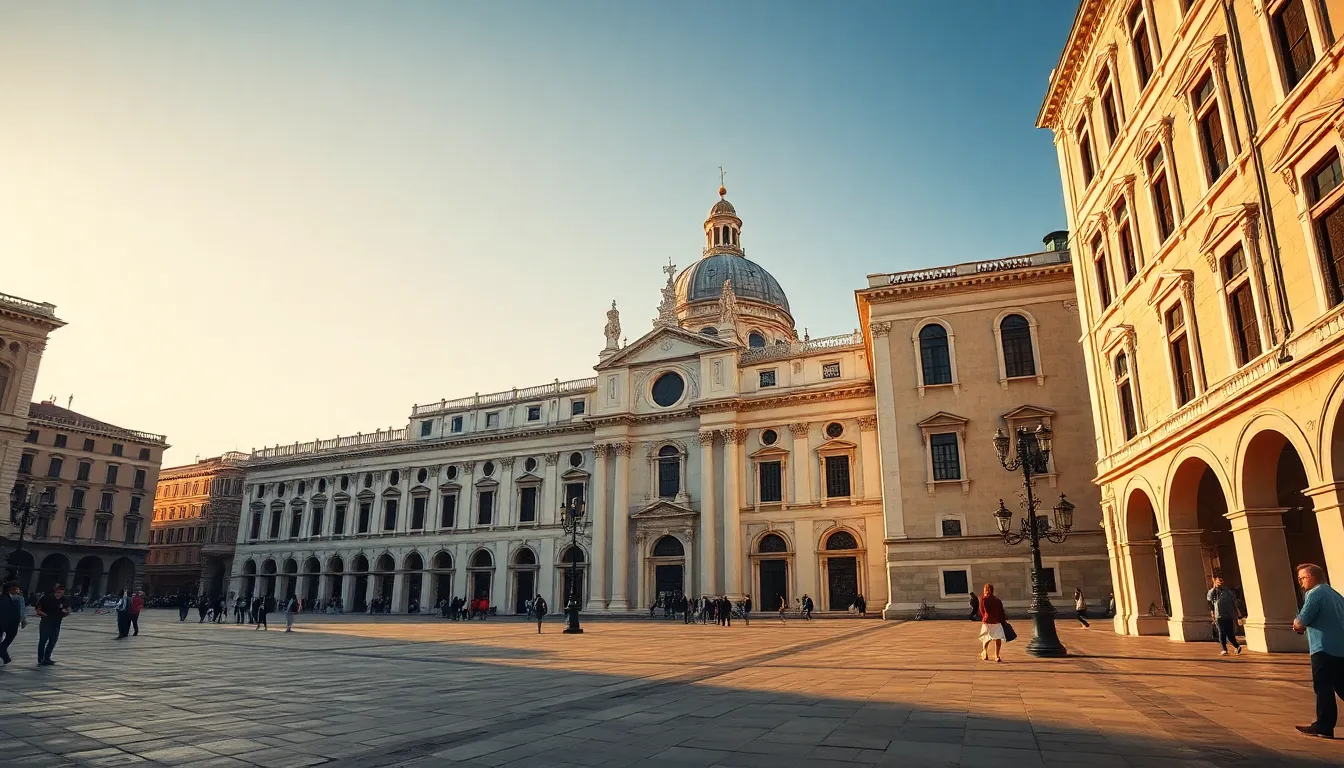
Venice gives you San Marco at the end of a long approach. You cross the lagoon, wind through the alleys and over the small bridges, and then the Piazza San Marco opens up and the basilica is in front of you, five domes, marble columns, and across the upper facade, mosaics that catch the sun and throw it back gold. Napoleon is supposed to have called the square the drawing room of Europe. I tell my groups to look up before they look anywhere else, because the gold on that facade is only the beginning of what waits inside.
A Church Built to Hold a Saint
San Marco was built for one reason: to house the body of Saint Mark the Evangelist, the author of the second Gospel. The story of how his relics reached Venice is one of the more remarkable in Christian heritage, and groups always want it told.
Mark, by tradition, founded the church in Alexandria, in Egypt, and was martyred there. For centuries his tomb remained in Alexandria, which by the ninth century had fallen under Muslim rule. In 828, two Venetian merchants took the relics from Alexandria and carried them by ship back to Venice. The old account says they hid the body beneath layers of pork in their cargo to discourage Muslim inspectors from searching too closely. Whatever the details, the relics arrived in Venice, and the city made Saint Mark its patron on the spot.
This was an act of devotion and of ambition together, and a group should understand both. Venice was a rising maritime republic that wanted the prestige of an apostolic patron to rival Rome’s Peter and Paul. Acquiring an evangelist gave the city spiritual standing to match its commercial power. The winged lion of Saint Mark became the emblem of Venice, and you will see it everywhere in the city. The first church on this site was built to receive the relics within a few years of their arrival; the basilica you visit today, begun in 1063, is the third church on the spot, raised to hold the saint in a manner the Venetians considered worthy.
The Golden Interior
Step inside and the reason for the basilica’s nickname, the Church of Gold, becomes obvious. The interior is covered in roughly 85,000 square feet of mosaics, most laid against a background of gold-leaf glass, accumulated over some eight centuries. They cover the domes, the arches, and the upper walls, telling the story of salvation from creation through the life of Christ and the acts of the apostles, with a particular focus on the life and translation of Saint Mark himself.
The architecture is Byzantine, modeled on the Church of the Holy Apostles in Constantinople, with five great domes in the shape of a Greek cross. This is the most important point I make to groups: San Marco does not look like a Western European cathedral because it was never meant to. Venice faced east, toward Constantinople and the trade of the Mediterranean, and its great church speaks the visual language of the Eastern Church. Standing under those domes is closer to standing in Hagia Sophia than in a Gothic cathedral of France. For groups exploring how Christianity moved between East and West, San Marco belongs in the same study as the mosaics of Ravenna and Monreale.
The Relics and the Pala d’Oro
The relics of Saint Mark rest beneath the high altar, in a sarcophagus that pilgrims have venerated for centuries. The body was lost for a time after a fire in the tenth century and, by tradition, rediscovered in 1094 when, during a prayer for its recovery, a section of pillar is said to have crumbled to reveal the saint’s arm. That moment of rediscovery is itself depicted in the basilica’s mosaics.
Behind the high altar stands the Pala d’Oro, the Golden Pall, one of the supreme works of medieval goldsmithing in the world. It is an altarpiece roughly ten feet wide and seven feet tall, made of gold and silver and set with thousands of gemstones, pearls, and more than eighty enamel panels, many of them Byzantine work brought to Venice over the centuries, several taken from Constantinople after the Fourth Crusade in 1204. The enamels depict Christ, the evangelists, scenes from the life of Mark, and saints of the Eastern and Western churches together. For a group, it is worth the small additional ticket to stand close to it. Photographs do not convey the depth of the color or the density of the work. It is faith expressed in the most precious materials a wealthy republic could gather.
Why It Belongs on a Heritage Itinerary
For a Christian group, San Marco is a chance to stand at the tomb of one of the four evangelists, the man whose Gospel many scholars consider the earliest written. That is not a small thing. To read from Mark’s Gospel while standing above the place his relics are venerated gives a group a connection to the text that no classroom can.
It is also a lesson in how faith, art, and worldly power intertwined in the medieval world. The Pala d’Oro and many of the basilica’s treasures came to Venice through trade, conquest, and the sack of Constantinople, and honest reflection on the building includes how some of its splendor was acquired. Groups with educators and clergy often find that conversation, the mixture of genuine devotion and imperial ambition, among the most thoughtful of the trip.
How Groups Visit San Marco
The basilica sits at the heart of Venice, reached on foot or by the vaporetto water buses, since no cars enter the city. The main basilica is free to enter, but the lines in Venice are notorious, often wrapping across the piazza in high season. We book timed-entry slots for groups so nobody loses an hour standing in the sun. For groups of 15 or more, your group leader travels free on a Heritage Tours itinerary.
Inside, there are several ticketed areas worth the small additional cost: the Pala d’Oro behind the altar, the treasury with its collection of Byzantine reliquaries, and the upper loggia and museum, which take you out onto the balcony above the piazza and up close to the mosaics, beside the famous bronze horses. The horses on the facade are replicas; the originals, also brought from Constantinople in 1204, are preserved inside the museum.
Practical Access
San Marco is an active basilica with a firm dress code, shoulders and knees covered, enforced at the entrance, so a light scarf or layer is essential. Large bags are not permitted inside and must be left at a nearby deposit, which we factor into the group’s timing. Photography rules vary by area and are sometimes restricted near the relics and the Pala d’Oro, so we brief groups beforehand.
Venice combines naturally with the rest of a northern Italy heritage route. Padua and its Shrine of Saint Anthony sit thirty minutes away, Ravenna’s Byzantine mosaics are within reach to the south, and the Marian shrine at Loreto lies further down the Adriatic, all covered in our guide to spiritual sites in Italy. For groups wanting depth beyond the standard route, our hidden heritage sites guide maps out the lesser-known stops.
FAQ: Visiting San Marco Basilica with a Group
Are the relics of Saint Mark really in the basilica?
By long tradition, yes. Venetian merchants brought the relics of Saint Mark the Evangelist from Alexandria to Venice in 828, and they rest beneath the high altar of the basilica, where they have been venerated for centuries. The basilica was built specifically to house them, and Saint Mark became the patron of Venice.
What is the Pala d’Oro?
The Pala d’Oro, or Golden Pall, is the basilica’s altarpiece behind the high altar, one of the finest works of medieval goldsmithing in the world. It is made of gold and silver set with thousands of gems and pearls and more than eighty enamel panels, many of Byzantine origin. Seeing it requires a small additional ticket, which we recommend.
Why does San Marco look so different from other Italian churches?
San Marco was modeled on Byzantine architecture, specifically the Church of the Holy Apostles in Constantinople, with five domes in a Greek-cross plan. Venice faced east toward Constantinople, and its great church speaks the visual language of the Eastern Church rather than the Gothic style of Western Europe. The interior holds about 85,000 square feet of golden mosaics.
Do groups need to book ahead for San Marco?
We strongly recommend it. The basilica is free to enter but the lines wrap across the piazza in high season. We book timed-entry slots so groups move in quickly, and we arrange the ticketed areas, the Pala d’Oro, the treasury, and the upper loggia, in advance. There is also a firm dress code and a restriction on large bags.
What other sites pair well with a Venice visit?
Padua and its Shrine of Saint Anthony are thirty minutes away. Ravenna’s Byzantine mosaics lie to the south, continuing the Eastern Church theme, and the Marian shrine at Loreto sits further down the Adriatic coast. Venice anchors a northern Italy heritage route well, and we build the surrounding itinerary around your group’s interests.
If your group is ready to stand at the tomb of an evangelist beneath a ceiling of gold, we would be glad to help you plan it. Explore our Italy heritage tours, see how we run group travel, and reach out to tell us what matters most to your community.