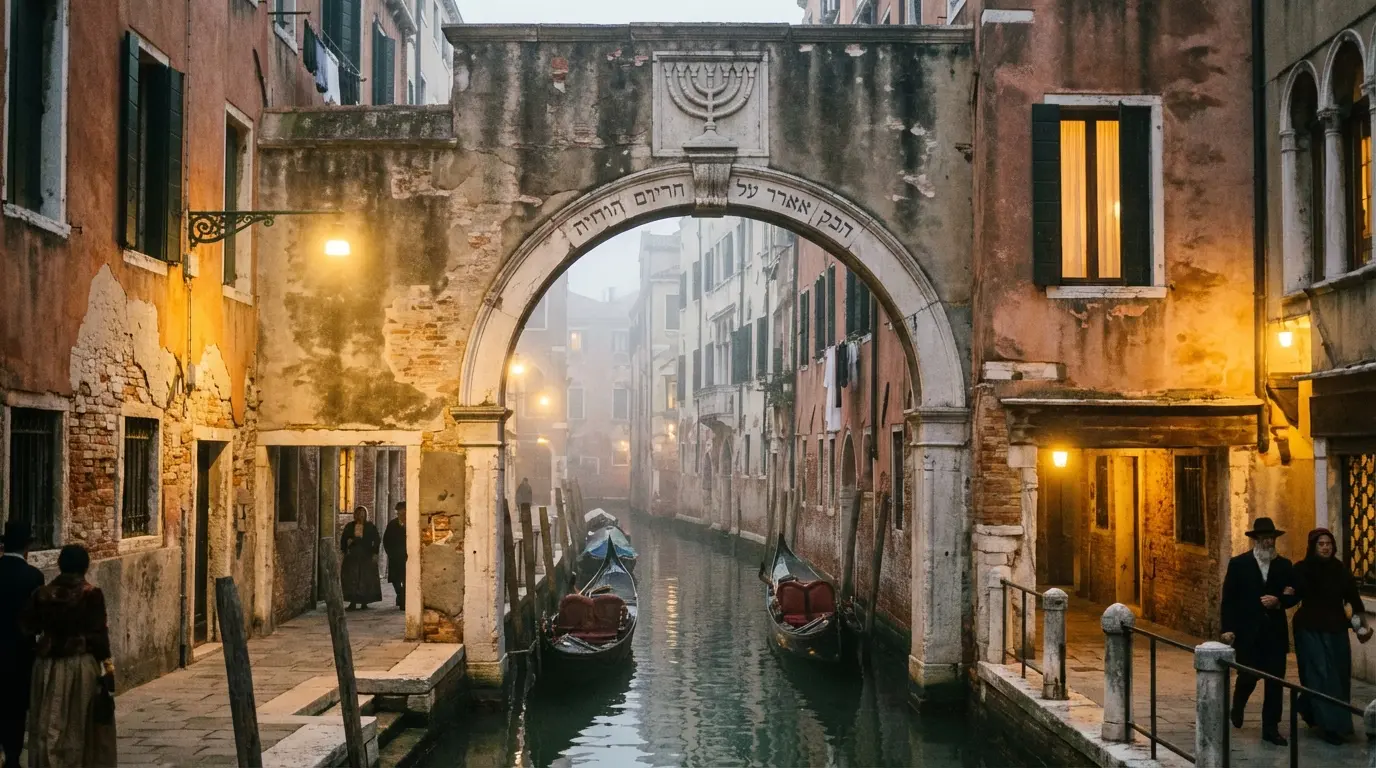
What “Hidden” Actually Means in Heritage Travel
When I say a heritage site is hidden, I do not mean it is literally unknown. I mean it is absent from the itinerary that most tour operators hand to their groups. The Vatican makes the list. The Colosseum makes the list. The Amalfi Coast, for some reason, makes the list. But the synagogue in Livorno that sheltered Sephardic refugees? The Jewish cemetery in Ferrara that has been standing since the 15th century? The early Christian oratory in Ravenna that holds some of the most extraordinary mosaics in the Western world?
These are not places you stumble upon. They require someone who knows they exist and understands why they matter.
Over my forty years in heritage travel, I have learned that the sites which change how a group thinks are rarely the ones they already know about. They are the places where the story surprises you, where you stand in a room or a courtyard and realize the history is deeper than you expected. Italy is full of those places, if you know where to look.
Sicily: Where the 1492 Expulsion Left Its Mark
Before 1492, Sicily was home to one of the largest and most established Jewish communities in all of Europe. Jewish life on the island stretched back centuries, rooted in commerce, scholarship, and daily religious practice. Entire neighborhoods in Palermo and Syracuse were organized around synagogues, markets, and communal life.
Then came the expulsion. In the same year that Ferdinand and Isabella drove the Jews from Spain, the decree was extended to Sicily. Tens of thousands of people were forced to abandon their homes, their businesses, their burial grounds. Some converted under pressure. Some fled to Naples or the Italian mainland. Some, over generations, made their way to the Ottoman Empire and eventually to the land of Israel.
Today, the physical traces are quiet but real. In Syracuse, the old Jewish quarter, the Giudecca, still carries the name. Beneath the Palazzo Cataldi, archaeologists uncovered a mikveh, a ritual bath, that had been sealed and forgotten for five hundred years. Standing in that space, knowing what happened above ground while this room was slowly buried, is an experience that no museum exhibit can replicate.
For Jewish groups especially, Sicily is not a detour. It is a chapter of the story that most people never read. And for many, discovering it on the ground, with their community beside them, is one of the most powerful moments of the entire trip.
The Ferrara Jewish Cemetery: One of the Most Moving Sites in Europe
Ferrara does not appear on most Italy itineraries, and that is a loss. The city’s Jewish community dates to the 13th century, and the ancient cemetery on Via delle Vigne is a place of extraordinary quiet and weight.
The headstones span centuries. Some are carved in Hebrew, some in Italian, some in both. The oldest graves belong to families who lived in Ferrara when the Este dukes still ruled, when the city was one of the more tolerant places in Italy for Jewish life. Later stones mark the families who stayed through harder centuries, through papal restrictions and ghetto walls.
What makes this cemetery different from larger, more famous memorial sites is its intimacy. You are not walking through a curated exhibit. You are standing among the graves of a community that lived, prayed, argued, celebrated, and endured in this one small city for seven hundred years. For a group traveling together, especially a congregation, that kind of encounter with continuity is difficult to find anywhere else.
The cemetery requires advance arrangements for access, which is one reason it rarely appears on standard tours. Heritage Tours works with local contacts in Ferrara to arrange visits, and I strongly recommend including it.
Livorno’s Sephardic Legacy: A City Built for Refugees
Livorno’s story is unlike any other city in Italy. In the late 16th century, the Medici rulers of Tuscany issued the Laws of Livorno, a set of guarantees that explicitly invited Jewish merchants, many of them Sephardic refugees expelled from Spain and Portugal, to settle in the city with full rights to worship, trade, and live without ghetto restrictions.
It worked. By the 17th century, Livorno was one of the most vibrant Jewish communities in the Mediterranean. Sephardic families from across the diaspora rebuilt their lives here. They established synagogues, printing houses, and commercial networks that connected Livorno to Amsterdam, Istanbul, and the ports of North Africa.
The original synagogue was destroyed during World War II, and the current building dates to the 1960s. But the Sephardic influence is still visible in the city’s layout, in family names recorded in communal archives, and in the traditions carried forward by the small community that remains.
For a group exploring what happened to Sephardic communities after the Spanish expulsion, Livorno is essential. It is one of the few places where the answer was not persecution or forced conversion but genuine welcome. That story deserves to be told on the ground where it happened.
Ravenna’s Mosaics and the Early Christian Communities Nobody Talks About
Ravenna was the seat of the Western Roman Empire in its final decades, and then the center of Byzantine authority in Italy for centuries after. What it holds, and what most visitors to Italy never see, is the most complete collection of early Christian mosaics outside of Istanbul.
The Basilica of San Vitale, built in the 6th century, contains wall and ceiling mosaics that glow with a depth of color that seven hundred years of Renaissance painting did not surpass. The figures of Christ, the apostles, Emperor Justinian, and Empress Theodora look out from gold backgrounds with a directness that feels personal rather than decorative.
For Christian groups, Ravenna offers something rare: a direct visual connection to the faith as it was practiced and expressed in the centuries before the medieval church took its familiar form. These mosaics were not art for art’s sake. They were teaching tools, devotional images, and declarations of belief made at a time when the shape of Christianity was still being debated.
The Mausoleum of Galla Placidia, a small building you could walk past without noticing, contains what many scholars consider the finest mosaic work in the Western world. The deep blue ceiling, covered in stars, has been called one of the most beautiful interior spaces ever created. It seats perhaps twelve people. Visiting with a small group, in silence, is the kind of moment that heritage travel exists to provide.
How to Add These Sites to Your Group Itinerary
Every site in this post can be woven into a broader Italy heritage tour without requiring your group to sacrifice the places they already expect to see. Rome, Venice, Florence, Assisi, these remain the anchors. But a well-designed itinerary builds in the stops that give the trip its real depth.
Sicily can be added as a two or three day extension at the beginning or end of a mainland tour. Ferrara sits between Venice and Bologna and requires only a half-day detour. Livorno is reachable from Florence in just over an hour. Ravenna works as a day trip from Bologna or as a stop between Venice and Florence.
The key is working with someone who knows these sites personally, who has arranged access, who understands how much time each one needs, and who can prepare your group for what they are about to encounter. That is what Heritage Tours does. We build the itinerary around what will matter most to your specific group, not around what is easiest to book.
FAQ
Are there Jewish heritage sites in Sicily?
Yes, and they are among the most significant in all of Italy. Syracuse’s Giudecca quarter, the mikveh beneath Palazzo Cataldi, and traces of pre-1492 Jewish life in Palermo all remain. Sicily was home to one of the largest Jewish communities in medieval Europe before the expulsion decree of 1492 forced tens of thousands to leave.
What happened to Italy’s Jewish communities after 1492?
The 1492 expulsion primarily affected Sicily and Sardinia, which were under Spanish rule. Jewish communities on the Italian mainland were not expelled at that time, though many faced restrictions, ghettoization, and periodic persecution in the centuries that followed. Cities like Livorno became havens for Sephardic refugees, while Rome’s ghetto endured until 1870.
Can a small group visit these lesser-known sites in Italy?
Yes, and in many cases a smaller group has an advantage. Sites like the Ferrara cemetery and Livorno’s communal archives require advance arrangements and work best with groups of five to twenty people. Heritage Tours coordinates access through local community contacts.
What is Livorno’s connection to Jewish history?
Livorno was one of the only cities in Europe that actively invited Jewish refugees to settle with full rights. The Medici rulers issued the Laws of Livorno in the late 1500s, attracting Sephardic families expelled from Spain and Portugal. By the 1600s, it was one of the most important Jewish commercial centers in the Mediterranean.
How is a heritage tour different from a regular sightseeing tour?
A heritage tour is built around meaning rather than checkmarks. The itinerary prioritizes sites for their historical, spiritual, and communal significance. Guides are chosen for their knowledge of faith traditions and community history. And the pace is designed to allow reflection, not just observation. For faith groups, the difference is between seeing Italy and understanding it.
If your group is ready for the kind of trip that goes deeper than the standard route, we would be glad to help you plan it. See our Italy heritage tours and let us know what matters most to your community.