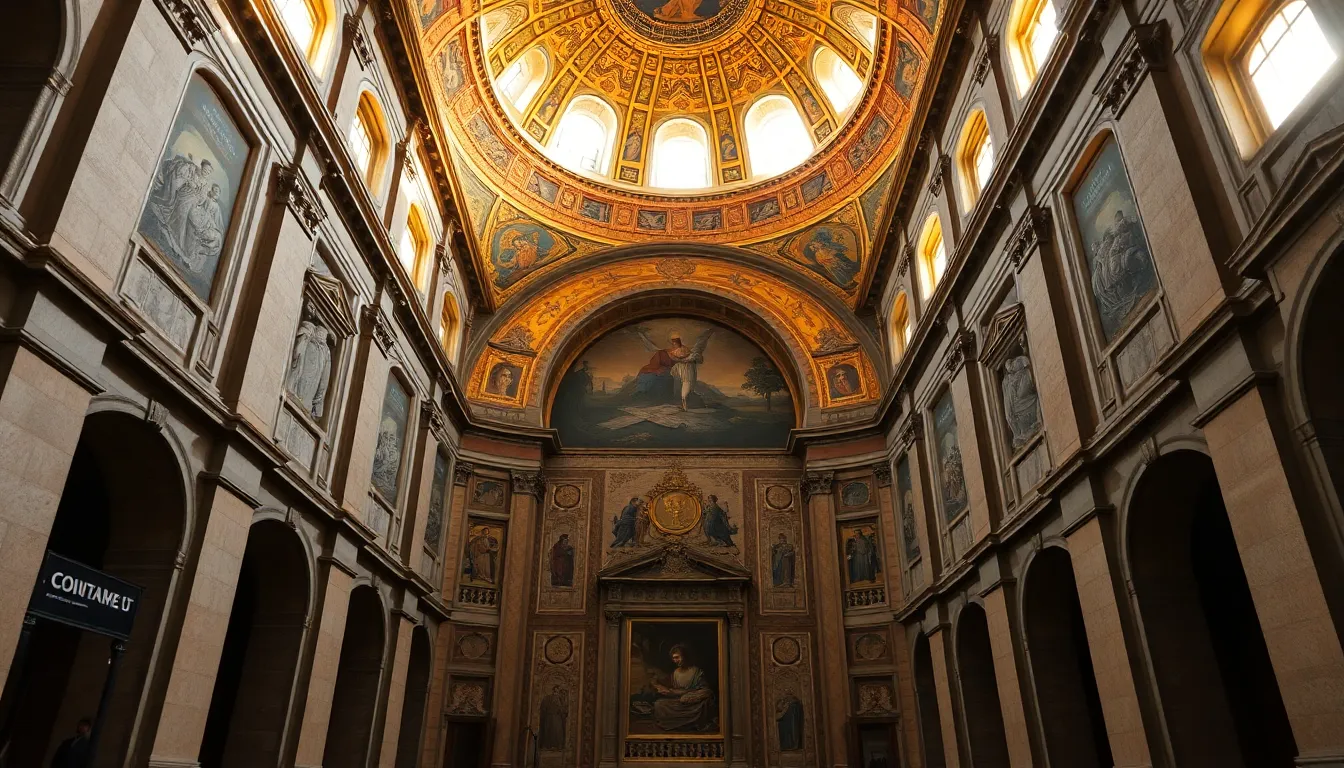
There is one site in Rome that, more than any other, lets a group physically descend through Christian history. You walk into a beautiful medieval church at street level, then you go down a staircase into a fourth-century church beneath it, then you go down again into a Roman world of the first century, with the sound of running water in the dark. By the time you climb back up, your group has traveled through nearly two thousand years without ever leaving the building. That place is the Basilica of San Clemente, and I rarely lead an Italy trip without it.
Most tourists never make it here. It sits a short walk from the Colosseum, but it is quiet, uncrowded, and it does something no other site in Rome does quite so clearly. Let me take you down through it level by level.
A Church Named for the Fourth Pope
San Clemente is dedicated to Saint Clement of Rome, traditionally counted as the fourth pope, leading the church near the end of the first century. He is remembered as the author of a famous letter to the Corinthian church, written while some of the apostles’ own contemporaries were likely still alive. That letter, known as First Clement, is one of the earliest Christian writings outside the New Testament, and it shows a church in Rome already reaching out to guide other congregations.
So before you even descend, the dedication itself plants the group in the first generations of the faith. This is not a church named for a medieval figure. It is named for a man who led believers in Rome within living memory of the apostles.
The Upper Basilica: The Twelfth-Century Church
The church you enter at street level was built in the early twelfth century, around 1100 to 1120. It is, on its own, one of the most beautiful medieval churches in Rome. The centerpiece is the apse mosaic above the altar, a golden, glowing image of the cross as the tree of life, with vines spreading out across the whole curved surface, filled with birds, figures, and small scenes of daily life.
I always give a group time to just stand under that mosaic. The theology in it is rich. The cross is shown not as an instrument of death but as a living tree from which all creation flourishes. Twelve doves on the cross represent the apostles. It is a sermon in glass and gold, and it rewards slow looking.
The upper basilica also holds frescoes of the life of Saint Catherine and beautifully carved choir screens that were actually moved up from the older church below. For most visitors, this would be the whole experience. But for your group, this is only the first floor. Our overview of the spiritual sites of Italy for faith travelers explains why sites like this, layered and quiet, often move groups more than the famous landmarks.
Going Down: The Fourth-Century Church
A staircase off to the side leads down into the original Basilica of San Clemente, a church built in the fourth century, not long after Constantine made Christian worship legal. For roughly seven hundred years, this was the main church on the site. After it was damaged and the upper church was built on top of it, the lower church was filled in and forgotten for centuries, only rediscovered and excavated in the nineteenth century by an Irish Dominican friar named Joseph Mullooly.
Walking into this level changes the mood of a group immediately. The light is dimmer. The ceilings are lower. And the walls hold faded early medieval frescoes, including a famous scene with one of the oldest known examples of written Italian, where a frustrated Roman official curses at workers trying to move a saint. It is a small, almost comic detail, and it makes the ancient world suddenly feel close and human.
Standing in this fourth-century space, I remind groups that this was a working church when the Roman Empire still stood, when many of the practices and prayers of the faith were taking the shape we know today.
Going Down Again: The Mithraeum and the First Century
Then comes the most surprising descent of all. Below the fourth-century church lie the remains of first-century Roman buildings. One of them was a private home, and beside it, in a back room, sits a remarkably preserved Mithraeum, a temple to the god Mithras.
Mithraism was a mystery religion popular among Roman soldiers and merchants, a direct competitor to early Christianity in the same neighborhoods and the same centuries. The temple here still has its stone benches where worshippers reclined and an altar carved with Mithras slaying the sacred bull. Standing in this room, your group is looking at the actual religious rival that the early Christians lived alongside and ultimately outlasted.
And running through this lowest level, you can hear it before you understand it, is an underground stream, water from an ancient Roman channel still flowing in the dark beneath the city. The sound is unforgettable. Groups go quiet down here without being told to.
Why the Layers Matter
What San Clemente offers a faith group is something no lecture can give: the physical experience of how the church grew out of, and then over, the pagan Roman world. You stand on a pagan temple. Above it, the church of the newly legal faith. Above that, the confident medieval church with its golden mosaic. The building is a cross-section of how Christianity rose within the empire and finally redefined it.
I have watched groups understand more church history in the forty-five minutes it takes to climb back up through San Clemente than in any classroom. The order matters too. Descend slowly, then climb back into the light. The ascent itself preaches.
For a sense of how San Clemente fits alongside Rome’s other early Christian sites, our piece on the footsteps of Paul in Italy covers the apostolic-era sites that pair well with a visit here.
Practical Notes for Groups
San Clemente is run by Irish Dominican friars, and the lower levels require a ticket. Photography is restricted in the excavated levels, which actually helps, because it keeps the group present rather than reaching for phones. The lower levels are cool and slightly damp year-round, so a light layer is sensible even in summer. The staircases are narrow, so very large groups move through in smaller waves.
Because group leaders travel free with fifteen or more participants, including a deep, well-guided stop like San Clemente in your itinerary is entirely realistic for a church or study group. Our group heritage tours page explains how that works, and our Italy destination page shows how San Clemente fits a wider Rome itinerary.
FAQ: The Basilica of San Clemente
Why is San Clemente called three churches in one?
San Clemente has three distinct levels stacked on top of one another. At street level is a twelfth-century medieval basilica. Beneath it lies the original fourth-century church. Below that are first-century Roman buildings, including a pagan temple to Mithras. Visitors descend through all three, traveling through nearly two thousand years of history inside a single building.
Who was Saint Clement of Rome?
Clement is traditionally counted as the fourth pope, leading the church in Rome near the end of the first century. He is remembered as the author of First Clement, a letter to the Corinthian church that is one of the earliest Christian writings outside the New Testament, showing the Roman church already guiding other congregations within living memory of the apostles.
What is the Mithraeum under San Clemente?
The Mithraeum is a small temple to the god Mithras, preserved in the lowest level of the site. Mithraism was a mystery religion popular among Roman soldiers and a direct competitor to early Christianity. The temple still has its stone benches and an altar carved with Mithras slaying a bull, giving visitors a direct look at the pagan world the early church grew up alongside.
Is San Clemente good for a faith group tour?
Very much so. Few sites in Rome let a group physically descend through Christian history the way San Clemente does, from a pagan temple to the early legalized church to the confident medieval basilica. It is quiet, uncrowded, and located a short walk from the Colosseum, which makes it easy to include in a Rome itinerary.
Are there any practical limits for groups visiting San Clemente?
The lower excavated levels require a ticket and restrict photography, the staircases are narrow so large groups move through in waves, and the underground levels stay cool and damp year-round, so a light layer is wise even in summer. With a good guide and a bit of pacing, it works beautifully for groups of fifteen or more.
If your group wants the experience of walking down through two thousand years of Christian history in a single afternoon, San Clemente belongs on your itinerary, and I would be glad to help you build it in. Contact us to start planning.