I have brought a lot of groups to Rome over the years, and I have learned that there are two ways to arrive in that city. You can arrive as a tourist, stepping off a plane into a taxi line. Or you can arrive the way Paul did, after a shipwreck, after months of detention, walking the last stretch of road on foot with friends coming out to meet you. Most of my groups want the second version. They want to understand what it cost the apostle to reach the heart of the empire, because that journey is the closing chapter of the book of Acts, and it is one of the most human passages in the whole New Testament.
So let me walk you through it. Not as a map, but as the journey it actually was, the one your group can still trace today.
Why Paul’s Italian Journey Matters
For most of Acts, Paul is in motion across the eastern Mediterranean. Then in chapter 27, everything narrows down to a single goal: Rome. Paul had appealed to Caesar, which was his legal right as a Roman citizen, and that appeal set the whole journey in motion. He was not a free man. He was a prisoner under guard, being transported to the capital to stand trial.
What makes the Italian leg of the journey so meaningful for a faith group is that it is the fulfillment of something Paul had wanted for years. He had written to the Roman church long before he ever saw the city, telling them he longed to visit. In Acts 23, the text says the Lord stood by Paul and told him plainly that he would testify in Rome. So when your group reaches Italian soil with the story, you are standing at the place where a promise made years earlier finally came true. That is a powerful thing to feel with a congregation around you.
The Shipwreck and the Long Way There
Before Italy, there was Malta. The ship carrying Paul was caught in a violent storm that lasted many days, and it ran aground on the island of Malta, where Paul and the whole company of two hundred and seventy-six survived. They wintered there for three months. The detail in Acts 28 about the viper that fastened on Paul’s hand, and the islanders watching to see if he would swell up and die, is the kind of vivid, specific reporting that tells you someone was actually there writing it down.
I mention Malta because it sets up the arrival in Italy. By the time Paul reaches the Italian coast, he has already survived a shipwreck, a winter delay, and a long sea voyage. He is not arriving fresh. He is arriving worn down and faithful, which is exactly the state your group will appreciate when they understand the full arc.
Puteoli: The First Italian Soil
After Malta, the ship put in briefly at Syracuse in Sicily, then at Rhegium on the toe of Italy, and finally landed at Puteoli on the Bay of Naples. Puteoli, modern Pozzuoli, was one of the great ports of the Roman world, the main harbor where grain ships from Egypt unloaded to feed the capital. This is where Paul first set foot on the Italian mainland.
The text gives us a small but moving detail here. At Puteoli, Paul found brothers and sisters, fellow believers, and they invited him to stay with them seven days. Think about what that means. There was already a Christian community on the Bay of Naples before Paul ever arrived. The faith had traveled ahead of the apostle. For a group standing in Pozzuoli today, looking out at the same bay, that detail reframes the whole story. Paul was not bringing the gospel to a blank map. He was joining a movement that was already spreading on its own.
Pozzuoli still has the remains of a Roman amphitheater and the old harbor area, and standing there gives your group a concrete sense of the scale of the port that received the apostle.
The Appian Way: The Road to the Capital
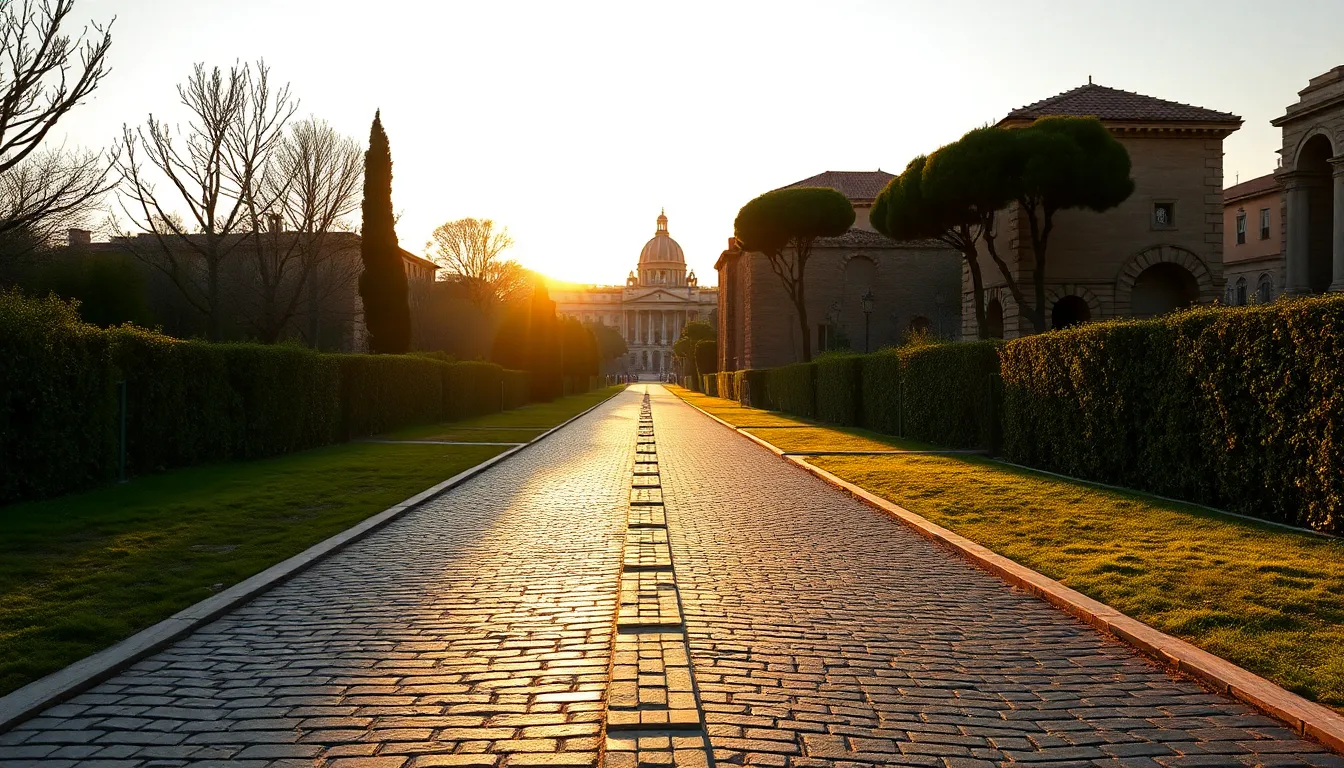
From Puteoli, the journey turned inland and north along the road toward Rome. The road they traveled was the Via Appia, the Appian Way, the oldest and most famous of the great Roman roads. It had been built more than three centuries before Paul walked it, and large stretches of it are still there today, the original basalt paving stones worn smooth.
Walking even a short section of the ancient Appian Way is, for many of my groups, the emotional center of the whole Italy itinerary. You are not looking at a road behind glass. You are standing on the actual surface that carried Paul toward his trial. The cypress trees, the tombs lining the road, the silence outside the city, all of it is close to what he would have experienced.
For more on building a faith itinerary around moments like this, our guide to the spiritual sites of Italy for faith travelers lays out how these pieces fit together across a full trip.
The Three Taverns and Forum of Appius
Acts 28 names two specific stops on the road south of Rome. As word spread that Paul was approaching, believers from the Roman church traveled out to meet him. Some came as far as the Forum of Appius, about forty-three miles from the city. Others met him at the Three Taverns, a rest stop roughly thirty-three miles out.
The text tells us that when Paul saw them, he thanked God and took courage. That single sentence carries a lot of weight. Here is a man who had survived a shipwreck and was heading into an uncertain trial, and what lifted his spirits was simply seeing fellow believers walk out to greet him. The friends did not solve his legal problem. They did not change his situation. They just showed up. I point this out to every group, because it is one of the most relatable moments in Acts, and it speaks directly to how a faith community supports its own.
For the full story of these roadside meetings, our article on Puteoli and the Three Taverns follows the route in detail.
Arrival in Rome
And then, the line that the whole book has been building toward: “And so we came to Rome.” Paul was allowed to live by himself with a soldier guarding him, under a form of house arrest that still permitted visitors. For two full years he stayed in his own rented place, welcoming everyone who came, proclaiming the kingdom of God and teaching about Jesus with all boldness and without hindrance. That is the last sentence of the book of Acts.
It is a strange and beautiful way to end. There is no account of the trial, no verdict, no execution. The story simply leaves Paul in Rome, still teaching, still free in the only way that mattered to him. For a group that has traced the journey from Puteoli, arriving in Rome closes the circle. Many of the early Christian sites in the city, including the tradition surrounding Paul’s later martyrdom and burial, connect directly to this final chapter. The Basilica of St. Paul Outside the Walls marks the traditional site of his tomb, and it is a natural anchor for a group following his story.
How a Group Experiences This Route
When I plan a Paul itinerary, I try to give the journey its proper shape. We start on the Bay of Naples at Pozzuoli, looking out at the harbor where he landed. We walk a stretch of the Appian Way. We read Acts 28 aloud on the road, which sounds simple but lands hard when you are standing where it happened. And we close in Rome at the sites tied to his final years.
Group leaders travel free with fifteen or more participants, which makes a focused trip like this realistic for a congregation or study group to organize around a single book of the Bible. You can see how that works on our group heritage tours page, and our Italy destination page lays out the broader itinerary options.
FAQ: Paul’s Journey in Italy
Where did Paul first arrive in Italy?
Paul first landed on the Italian mainland at Puteoli, the modern city of Pozzuoli on the Bay of Naples, as recorded in Acts 28:13. Puteoli was a major Roman port, the main harbor where Egyptian grain ships supplied the capital. Paul found a community of believers already there and stayed with them for seven days before continuing on toward Rome.
What road did Paul travel to reach Rome?
Paul traveled north from Puteoli along the Via Appia, the Appian Way, which was the oldest and most important of the Roman roads. Long stretches of the original paved road survive today just outside Rome, and walking a section of it is one of the most meaningful stops for any group tracing Paul’s journey.
What were the Three Taverns and the Forum of Appius?
These were two rest stops along the Appian Way south of Rome, named in Acts 28:15. Believers from the Roman church traveled out from the city to meet Paul at these points, some coming as far as the Forum of Appius about forty-three miles out, and others to the Three Taverns about thirty-three miles out. When Paul saw them, the text says he thanked God and took courage.
Can faith groups still visit these sites today?
Yes. Pozzuoli preserves its Roman amphitheater and harbor remains, sections of the ancient Appian Way are open to walk, and Rome holds the sites connected to Paul’s final years, including the Basilica of St. Paul Outside the Walls at the traditional location of his tomb. A well-planned itinerary can trace the route from the Bay of Naples to Rome in the order Acts describes.
How long should a group spend tracing Paul’s journey in Italy?
Most groups dedicate two to three days to the Paul-focused portion of an Italy trip, with time on the Bay of Naples, a walk on the Appian Way, and the relevant sites in Rome. That fits comfortably inside a larger Italy heritage itinerary that also includes the Vatican, the catacombs, and other Christian heritage sites.
If your community is drawn to walking the closing chapter of Acts on the ground where it happened, I would love to help you shape it into a trip. Contact us whenever you are ready to start planning.