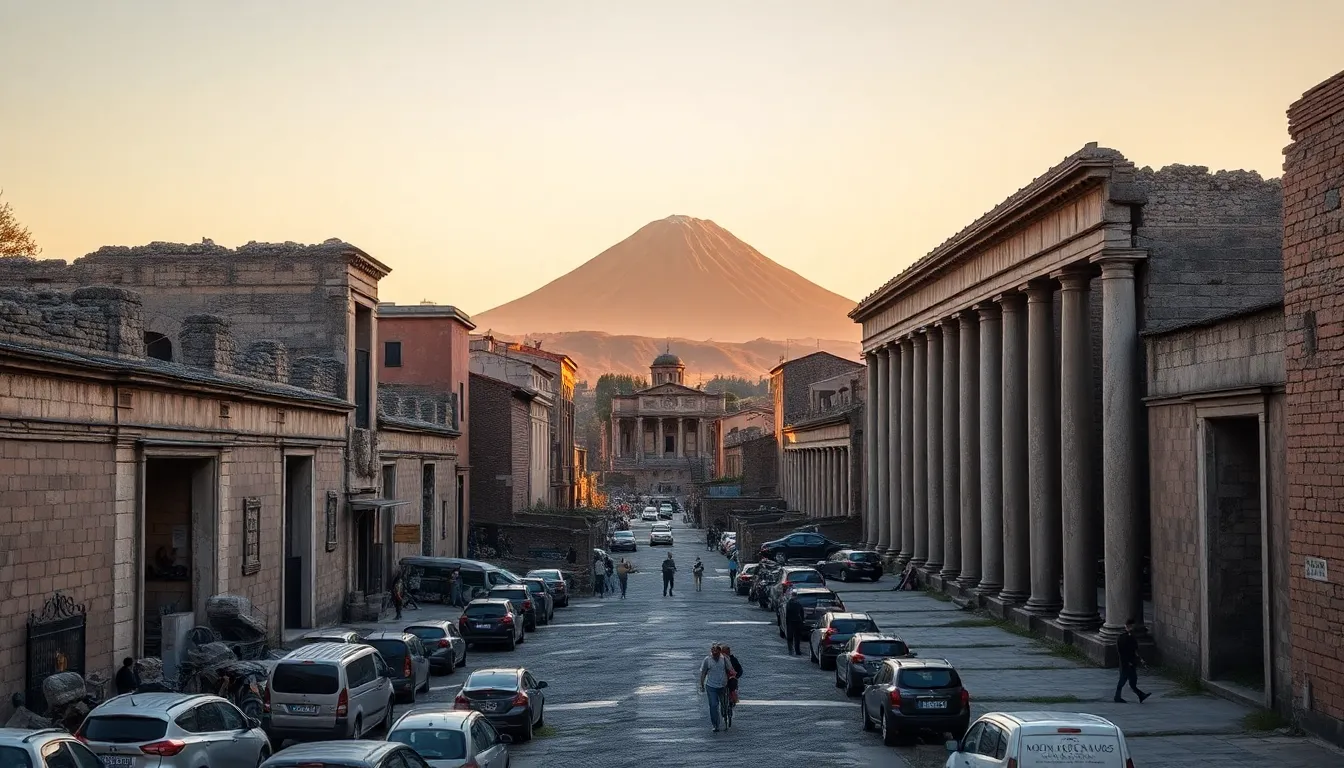
When I bring a group to Pompeii, I almost always hear the same thing at some point during the walk: “I didn’t expect it to feel so ordinary.” That is exactly the point. Pompeii is not a temple or a cathedral. It is a normal Roman town, frozen on the day it died, and that ordinariness is what makes it speak to a faith group. You are walking through the everyday world of the first-century Mediterranean, the same world the apostle Paul moved through within a few years of this town’s destruction.
Most tour operators treat Pompeii as a stop for the history-curious and leave it at that. For a heritage group, there is a richer way to read it, and it starts with a beach a short distance up the coast.
A Town Caught in a Single Afternoon
On an autumn day in 79 AD, Mount Vesuvius erupted. Pompeii, a busy town of perhaps twelve to fifteen thousand people, was buried under volcanic ash and pumice over the course of about a day. Nearby Herculaneum, a smaller and wealthier seaside town, was engulfed by superheated flows of gas and rock that arrived faster and hotter.
The same disaster preserved both places in very different ways. Pompeii was buried in ash that settled around buildings and bodies and then hardened. Centuries later, excavators found cavities where victims had decayed, and by pouring plaster into those voids they recovered the exact shapes of people in their final moments. Those casts are among the most haunting things you will see anywhere, and I prepare groups for them, because they are not artifacts. They are the impressions of human beings.
Herculaneum was sealed by deep, hot mud that carbonized rather than destroyed. Wooden doors, beds, staircases, even loaves of bread survived. The town is smaller, less crowded, and in some ways better preserved than its famous neighbor, and I often prefer it for groups who want to feel a Roman house as a place people actually lived.
Together, the two sites give the most complete picture we have of daily life in the Roman world: the shops, the kitchens, the public baths, the graffiti scratched on walls, the bakeries with their grindstones still standing. This is the texture of the world into which the early church was born.
The Connection to Paul’s Journey
Here is the link that turns Pompeii from a general-interest ruin into a heritage site, and it is one most visitors never hear.
The Book of Acts records that the apostle Paul, traveling as a prisoner toward Rome, landed at the port of Puteoli, modern Pozzuoli, on the Bay of Naples. Acts 28 says he found believers there and stayed with them seven days before continuing on to Rome. Puteoli sits on the same bay as Pompeii and Herculaneum, a short distance up the coast.
That detail matters more than it first appears. It tells us there was already a Christian community on the Bay of Naples by around 60 AD, before Paul ever reached the capital. The faith had traveled ahead of him through the trade and shipping networks of the Roman Mediterranean. When Paul stepped ashore at Puteoli, brothers and sisters in the faith were waiting for him.
Now hold the dates together. Paul landed at Puteoli around 60 AD. Vesuvius destroyed Pompeii and Herculaneum in 79 AD. The towns your group walks through were alive, busy, and trading on the same bay during the years the first Christians were establishing themselves there. Some scholars have even pointed to ambiguous markings at Pompeii and Herculaneum that may, possibly, hint at a Christian or Jewish presence, though the evidence is debated and I am careful not to overstate it. What is certain is the setting. These cities show your group the precise world, the streets, the houses, the markets, where the New Testament’s account of the faith reaching Italy actually unfolded.
Reading the Sites With a Faith-Heritage Group
I frame Pompeii and Herculaneum for groups as the stage set of Acts 28. Paul wrote letters into this kind of world. He preached in towns laid out like these, with forums like this forum, in houses arranged like these houses. When your people read the New Testament after walking these streets, the words sit in a real place rather than a vague ancient haze.
There is a Jewish dimension too. The Roman world that Paul moved through was full of Jewish communities, and the Bay of Naples had a Jewish presence in this period. The broader region tells the story of how both Jews and the earliest Christians lived inside the Roman Empire, under its power, in its cities, speaking its languages. For a group exploring the Mediterranean world of the Scriptures, these towns are a vivid chapter.
I also keep the human weight of the sites in view. These were people, and they died in a catastrophe. I find that faith groups, accustomed to sitting with questions of mortality and meaning, often respond to Pompeii more deeply than general tourists do. The plaster casts ask a question that a congregation is well equipped to hold.
These sites pair naturally with the Roman chapters of an Italy itinerary, including the Colosseum and the martyr tradition and the Pantheon’s path from pagan temple to Christian church, since all three show the same Roman world meeting the early faith from different angles.
Practical Access for Groups
Pompeii is large, genuinely large, and a group cannot see all of it in one visit. The full site covers more than 150 acres, and trying to do everything leaves people exhausted and overwhelmed. I plan a focused route through the highlights, the Forum, a bath complex, a bakery, one or two of the grand houses, and the casts, and let depth win over coverage. Herculaneum, being smaller, can be seen more completely in a couple of hours and makes a strong pairing or alternative.
The ground is the main practical challenge. The streets are original Roman paving, uneven and rutted by ancient cart wheels, with raised stepping stones at crossings and few flat stretches. Sturdy shoes are essential, and I flag this clearly for older members. Shade is limited, and the summer sun on the Bay of Naples is strong, so morning visits and plenty of water are the rule.
Both sites are reachable from Naples or Sorrento, and many groups combine them with the Amalfi Coast or a wider southern Italy route. Advance group tickets and a licensed guide are worth arranging, because the sites are crowded and a guide who can connect the ruins to the world of Acts is what lifts the visit from sightseeing into heritage. You can see how we build the Bay of Naples into a wider itinerary on our Italy heritage destination page, and how the group leader experience works, including that group leaders travel free with fifteen or more participants.
FAQ: Visiting Pompeii and Herculaneum
What is the connection between Pompeii and the apostle Paul?
Acts 28 records that Paul landed at Puteoli, modern Pozzuoli, on the Bay of Naples, where he found a Christian community already established and stayed seven days before continuing to Rome. Puteoli sits on the same bay as Pompeii and Herculaneum, a short distance away. The towns your group walks through were alive and trading during the same years the first Christians settled on that coast, around 60 AD, before Vesuvius destroyed them in 79 AD.
Should a group visit Pompeii or Herculaneum, or both?
Both if time allows, because they complement each other. Pompeii is far larger and more famous, with the dramatic plaster casts, but it can overwhelm. Herculaneum is smaller, less crowded, and in some ways better preserved, with carbonized wood and household objects intact. Many groups do a focused route through Pompeii and add Herculaneum for a closer feel of a Roman home.
What are the plaster casts at Pompeii?
When excavators found cavities in the hardened ash where victims had decayed, they poured plaster into the voids and recovered the exact shapes of people in their final moments. The casts are deeply affecting, and I prepare groups for them in advance, because they are the impressions of real human beings caught in the disaster.
Is Pompeii difficult to walk for older group members?
It can be. The streets are original uneven Roman paving with raised crossing stones and few flat areas, the site is very large, and shade is limited. Sturdy shoes, a focused route rather than the whole site, morning timing, and plenty of water make it manageable for mixed-age groups. Herculaneum, being smaller, is generally easier.
Why visit Pompeii on a faith-heritage tour?
Because it shows the everyday Roman world into which the early church was born, the same world Paul moved through and wrote his letters into. Walking these streets, forums, and houses gives a congregation a real setting for the New Testament’s account of the faith reaching Italy, and the human weight of the buried cities resonates strongly with faith communities.
If your community wants to walk the streets of the world the New Testament describes, on the same bay where Paul came ashore, we would be glad to help you plan it. Contact us and tell us what your group is hoping to encounter.