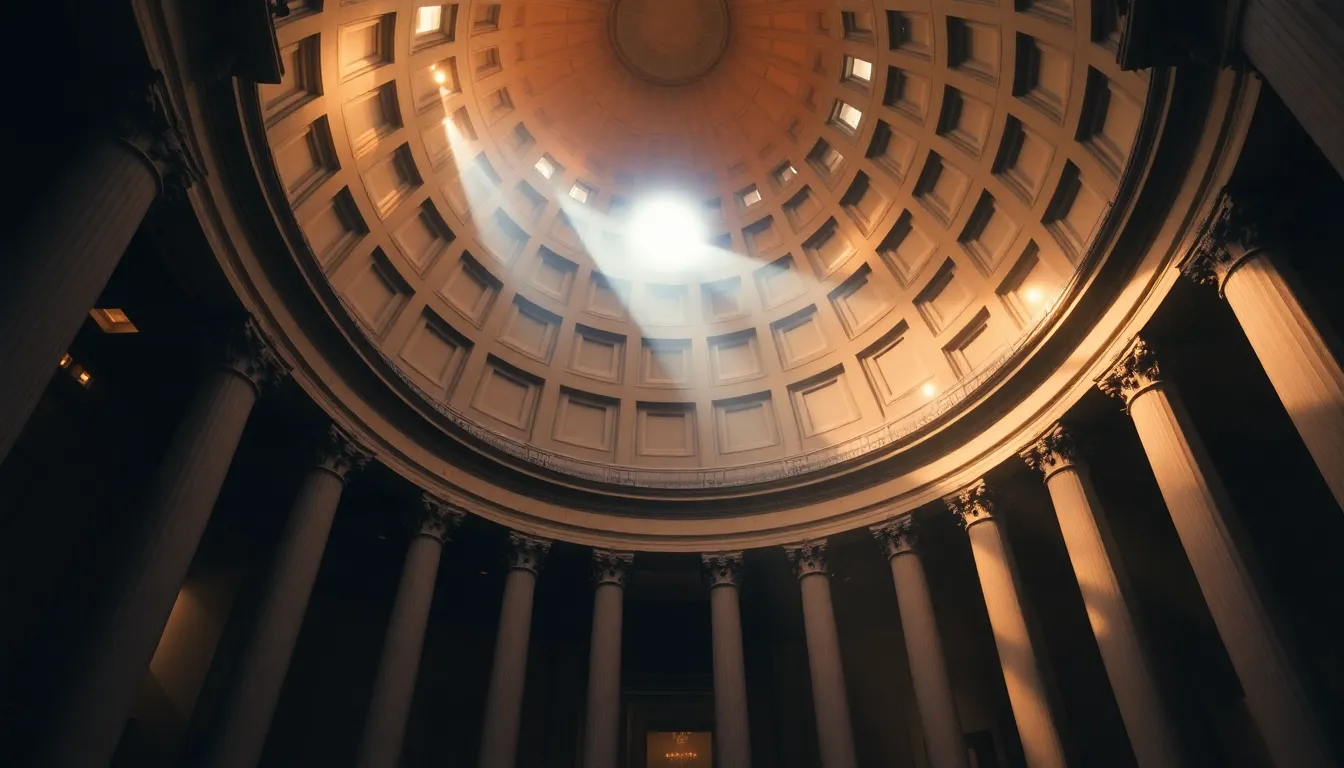
I have a habit when I bring a group into the Pantheon. I let them walk in, look up at the great open eye in the ceiling, and feel the scale of the room for a minute. Then I ask one question: do you realize you are standing in a working church? Almost no one does. The Pantheon reads so completely as an ancient Roman monument that visitors miss the most remarkable thing about it, which is that it never died. It changed faith and kept going.
For a heritage group, that survival is the whole story. The Pantheon is the clearest place in Rome to stand inside the moment when the old world became the Christian world, because the building did not get torn down and replaced. It got baptized and carried on.
The Roman Temple That Refused to Fall
The Pantheon you walk into today was built by the emperor Hadrian around 113 to 125 AD, on the site of an earlier temple raised by Marcus Agrippa, whose name still runs across the front in bronze letters. The word Pantheon comes from the Greek for “all the gods,” and the building was dedicated to the gods of Rome.
What Hadrian’s architects achieved has never quite been equaled. The dome is a perfect hemisphere of unreinforced concrete, and to this day it remains the largest unreinforced concrete dome in the world, almost nineteen centuries after it was poured. Its diameter and its height from floor to oculus are identical, so the interior would hold a perfect sphere. The geometry is exact and deliberate.
At the center of the dome is the oculus, a circular opening nearly thirty feet across, open to the sky. It is the building’s only source of light, and it is not glazed. Rain falls through it onto a gently sloped floor with drains built to carry the water away. Through that opening, the sun moves across the interior through the day like a slow searchlight. I tell groups to watch the disk of light travel down the wall, because the Romans designed the room to do exactly that, and the effect is as moving now as it was meant to be.
How a Pagan Temple Became a Church
Here is the hinge of the whole story. In the year 609, the Byzantine emperor Phocas gave the Pantheon to Pope Boniface IV. The pope consecrated it as a Christian church, and it has been one ever since.
That single act is why the building survives so completely. Across the medieval centuries, the temples and monuments of pagan Rome were stripped for their stone, their marble, and their bronze. The Forum became a quarry and a cattle field. But the Pantheon was now a church, protected by the authority of the papacy, and so it kept its dome, its columns, and its bronze doors while the city around it fell into ruin. Consecration was preservation.
The new dedication carried real meaning. Boniface named the church Santa Maria ad Martyres, Saint Mary and the Martyrs. Tradition holds that the pope had the bones of martyrs brought from the catacombs outside the city and reburied beneath the church, so that a building raised to all the pagan gods became a shrine to the witnesses of the Christian faith. The “all the gods” of the name gave way to “all the martyrs.” For a faith group, that reversal is the heart of the visit.
Reading the Building With a Faith-Heritage Group
When I teach the Pantheon to a group, I frame it as a single conversion happening in stone. The same dome, the same oculus, the same floor, redirected from one understanding of the divine to another. Nothing was destroyed. Something was reconsecrated.
I point them to the oculus and the shaft of light, and I let the room do its work, because Christian and Jewish traditions alike speak of God as light and of light from above. The Romans built it to honor their gods. The church kept it and gave it a new name. The light did not change. What changed was who the people standing under it understood it to point toward.
This makes the Pantheon a quieter, more contemplative stop than the grander Roman sites, and I plan it that way. It pairs especially well with the Colosseum and its martyr tradition, since both buildings turn on the memory of the martyrs, and with the Sistine Chapel’s sweep from creation to judgment. Together they let a group trace how the Roman world and the Christian world fold into each other across this one city.
What Else Lives Inside
The Pantheon is also a burial place, which surprises groups. The painter Raphael, one of the towering figures of the Renaissance, is buried here under a simple Latin inscription. Two kings of unified Italy, Vittorio Emanuele II and Umberto I, lie here as well, which is why you may see members of Italian monarchist associations keeping a quiet honor guard by the tombs.
Mass is still celebrated in the Pantheon. On certain feast days, most famously at Pentecost, the firefighters of Rome climb to the roof and drop tens of thousands of red rose petals through the oculus, so that the petals drift down through that ancient shaft of light onto the congregation below. It is one of the most beautiful living traditions in the city, and a reminder that this is not a museum. It is a church that has been holding services for more than fourteen hundred years.
Practical Access for Groups
The Pantheon sits in the heart of old Rome, on the Piazza della Rotonda, a short walk from the Trevi Fountain and Piazza Navona, so it slots easily into a walking day through the historic center. In recent years a modest timed-entry ticket has been introduced for general visitors, with reduced or free entry tied to worship, so a group should check the current arrangement and book ahead in high season to avoid the queue on the piazza.
Because it remains an active place of worship, respectful conduct is expected. Quiet voices, modest dress, and awareness that you may arrive during Mass, when visiting pauses. I always tell groups this is a feature, not an inconvenience. Arriving during a service is a chance to see the building doing the thing it was reconsecrated to do.
The interior is step-free at the main entrance and largely flat inside, which makes it one of the easier major Roman sites for members with limited mobility. There is little seating, and the floor can be wet directly under the oculus after rain, so I point that out as groups move around.
A guide who can hold both halves of the story, the Roman engineering and the Christian reconsecration, turns a five-minute photo stop into one of the most thoughtful half-hours of a Rome itinerary. You can see how we build the Pantheon into a wider route on our Italy heritage destination page, and how the group leader experience works, including that group leaders travel free with fifteen or more participants.
FAQ: Visiting the Pantheon
Is the Pantheon a church or a Roman temple?
Both, in sequence. It was built as a Roman temple to all the gods around 113 to 125 AD under the emperor Hadrian. In the year 609 it was given to the pope and consecrated as the Christian church of Santa Maria ad Martyres, Saint Mary and the Martyrs. It has functioned as a church ever since, and Mass is still celebrated there.
Why did the Pantheon survive when other Roman temples were destroyed?
Because it became a church. When Pope Boniface IV consecrated it in 609, the building came under papal protection, while pagan temples across Rome were stripped for stone, marble, and bronze. The conversion to Christian use is the direct reason the dome, columns, and bronze doors still stand today.
What is the hole in the Pantheon ceiling?
It is the oculus, a circular opening nearly thirty feet across at the top of the dome, open to the sky and unglazed. It is the building’s only light source. Rain falls through it onto a sloped, drained floor, and on Pentecost the Rome fire brigade drops red rose petals through it onto the congregation below.
Can a group attend Mass at the Pantheon?
Yes. The Pantheon is an active church, and Mass is celebrated on Sundays and feast days. Visiting pauses during services, so a group may arrive to find worship underway. I treat that as part of the experience, since it shows the building still doing what it was reconsecrated to do.
Do groups need tickets for the Pantheon?
In recent years a modest timed-entry ticket has applied to general visitors, with reduced or free access tied to worship. Arrangements change, so a group should confirm the current rules and book ahead in busy seasons to avoid the queue on the Piazza della Rotonda.
If your community wants to stand inside the moment when ancient Rome became the Christian world, the Pantheon is the place to do it. We would be glad to help you plan a Rome itinerary that gives it the time it deserves. Contact us and tell us what your group is hoping to find.