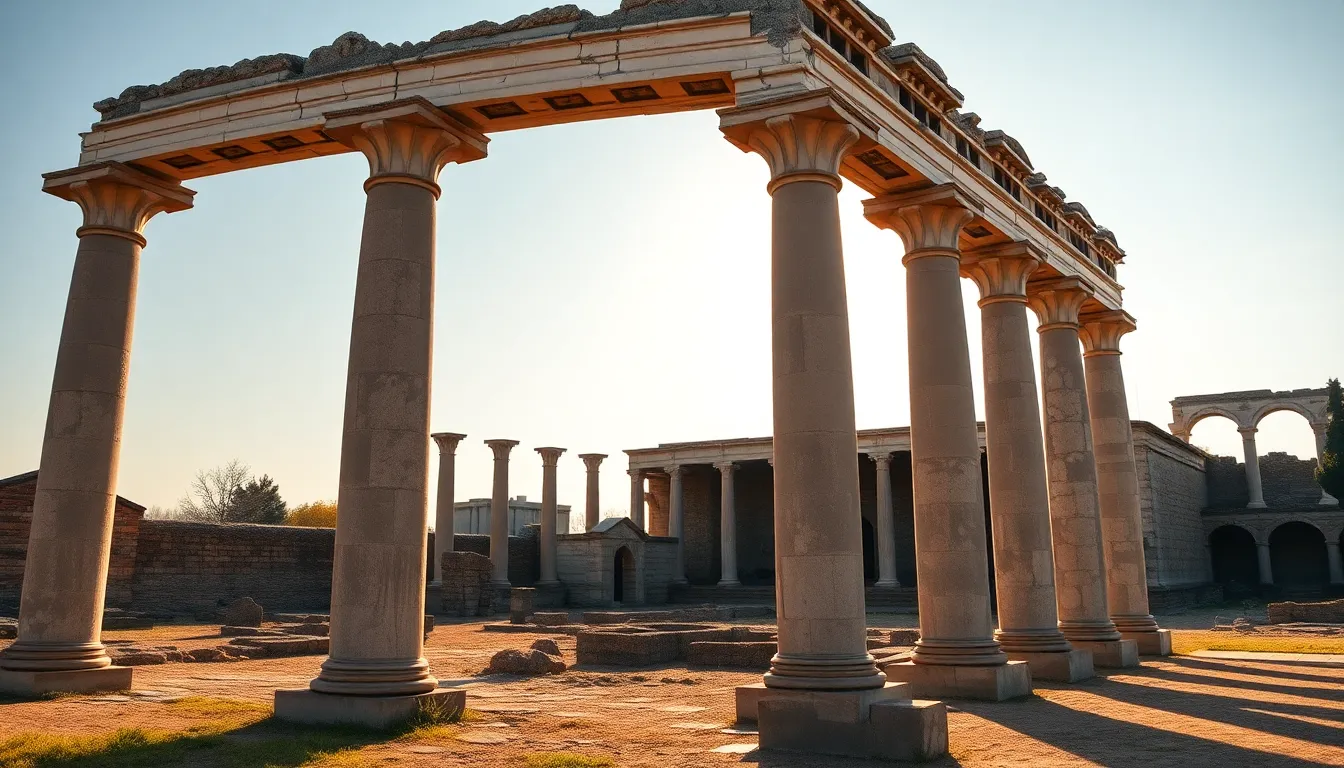
I have a confession about Ostia Antica. For years I treated it as the optional half-day, the thing we did if the group had time after Rome. Then one autumn a rabbi stood at the edge of the synagogue ruins, looked at the four marble columns still standing, and asked me how old they were. When I told him these stones were a Jewish house of prayer while the Second Temple was still standing in Jerusalem, he sat down on a low wall and stayed there a long time. I have never treated Ostia as optional since.
This is the oldest known synagogue in Europe, and one of the oldest anywhere in the Jewish diaspora. It sits about thirty minutes from central Rome, at the ruins of the ancient port that fed the imperial city. Most tourists who visit Ostia Antica walk straight past it toward the theater and the bathhouses. For a faith group, it is one of the most quietly powerful sites in all of Italy, and almost nobody is there.
What Ostia Antica Was
To understand the synagogue you have to understand the town. Ostia Antica was Rome’s harbor, the place where grain ships from Egypt and North Africa unloaded the wheat that kept a million Romans fed. It was a working port city, with warehouses, apartment blocks, taverns, public latrines, and temples to a dozen gods. At its height it held tens of thousands of people from across the Mediterranean.
A port city like that is exactly where you would expect to find Jews in the Roman world. Jewish merchants, traders, and travelers moved along the same sea routes as everyone else, and a community settled at Ostia drawn by the same commerce that drew everyone. The synagogue sits near the edge of the ancient town, close to where the sea once reached, which made sense for a community tied to maritime trade.
What makes Ostia so valuable for a group is that the ruins are not a single restored monument standing alone. You walk a real Roman street, past real Roman shops and homes, and the synagogue is part of that living fabric. Your group sees how a diaspora Jewish community lived inside a Roman city, not behind walls, not separated, but woven into a working port. That is a very different picture from the ghettos that came centuries later, and it is worth drawing the contrast aloud.
The Synagogue Itself
The building was first constructed in the first century of the Common Era, during the period when the Temple still stood in Jerusalem. Think about what that means. While priests were still offering sacrifices on the Temple Mount, Jews at this Italian port were gathering in a purpose-built hall to pray and read Torah. The synagogue was expanded and rebuilt over the following centuries, and what you see today reflects its fourth-century form, but the foundations reach back to the first.
Several features survive and reward a slow walk. Four marble columns topped with capitals carved with the menorah, the shofar, the lulav, and the etrog still mark the entrance to the main hall, and they remain the clearest sign of what this building was. There is an aedicula, a raised niche framed by columns, that held the Torah ark, oriented toward Jerusalem. Archaeologists also identified a room with an oven, almost certainly for baking the unleavened bread and other communal needs, and a basin near the entrance for ritual washing. These are not abstractions. They are the working parts of a real congregation’s life, eighteen centuries ago.
The site was only excavated in the 1960s, during work connected to a planned highway, which is part of why it is still so little known. It has none of the crowds of central Rome. On a typical morning your group may have the entire synagogue to itself, which is rare for a site of this significance and worth using deliberately. I build in time for people to simply stand there.
Why It Belongs in a Heritage Itinerary
I want to be direct about why this matters more than its modest ruins might suggest. The story most groups know begins with the Rome Ghetto and the Great Synagogue, which speaks of confinement, papal decrees, and survival. That is the medieval and modern chapter. Ostia is the chapter before all of that, the deep antiquity of Jewish life in Italy, predating the ghetto by more than a thousand years.
When a group sees Ostia first and Rome second, the whole trip reframes. Jewish presence in Italy is not a story that begins with persecution. It begins with a community trading, settling, and building a house of prayer in a Roman port while Jerusalem’s Temple still stood. The ghetto walls of 1555 came down on top of a presence already fifteen centuries old. That depth changes how your people understand everything else they see.
Ostia pairs naturally with Rome because of the geography, and it sets up the contrast with later sites beautifully. It also speaks to the wider Sephardic and diaspora heritage of Italy, reminding a group that Jewish life on this peninsula has been continuous and varied for more than two thousand years.
Visiting Ostia Antica With a Group
The site is large, flat, and open, spread across the footprint of a whole ancient town, so there is real walking involved, much of it on uneven ancient paving. For mixed-age groups I plan a focused route rather than trying to cover everything, with the synagogue as one anchor and the forum, theater, and main street as the others. Good footwear matters, and so does sun protection, because there is little shade among the ruins.
Spring and autumn are the best seasons here, for the same reasons they are best across central Italy: the heat of high summer makes a long open-air walk genuinely taxing, especially for older travelers. A morning visit beats the midday sun and the small afternoon crowds.
Heritage Tours arranges a guide who knows the Jewish history of the site specifically, not just a general Ostia guide, along with transport from central Rome and timing that keeps the group comfortable. With fifteen or more participants, the group leader travels at no cost. You can see how we structure these journeys on our group heritage tours page and our Italy destination page.
FAQ: The Ostia Antica Synagogue
How old is the Ostia Antica synagogue?
The synagogue was first built in the first century of the Common Era, during the period when the Second Temple still stood in Jerusalem. It was expanded and rebuilt over the following centuries, and the visible remains largely reflect its fourth-century form, but its foundations are first-century. This makes it the oldest known synagogue in Europe and one of the oldest in the entire Jewish diaspora.
Where is Ostia Antica and how do you get there?
Ostia Antica is the site of ancient Rome’s harbor, located about thirty minutes from central Rome by road or train. The ancient town is a large archaeological park, and the synagogue sits near its western edge, close to where the Mediterranean shoreline once reached. Heritage Tours arranges transport and a specialist guide from central Rome as part of a group itinerary.
What can you actually see at the synagogue?
The surviving remains include four marble columns with capitals carved with Jewish symbols, the menorah, shofar, lulav, and etrog, a raised niche that held the Torah ark oriented toward Jerusalem, a basin for ritual washing near the entrance, and a room with an oven likely used for communal food preparation. You walk the building as part of a real Roman street, surrounded by the shops, homes, and public spaces of the ancient port.
Why is Ostia Antica important for a Jewish heritage tour?
It tells the deepest chapter of Jewish life in Italy. While the Rome Ghetto speaks of confinement beginning in 1555, Ostia shows a Jewish community living woven into a working Roman port more than a thousand years earlier, while the Jerusalem Temple still stood. Seeing Ostia first reframes the entire Italian Jewish story, showing that it begins not with persecution but with a settled, building, praying community in deep antiquity.
Is Ostia Antica crowded?
No, which is part of its appeal. Because it was only excavated in the 1960s and sits outside the central tourist circuit, Ostia receives a fraction of the visitors of the Roman Forum or the Colosseum. Groups often have the synagogue area largely to themselves, which makes it one of the quietest and most reflective sites on an Italy heritage itinerary.
If Ostia Antica belongs in your community’s journey, and I would argue it does, I would be glad to help you build it into the right itinerary. Reach out whenever you are ready, and we can talk through how it fits with Rome and the rest of Italy.