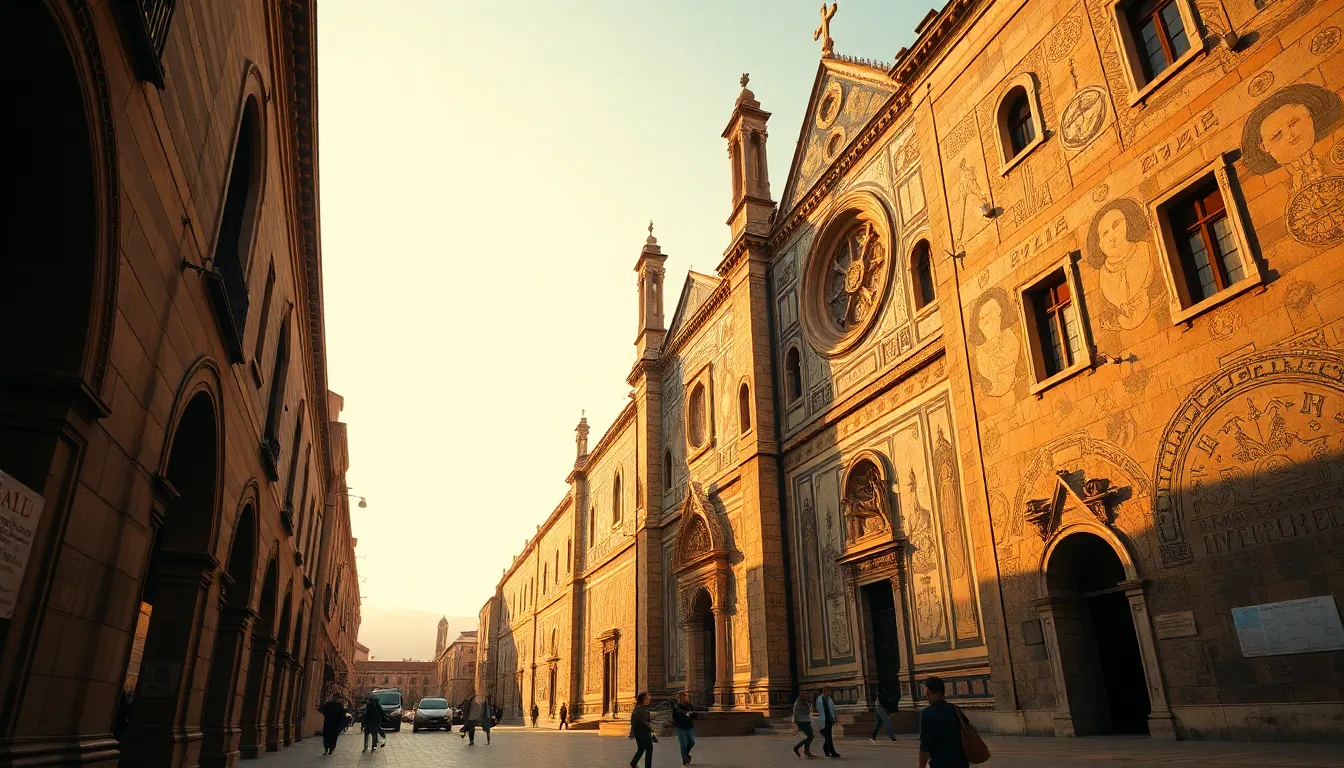
I have walked groups into a lot of churches over forty years, and I can count on one hand the ones where the whole group goes silent at the door. Monreale is one of them. You step out of the bright Sicilian sun into the nave, your eyes adjust, and you realize the entire upper half of the building, every wall, the apse, the arches, is sheathed in gold. Not gilded edges. Gold across acres of surface, telling the whole of Scripture in glass and light.
Most Italy itineraries never reach it. Monreale sits in the hills above Palermo, off the standard route, and that is exactly why it rewards a group willing to make the climb.
A Church Built by a King in a Hurry
The Cathedral of Monreale, properly the Cathedral of Santa Maria Nuova, was begun around 1174 under William II, the Norman king of Sicily. The Normans were an unlikely people to build one of the most beautiful churches in Christendom. They were descended from Vikings who had settled in northern France, then conquered Sicily in the eleventh century from its Arab rulers. What they created on the island was something Europe had not seen: a kingdom where Latin Christians, Greek Orthodox Christians, Arabs, and Jews lived and worked under one crown.
Monreale is the artwork of that world. William wanted it built fast, and it was, in roughly a decade, which is why the mosaic program has a unity that cathedrals built over centuries never achieve. The whole cycle was designed and executed as one vision. He also wanted it built grand, partly out of devotion and partly to outshine the archbishop of Palermo, with whom he was feuding. Royal pride and faith built this church together, and the result is one of the high points of medieval art.
The Mosaics: Scripture You Can Walk Through
There are roughly 68,000 square feet of golden mosaics covering the interior, made by craftsmen trained in the Byzantine tradition, likely brought from Constantinople and Greece, working alongside local artisans. The scale is hard to convey until you are standing inside it.
The program is laid out like a book. Along the upper walls of the nave, the story of Genesis unfolds: the creation of the world over the days, Adam and Eve, Cain and Abel, Noah and the flood, the tower of Babel, Abraham. Move toward the altar and the New Testament takes over, the life of Christ, his miracles, his passion. The side aisles carry the acts of Peter and Paul.
Dominating all of it, filling the curve of the apse above the altar, is the enormous figure of Christ Pantocrator, Christ the ruler of all. His face is more than twenty feet across. One hand is raised in blessing; the other holds an open book with the words, in Greek and Latin, “I am the light of the world.” Standing in the nave and looking up into that face is the moment groups remember. The Byzantine artists understood that gold reflects light differently as you move, so the image seems to follow you, to be present rather than painted.
Why It Matters for a Faith Group
For Christian travelers, Monreale is a chance to read Scripture the way most believers across history actually received it, not from a printed page but from the walls of the church, in images meant to teach and to move. The Genesis cycle alone is a complete visual catechism. I have watched groups spend an hour just on the early chapters of Genesis, recognizing each scene, talking through them in a way that printed text rarely prompts.
There is a deeper layer for groups interested in how faith communities lived alongside one another. The Christ Pantocrator and the Greek inscriptions reflect the Eastern, Byzantine roots of this art, even though the church was Latin and Roman Catholic. The cloister beside the cathedral, with its 228 paired columns, every capital carved differently, blends Christian, classical, and Islamic decorative traditions. This is a building that holds the whole of medieval Mediterranean faith in one place. For groups exploring how Christianity moved between East and West, Monreale belongs in the same conversation as Ravenna’s mosaics.
For Jewish travelers, the Genesis and patriarch cycles are familiar ground rendered in extraordinary form, the shared narrative of the Hebrew Scriptures. And Sicily itself holds deep Jewish history, the communities that thrived here until the expulsion of 1492, which we cover in our guide to hidden heritage sites in Italy.
How Groups Visit Monreale
Monreale is a small hill town about eight miles southwest of Palermo, roughly a 30-minute drive up into the hills. Most groups visit it as a half-day excursion from Palermo, which makes it an easy addition to any Sicily itinerary. The cathedral is the reason to come, but the town square and the views back over the Conca d’Oro, the valley that runs down to Palermo and the sea, are worth a few minutes.
Inside, there are two separate experiences. Walking the nave to see the mosaics is the main visit and takes a calm group about 45 minutes to an hour. Then there are two ticketed additions: the cloister next door, which I always recommend, and the climb to the roof terraces, which gives you a close view of the mosaics from above and a panorama over the valley. The roof involves a tight spiral staircase and is optional.
For groups of 15 or more, your group leader travels free on a Heritage Tours itinerary, and we arrange the timing so you are inside the cathedral when the morning light is doing the most for the gold.
Practical Access
The cathedral is an active place of worship, so visiting hours pause during Mass, and the timing shifts on Sundays and feast days. We confirm the current schedule before every group visit so nobody arrives to a closed nave. There is a dress code, shoulders and knees covered, enforced as in any major Italian church, so a light scarf or layer is worth carrying.
Monreale combines naturally with Palermo’s other Norman-era sites, especially the Palatine Chapel inside the Royal Palace, which shares the same golden-mosaic tradition on a smaller, more intimate scale. A full day covering both gives a group the complete picture of Norman Sicily’s faith and art. Sicily works as a two or three day extension at the start or end of a mainland Italy tour, and it pairs well with the broader route in our guide to spiritual sites in Italy.
FAQ: Visiting Monreale Cathedral with a Group
Where is Monreale Cathedral and how do you get there?
Monreale sits in the hills about eight miles southwest of Palermo, in Sicily. It is roughly a 30-minute drive up from the city, and most groups visit it as a half-day excursion from a Palermo base. We arrange private coach transport so the group stays together and arrives at the right time of day.
What makes the Monreale mosaics special?
The cathedral holds roughly 68,000 square feet of golden Byzantine-style mosaics, completed in a single decade in the late twelfth century. Because the whole program was designed and built at once, it has a unity that most cathedrals lack. The cycle runs from Genesis through the life of Christ, crowned by a Christ Pantocrator more than twenty feet across in the apse.
Is Monreale a working church or a museum?
It is an active Roman Catholic cathedral, so it holds regular Mass and closes to visitors during services. Visiting hours pause for worship and shift on Sundays and feast days. We confirm the current schedule before each group visit and build the day around it.
Should a group also see the cloister and the roof?
The cloister is worth it for nearly every group, 228 paired columns with individually carved capitals blending Christian, classical, and Islamic styles. The roof terrace gives a close view of the upper mosaics and a valley panorama but involves a tight spiral staircase, so we treat it as optional based on the group’s mobility.
How does Monreale fit with the rest of a Sicily visit?
It pairs naturally with Palermo’s other Norman sites, especially the Palatine Chapel, which shares the same mosaic tradition. Sicily as a whole works as a two or three day extension on a mainland Italy heritage tour, combining Christian art with the island’s deep Jewish history.
If your group is ready to stand under the golden walls of Monreale and read Scripture the way the medieval church received it, we would be glad to help you plan it. Explore our Italy heritage tours, see how we run group travel, and reach out to tell us what matters most to your community.