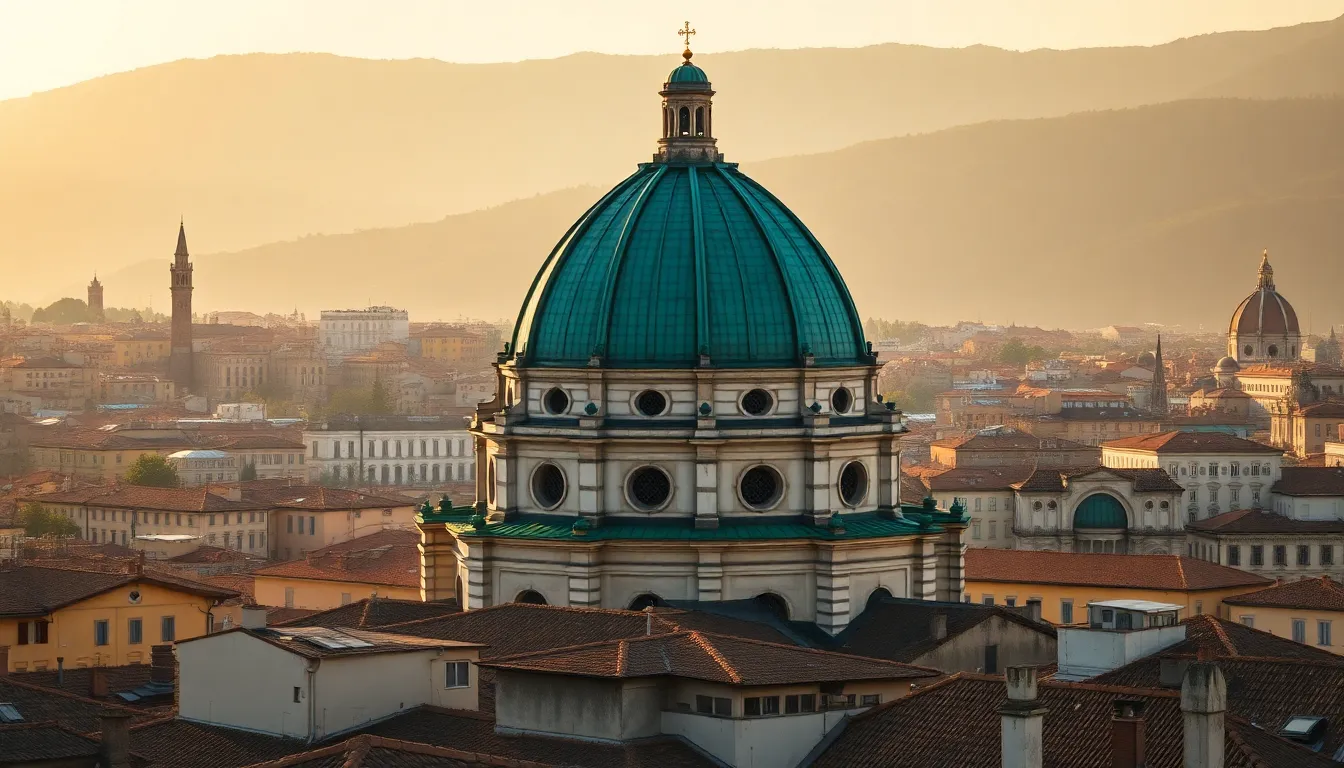
The first time I brought a group into the Great Synagogue of Florence, a rabbi who had been to Rome and Venice many times stopped at the door and said nothing for a full minute. He had expected another beautiful building. What stopped him was the dome. That green copper dome is the thing people remember, and it is the thing I want to talk about first, because it tells you something about how the Jews of Florence chose to be seen.
Most travelers come to Florence for the Renaissance. The Uffizi, the Duomo, Michelangelo’s David. What they do not expect is that a few blocks east of the tourist crush sits one of the most ambitious Jewish buildings in Europe, and behind it a story that runs from Medici protection to ghetto walls to a German military garage in 1944. Florence is not a footnote to the Italian Jewish story. It is one of its richest chapters.
The Medici Years and the Road to the Ghetto
Jewish presence in Florence goes back to the late Middle Ages, when Jewish bankers and moneylenders were permitted to operate in a city that needed credit and forbade Christians from charging interest. The relationship was always conditional. Florence wanted what the Jewish community could provide and resented needing it.
The Medici complicate any simple version of this story. Cosimo I de’ Medici, who consolidated power in the sixteenth century, invited Jewish merchants to settle and trade. He saw economic value in a Jewish presence, particularly in the port city of Livorno, which he and his successors developed into a haven. But the same dynasty that invited Jews in also confined them. In 1571, under pressure from the Church and following the pattern set in Rome and Venice, Cosimo I established a ghetto in the heart of Florence, near the present-day Piazza della Repubblica.
For nearly three centuries the Jews of Florence lived behind those walls. The ghetto was crowded, the restrictions were real, and the gates closed at night. What I tell groups is that the ghetto and the invitation came from the same family. That contradiction, protection and confinement braided together, is the truth of Jewish life under Christian power in Renaissance Italy. It was never one thing.
Emancipation and a Synagogue Built to Be Seen
The ghetto walls came down in stages through the nineteenth century, and full emancipation arrived with the unification of Italy in 1861. For the first time in three hundred years, the Jews of Florence were citizens. What they built next was a statement.
The Great Synagogue of Florence, the Tempio Maggiore, was completed in 1882. The community could have built something modest. Instead they commissioned a structure in the Moorish Revival style, with horseshoe arches, intricate geometric mosaics, and that unmistakable copper dome designed to be visible from across the city. The building was funded in large part by a bequest from David Levi, a leader of the community who left his fortune for exactly this purpose.
The choice of Moorish style was deliberate and worth explaining to a group. Across nineteenth-century Europe, newly emancipated Jewish communities reached for an architectural language that was distinctly their own, that pointed back to the golden age of Sephardic Spain rather than imitating the churches around them. The Tempio Maggiore belongs to that movement. Step inside and the interior is even more overwhelming than the exterior: deep blues and reds, gilded patterns climbing every wall, light falling through high windows onto a vast open sanctuary. It rivals the work I describe at the Scola Spagnola in Venice, and it was built by a community that had just emerged from confinement and wanted the whole city to know it was still here.
1944: The Synagogue as a Garrison
The hardest part of the story comes in the Second World War. When the Germans occupied Florence, they seized the synagogue and used it as a garage and depot for military vehicles. The sacred space was desecrated. Before the worst of it, members of the community and sympathetic Florentine neighbors managed to hide many of the Torah scrolls and ritual objects, smuggling them out and protecting them through the occupation.
As the Germans retreated in 1944, they mined the building and attempted to destroy it. The explosives damaged the structure but did not bring it down. Partisans are credited with cutting some of the detonation wires. The synagogue survived, scarred but standing.
The community did not survive intact. Hundreds of Florentine Jews were deported to Auschwitz, and many did not return. I always slow down here when I am with a group, because the building you are standing in held both the ambition of 1882 and the catastrophe of 1944, and both belong to it. After the war, the diminished community restored the synagogue. The damage was repaired. The scrolls came back. Today there are plaques near the entrance naming those who were deported, and most groups want a few quiet minutes there. I give it to them.
The Old Jewish Quarter and What Remains
The original ghetto near Piazza della Repubblica is gone. It was demolished in the late nineteenth century during an urban renewal project that flattened the medieval center, and the grand square that replaced it carries an inscription about restoring the city to “ancient decorum.” There is nothing left to walk through of the ghetto itself, which is its own kind of loss, and worth naming honestly rather than pretending the stones are still there.
What remains is the synagogue complex itself, which is the right anchor for a Florence visit. Inside the building you will find the Jewish Museum of Florence, spread across two floors. It holds ritual silver, textiles, and documents that trace the community from the ghetto years through emancipation and the war. The museum is small enough to absorb in an hour and rich enough to reward the time. For groups, I arrange the synagogue and museum together, with a guide who can connect what you see in the cases to the building around you.
If you want to understand the wider arc that Florence sits inside, the hub guide to Jewish heritage in Italy lays out how Rome, Venice, Florence, and Sicily fit together. Florence pairs especially well with Jewish Livorno, the Tuscan port the Medici opened as a refuge, which tells the other half of the Medici story: not confinement, but welcome.
Building Florence Into a Group Itinerary
For a heritage group, Florence works as a one-day or two-day stop. A focused day centers on the Tempio Maggiore and its museum in the morning, when the light through the high windows is at its best, followed by time to walk the area around the former ghetto and the surrounding streets in the afternoon. Groups that want more depth add a half day in Livorno, an hour and a half away, to follow the Medici thread to its more hopeful conclusion.
Access to the synagogue requires advance arrangement, and security at the entrance is real, as it is at most active Jewish sites in Europe. Heritage Tours handles the bookings, coordinates a guide who specializes in Jewish Florence, and keeps the group together with hotel pickup and dropoff so no one is navigating an unfamiliar city alone. With fifteen or more participants, the group leader travels at no cost, which for a rabbi or educator is often what moves a trip from idea to reality. You can see how we structure these journeys on our group heritage tours page and our broader Italy destination page.
FAQ: Jewish Florence and the Great Synagogue
What style is the Great Synagogue of Florence?
It is built in the Moorish Revival style, completed in 1882. The design features horseshoe arches, geometric mosaics, and a distinctive green copper dome visible across the city. The style was a deliberate choice by the newly emancipated community to claim an architectural identity rooted in the Sephardic past rather than imitating the surrounding churches. The richly decorated interior, in deep blues, reds, and gold, is considered one of the most beautiful Jewish interiors in Europe.
Can you visit the Great Synagogue of Florence?
Yes. The synagogue and the Jewish Museum of Florence housed within it are open to visitors, though entry requires passing through security, and groups should arrange access in advance. The museum traces the community from the ghetto era through emancipation and the Second World War. Heritage Tours coordinates entry, timing, and a specialist guide as part of a group itinerary.
What happened to the synagogue during World War II?
During the German occupation, the synagogue was seized and used as a military garage and depot. As the Germans retreated in 1944, they mined the building and tried to destroy it. The explosives caused serious damage but did not bring it down, partly because partisans cut some of the detonation wires. Many Torah scrolls and ritual objects had been hidden by community members and neighbors beforehand. The building was restored after the war by the surviving community.
Is there anything left of the Florence ghetto?
Very little. The original ghetto near today’s Piazza della Repubblica was demolished in the late nineteenth century during an urban renewal project that cleared much of the medieval center. The square that replaced it bears no trace of the Jewish quarter that stood there for three centuries. The synagogue complex and its museum, built after emancipation in a different part of the city, are now the main anchors for understanding Jewish Florence.
How does Florence fit into a wider Italy heritage tour?
Florence sits naturally between Rome and Venice on a north-moving itinerary and pairs especially well with the Tuscan port of Livorno, ninety minutes away, which tells the more welcoming side of the Medici relationship with the Jewish community. A focused Florence visit runs one to two days centered on the Tempio Maggiore and its museum. Heritage Tours builds custom routes that connect Florence to Rome, Venice, Livorno, and beyond based on a group’s interests and time.
If you are a rabbi or educator thinking about Florence for your community, I would welcome the chance to help you plan it. Reach out whenever you are ready, and we can start with the question of what you most want your group to see.