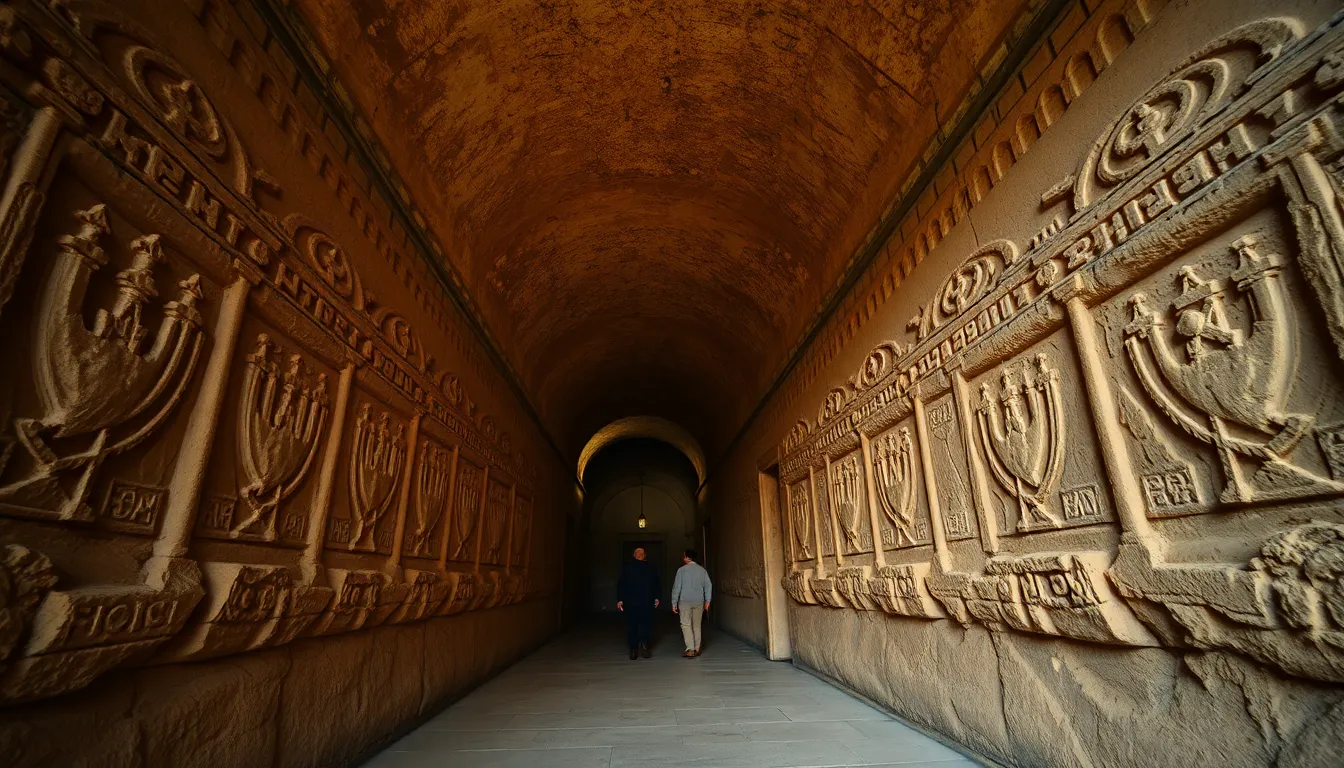
The first time I brought a congregation underground in Rome, a man who had been quiet all week stopped in front of a wall and did not move. Carved into the soft tufa stone, faint but unmistakable, was a menorah. Seven branches. Pressed into the rock by a hand that had been dust for sixteen hundred years. He turned to me and said, “They were here before everything.” That is the sentence I want every group to carry out of these tunnels.
Most travelers come to Rome knowing about the Christian catacombs. The ones along the Appian Way, on every tour bus route, marketed and lit and ready for crowds. What far fewer people know is that the Jewish catacombs of Rome are older. They are the foundation under the foundation. And for a group tracing the oldest continuous Jewish presence in Europe, they belong near the center of the itinerary, not at the edge of it.
Why These Catacombs Came First
Jewish families were living in Rome by the 2nd century BCE. Long before the Christian community existed, the Jewish community of Rome was burying its dead in underground galleries cut into the volcanic rock that rings the city. The practice of catacomb burial, the long corridors lined with niches, the family chambers, the carved symbols, was a Jewish and Roman pattern that the early Christians later adopted.
That sequence matters for how your group understands what they are seeing. The Christian catacombs did not invent the form. They inherited it. When you stand in a Jewish gallery in Rome, you are standing in an older layer of the same story, in the burial places of a community that was Roman and Jewish at once, that spoke Greek and Latin, that wove its faith into the fabric of the ancient city.
Six Jewish catacombs have been identified around Rome. Two of them carry the weight of the story for most visiting groups: Villa Torlonia and Vigna Randanini. The others, including the lost or inaccessible sites at Monteverde and elsewhere, survive mostly in scholarship and in the artifacts recovered from them.
Villa Torlonia: Symbols Pressed Into Stone
The catacombs beneath the grounds of the Villa Torlonia estate are among the most significant Jewish burial sites in the ancient world. They run for hundreds of meters of galleries, dating roughly from the 3rd to the 4th century CE, and they hold some of the richest collections of Jewish symbols found anywhere from this period.
The walls speak in a visual language your group will recognize. The menorah appears again and again, the seven-branched lampstand that had stood in the Temple in Jerusalem before its destruction. Alongside it, the shofar, the lulav and etrog of Sukkot, the Torah ark. These were not decorative choices. They were declarations of identity, carved by a people who wanted their dead to be known, across whatever centuries might follow, as Jews.
There is a particular poignancy to the painted chambers at Villa Torlonia. In some of them, the imagery blends the Jewish symbols with the artistic conventions of the surrounding Roman world. This is the visual record of a community that lived inside a larger culture without dissolving into it. For a rabbi or an educator, that tension, belonging and distinctness held together, is one of the deepest lessons these walls offer.
Access to the Villa Torlonia catacombs has been restricted for conservation reasons over the years, and arrangements can change. This is exactly the kind of site where advance coordination separates a meaningful group visit from a locked gate. We handle that coordination as part of building the itinerary.
Vigna Randanini: Walking the Galleries
Vigna Randanini, located near the Appian Way, is the Jewish catacomb most often made accessible to organized groups. It dates to roughly the 2nd through 4th centuries CE, and walking its corridors gives your group the physical experience that no photograph delivers.
The galleries are narrow. The ceilings are low in places. The niches, the loculi, are cut in rows into the walls, where bodies were laid and sealed. Here and there the original plaster survives, and with it the inscriptions, many in Greek, some in Latin, occasionally with a Hebrew word or a carved menorah marking the resting place of someone named two thousand years ago.
What moves groups most at Vigna Randanini is not any single object. It is the accumulation. Corridor after corridor of ordinary people, families, the named and the unnamed, who lived their whole lives as Jews in imperial Rome. They paid their taxes, kept their festivals, raised their children, and were buried by their community in the rock beneath the city. Standing among them collapses the distance between the modern visitor and the ancient one.
I always build in time for silence here. These are graves. The dignity of the space asks for it, and groups almost always meet that request on their own, without being told.
How the Catacombs Fit a Rome Itinerary
The Jewish catacombs are not a substitute for the Rome Ghetto and the Great Synagogue. They are the chapter that comes before. A well-built day can move from the ancient world to the continuous present, and the catacombs anchor the ancient end of it.
A pattern that works well for groups is to begin underground, in the burial galleries that hold the oldest physical evidence of Jewish Rome, then surface into the Ghetto, where Jewish life continued through papal decree, emancipation, and the twentieth century. The day closes at the Great Synagogue and the Jewish Museum of Rome, where artifacts recovered from the catacombs are displayed. Seeing a menorah carved in a tunnel in the morning and then a menorah from that same world in a museum case in the afternoon ties the whole arc together for your group.
For a deeper frame on the city and the wider country, our overview of Jewish heritage in Italy sets the catacombs in their full context, and our guide to the history of Italy’s Jewish community traces the two-thousand-year line that begins right here, in the rock beneath Rome.
Practical Notes for Group Leaders
The catacombs require preparation that the average tourist site does not. A few things I tell every group leader before we go:
These are active archaeological and conservation sites, and access is controlled. Visits to Villa Torlonia and Vigna Randanini are arranged in advance, often with a specialist guide and a defined window. You cannot simply show up at the gate the way you can at the Colosseum.
The footing underground is uneven, the light is low, and the temperature is cool and damp year-round. For mixed-age groups, this is worth flagging ahead of time. Comfortable closed shoes and a light layer make the difference. Most members manage the galleries comfortably, but anyone with serious mobility limitations should be planned for in advance.
Photography is often limited or prohibited to protect the fragile painted surfaces. I gently prepare groups for this, because the instinct to photograph everything runs strong, and the deeper experience here is to look rather than to capture.
With fifteen or more participants, the group leader travels at no cost, which for a rabbi or educator organizing a congregation trip can be the detail that moves Italy from a someday idea to a confirmed date.
FAQ: Jewish Catacombs of Rome
Are the Jewish catacombs older than the Christian catacombs in Rome?
Yes. The Jewish community of Rome was burying its dead in underground galleries before the Christian catacombs existed. Jewish families had lived in Rome since the 2nd century BCE, and the catacomb burial form, later adopted by early Christians, has deep roots in the Jewish and Roman practice of the ancient city. Visiting the Jewish catacombs places your group at the oldest layer of the story.
Can groups visit Villa Torlonia and Vigna Randanini?
Vigna Randanini is the Jewish catacomb most regularly opened to organized groups, typically with advance arrangement and a specialist guide. Villa Torlonia has faced conservation restrictions that affect access. Because availability changes, both sites require coordination ahead of time rather than walk-up entry. Heritage Tours arranges access as part of building the itinerary.
What will we actually see in the catacombs?
Long galleries cut into volcanic tufa stone, lined with burial niches, and marked with carved and painted Jewish symbols: menorahs, the shofar, the lulav and etrog, the Torah ark. Many inscriptions survive, mostly in Greek, naming individuals buried two thousand years ago. The experience is one of accumulation, corridor after corridor of ordinary Jewish lives in imperial Rome.
Is the visit physically demanding?
Moderately. The galleries have uneven footing, low light, and a cool, damp climate year-round. Most members of a mixed-age group manage comfortably with closed shoes and a light layer. Anyone with significant mobility limitations should be planned for in advance, which we do as part of the itinerary.
How do the catacombs fit into a Rome Jewish heritage day?
They anchor the ancient end of the story. A strong day moves from the underground burial galleries to the Rome Ghetto and finishes at the Great Synagogue and Jewish Museum, where artifacts recovered from the catacombs are displayed. Seeing a carved menorah in a tunnel and then a related object in the museum ties the two-thousand-year arc together for your group.
If you want your group to begin Rome where the story actually begins, underground, in the oldest evidence of Jewish life in Europe, we would be glad to help you plan it. Learn more about our Italy heritage tours, see how the group leader experience works, and reach out whenever you are ready to start the conversation.