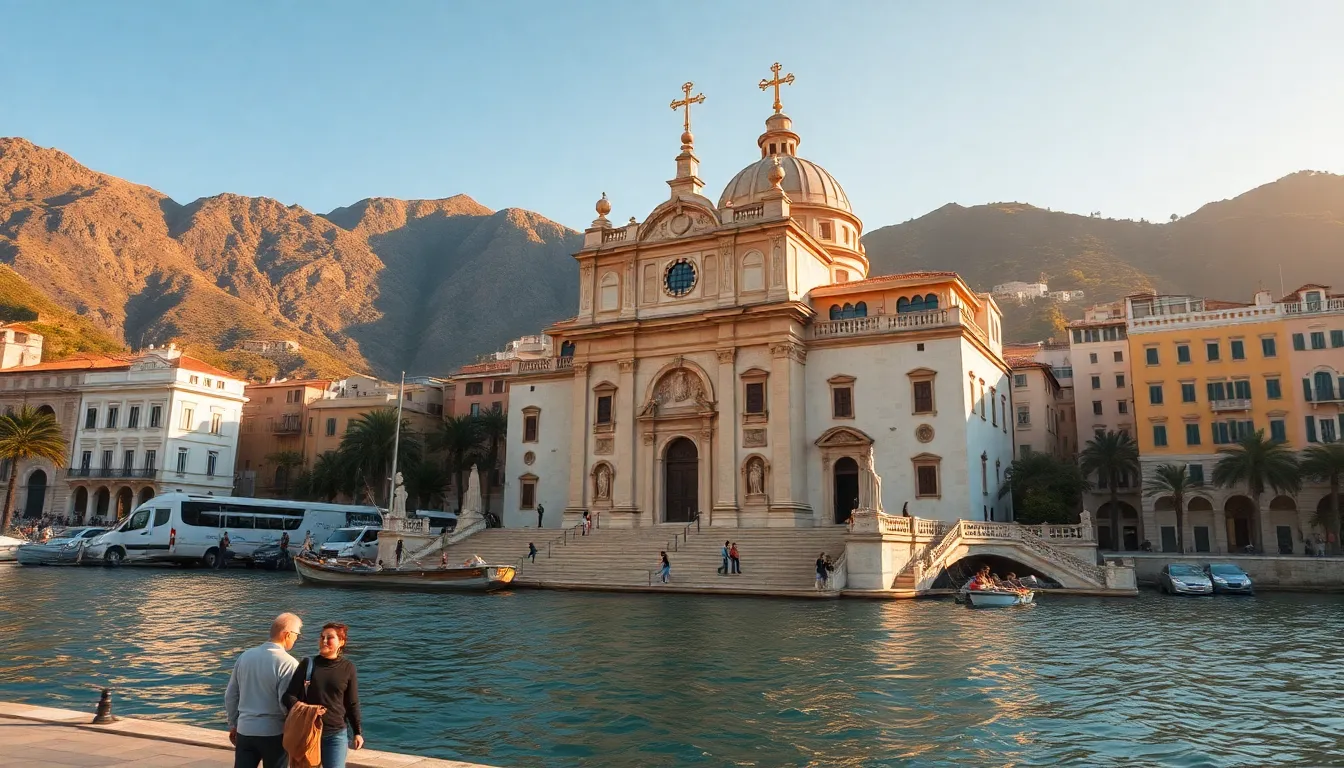
Most of the American groups I lead have never heard of Loreto before I put it on the itinerary. By the time we leave, it is often the stop they talk about on the drive home. There is something about a small stone house, set inside a vast marble shrine, on a quiet hill above the Adriatic, that reaches people in a way the famous basilicas sometimes do not. It is intimate. You can touch the walls. And for a group with any devotion to Mary, that intimacy lands hard.
What the Holy House Is
At the center of the Basilica della Santa Casa in Loreto stand three stone walls. Tradition holds that these are the walls of the house in Nazareth where Mary lived, where the angel Gabriel announced that she would bear Christ, and where the Holy Family lived after returning from Egypt. The fourth side is open, where an altar now stands beneath an image of the Madonna.
The structure is small, the size of a modest single room, and it sits oddly inside the soaring basilica built around it, like a treasure inside a case. That is precisely the intended effect. The shrine exists to shelter and honor the house, not to compete with it.
The tradition says the walls were carried from Nazareth to the Adriatic coast in the late thirteenth century, after the Crusader hold on the Holy Land collapsed and the sites of Christ’s life passed out of Christian control. The poetic version of the story says angels carried the house through the air, which is why Mary of Loreto became the patroness of aviators. The version many historians find more persuasive is that the stones were transported by ship and by a family, the Angeli, whose name may itself have generated the legend of the angels. Modern study of the masonry has found that the stones and building techniques are consistent with construction in the Nazareth region, not local Italian work, which is part of why the tradition has held the loyalty of so many pilgrims.
A Balanced Word on the Tradition
I tell groups the same thing here that I tell them in Turin. You do not have to resolve the question of how the walls arrived to be moved by the place. Whether you hold the tradition literally, take the historical ship-transport account, or simply approach it as one of the great pilgrimage shrines of Europe, the experience of standing inside that small room is real. The Church presents the Santa Casa as a place of devotion to the mystery of the Incarnation, the belief that God took on human flesh in an ordinary home. That mystery is the heart of the visit, and it does not rise or fall on the engineering of how stones crossed the Mediterranean.
A Shrine That Has Drawn Pilgrims for Seven Centuries
Loreto became one of the most important pilgrimage destinations in Catholic Europe, second in Italy only to Rome for much of its history. Popes came. Saints came. The basilica was built and adorned over centuries by some of the finest architects and artists of the Renaissance. The marble screen that surrounds the Holy House was designed by Bramante, the architect who began the new Saint Peter’s in Rome, and carved with scenes from the life of Mary by the leading sculptors of the day.
The continuity is the thing. Pilgrims have walked to this hill, prayed in this room, and left their petitions for more than seven hundred years without a break. When a group enters and finds people kneeling along the worn stone, praying in a dozen languages, it connects the heritage you have been studying to a faith that is fully alive in the present moment.
Why It Belongs on a Heritage Itinerary
For Catholic groups, Loreto is one of the great Marian shrines of the world, and for travelers with a strong devotion to Mary it can be the spiritual center of an entire Italy trip. The focus on the Annunciation and the home in Nazareth gives the visit a quality the great cathedrals lack. Those buildings overwhelm you with scale. Loreto draws you in close, to the human size of the room where, in Christian belief, the Incarnation began.
For Protestant and educator groups, the appeal is different but real. Loreto is a window into how medieval and Renaissance Christendom thought about relics, pilgrimage, and the connection between the Holy Land and Europe. The story of the house’s transfer is also the story of what happened to Christian devotion when access to the actual sites in Nazareth and Jerusalem was lost. It is a chapter in the history of Christian longing for the land of the Gospels.
How Groups Visit Loreto
Loreto sits on the Adriatic coast in the Marche region, roughly three hours from Rome by car and well placed for groups traveling between Rome and the north, or between Rome and Assisi. It is not a quick detour off the main highway, and I consider that part of its character. The effort to reach it mirrors the pilgrim tradition, and groups arrive feeling they have made a journey rather than checked a box.
The town itself is small and built entirely around the basilica. The visit is focused: an hour and a half is usually enough to enter the Holy House, see the basilica’s interior and the Bramante screen, and walk the piazza outside, which opens to a long view over the countryside toward the sea. For groups of 15 or more, your group leader travels free on a Heritage Tours itinerary, and we arrange a Mass or a time of quiet inside the Holy House when the group wishes it, which we coordinate with the shrine in advance.
Practical Access
The basilica is free to enter and observes the standard dress code, shoulders and knees covered, which matters more here than at some sites because it is an active shrine with constant devotion. We ask groups to dress accordingly so nobody is turned away at the door of the Holy House itself.
The Holy House can become crowded during major Marian feasts and on the feast of the Translation of the Holy House on December 10, which is the shrine’s own celebration. For a group seeking a quieter, more reflective visit, a weekday morning is ideal, and we plan the schedule around it. Loreto pairs naturally with the wider faith route through central and northern Italy, including Assisi, Ravenna, and the other stops in our guide to spiritual sites in Italy, and complements the lesser-known sites in our hidden heritage sites guide.
FAQ: Visiting the Holy House of Loreto with a Group
What is the Holy House of Loreto?
It is a small structure of three stone walls, housed inside the Basilica della Santa Casa in Loreto, on Italy’s Adriatic coast. Tradition holds that these are the walls of the house in Nazareth where Mary received the Annunciation. The shrine was built around the house to shelter and honor it, and pilgrims have venerated it for more than seven hundred years.
How is the house said to have come from Nazareth to Italy?
The traditional story says angels carried the house through the air in the late thirteenth century, which is why Mary of Loreto is the patroness of aviators. A historical account holds that the stones were transported by ship by a family named Angeli, whose name may have inspired the angel legend. Study of the masonry has found it consistent with construction in the Nazareth region.
Do you have to believe the tradition to find the visit meaningful?
No. The shrine centers on devotion to the Incarnation, the belief that God took on human flesh in an ordinary home. Whether a traveler holds the transfer tradition literally, accepts the ship account, or simply approaches Loreto as one of Europe’s great pilgrimage shrines, standing inside the small room is a genuine experience.
How much time does a group need at Loreto?
About an hour and a half is enough to enter the Holy House, see the basilica interior and the Bramante marble screen, and walk the piazza with its view toward the sea. The town is small and built entirely around the shrine, so the visit is focused. We can also arrange a Mass or quiet time in the Holy House by prior coordination.
Where is Loreto and how does it fit an itinerary?
Loreto is on the Adriatic coast in the Marche region, about three hours from Rome by car. It fits well for groups traveling between Rome and the north or toward Assisi. The effort to reach it adds genuine pilgrimage character to a trip, and it pairs naturally with Assisi, Ravenna, and other central Italy faith sites.
If your group has a devotion to Mary or simply wants to stand inside one of Europe’s most beloved shrines, we would be glad to help you plan it. Explore our Italy heritage tours, see how we run group travel, and reach out to tell us what matters most to your community.