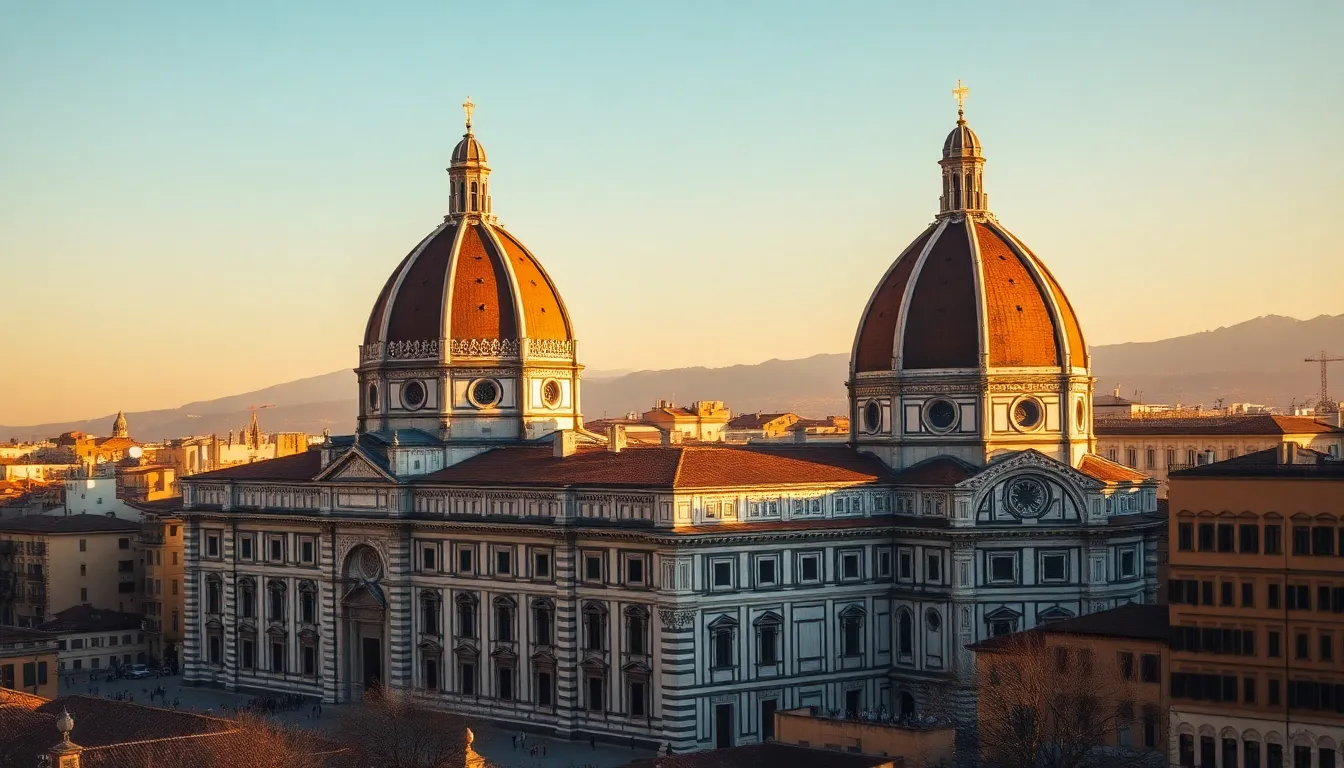
The first time I brought a group into the Piazza del Duomo in Florence, a pastor I had known for years stopped walking and said nothing for a full minute. The cathedral does that. You turn a corner from a narrow medieval street and the whole thing opens in front of you, green and white and pink marble climbing toward a dome that should not, by the engineering of its day, have been able to stand.
That tension between what was attempted and what was achieved is the heart of why the Florence Duomo belongs on a heritage itinerary. This is not only a beautiful building. It is a record of faith expressed through human ambition, and a group that understands the story will see far more than a group that only sees the marble.
What the Duomo Actually Is
The full name is the Cathedral of Santa Maria del Fiore, the Cathedral of Saint Mary of the Flower. Construction began in 1296 and the main structure took roughly 140 years to complete. The people who laid the first stones knew they would never see it finished. They built for grandchildren they would never meet, which is its own kind of faith.
What most visitors call “the Duomo” is really three connected monuments in one square. There is the cathedral itself, the largest masonry church in Italy when it was built. There is Giotto’s bell tower, the campanile, standing beside it. And there is the Baptistery of San Giovanni across the square, older than both, where Florentines were baptized for centuries, including the poet Dante.
When you visit with a group, it helps to treat these as one experience rather than three separate tickets. They were built to work together. The baptistery received you into the faith, the cathedral was where you worshipped, and the bell tower called you to both.
Brunelleschi’s Dome: The Problem Nobody Could Solve
Here is the part of the story that holds a group’s attention. For more than a century after construction began, the cathedral had a hole in its roof. The original architects had designed a dome wider than any built since ancient Rome, and then nobody could figure out how to build it. The technology to span that gap did not exist. The city left the crossing open to the sky and hoped someone would eventually solve it.
That someone was Filippo Brunelleschi, a goldsmith and clockmaker with no formal training as an architect. He won the commission in 1418 with a design so unconventional that the committee did not fully believe it would work. He built the dome with two shells, an inner and an outer, and laid the bricks in a herringbone pattern that allowed each ring to support itself as it rose. He did it without the massive wooden scaffolding everyone assumed was required, because no forest in Tuscany could have supplied timber long enough.
The dome was completed in 1436. It remains the largest masonry dome in the world. When you stand beneath it with a group and explain that a man solved by hand what the experts said was impossible, something shifts in how people look up. They stop seeing decoration and start seeing the determination it took.
Why It Matters for a Faith Group
For Christian travelers, the Duomo is a statement about what people will build when they believe the work is for God. The scale is not vanity. It is devotion made visible in stone, the same impulse that built the cathedrals of northern Europe and, centuries earlier, the Temple in Jerusalem.
The interior is more restrained than the exterior suggests, which surprises people. But the underside of the dome holds Giorgio Vasari’s vast fresco of the Last Judgment, covering the space your eyes are drawn to the moment you walk in. For a group, sitting quietly in the nave and looking up at that scene is a chance to talk about how earlier generations understood judgment, mercy, and the weight of a life. The art was meant to teach the unlettered. It still teaches.
The Baptistery deserves the same attention. Its ceiling is covered in golden mosaics depicting the story of salvation, and the building’s most famous feature stands at the entrance: the bronze doors Lorenzo Ghiberti spent twenty-seven years completing. Michelangelo is said to have called them the Gates of Paradise. They portray scenes from the Hebrew Scriptures, Adam and Eve, Noah, Abraham, Moses, in panels so finely worked that they look carved from a single sheet of light. For a mixed group of Christian and Jewish travelers, those doors are common ground, the shared inheritance of the Hebrew Bible rendered in gold.
How Groups Visit the Duomo
The square is free to enter and the cathedral itself is free to walk through, but everything else requires a ticket, and the ticketing changes often. As of now, a single combined pass covers the dome climb, the bell tower, the baptistery, the crypt, and the Opera del Duomo Museum. That museum, which most tours skip, holds the original Gates of Paradise panels (the ones on the baptistery are replicas) along with Michelangelo’s late, unfinished Pieta. For a heritage group it is worth the hour.
The dome climb is 463 steps with no elevator, through the narrow space between Brunelleschi’s two shells. It is not suitable for everyone. The view from the top is extraordinary, but I never make it a required stop. A group with mixed mobility can see the cathedral, the baptistery, and the museum fully without climbing a single step, and they will not feel they missed the heart of it.
For groups of 15 or more, your group leader travels free on a Heritage Tours itinerary, and we handle the timed entries so nobody stands in the line that wraps around the square in summer.
Practical Access
Reservations are mandatory for the dome climb and are released on a timed schedule, so book early, especially for May through September. The cathedral enforces a dress code: shoulders and knees covered for everyone. I tell groups to bring a light scarf or layer, because being turned away at the door after walking across the city is a frustrating way to lose twenty minutes.
Mornings are calmer than afternoons. We usually bring groups into the square when it opens, while the marble still has the early light on it and the crowds are thin. Florence sits comfortably on most Italy itineraries, two hours from Rome by fast train and an easy base for reaching Assisi, Ravenna, and the Tuscan countryside. The Duomo pairs naturally with the other faith and heritage sites we cover in our guide to spiritual sites in Italy, and with the lesser-known stops in our hidden heritage sites guide.
FAQ: Visiting the Florence Duomo with a Group
Do you have to climb the dome to appreciate the Duomo?
No. The dome climb is 463 steps with no elevator, and many groups skip it. The cathedral interior, the baptistery, the Opera del Duomo Museum, and the square itself give you the full story without the climb. We design itineraries so that travelers with limited mobility experience the heart of the site, not a reduced version of it.
What is the Gates of Paradise?
It is the name traditionally given to the gilded bronze east doors of the Florence Baptistery, created by Lorenzo Ghiberti between 1425 and 1452. The ten panels depict scenes from the Hebrew Scriptures. The originals are preserved in the Opera del Duomo Museum to protect them, and high-quality replicas hang on the baptistery itself.
Is there a dress code for the cathedral?
Yes. Shoulders and knees must be covered for both men and women, and the rule is enforced at the entrance. We advise groups to carry a light scarf or layer so a warm-weather day does not become a reason to be turned away.
How much time should a group plan for the Duomo complex?
Allow a half day to do it properly. That covers the cathedral, the baptistery, the museum, and time in the square. Adding the dome climb extends it by about an hour, including the wait for your timed entry. We build the schedule so the group is never rushed through the parts that matter.
Why is Brunelleschi’s dome historically significant?
When Brunelleschi completed it in 1436, it was the largest dome built since antiquity, and it remains the largest masonry dome in the world. He engineered it without the conventional wooden scaffolding everyone believed was necessary, using a double-shell structure and a herringbone brick pattern. It is regarded as one of the defining achievements of the Renaissance.
If your group is ready to stand in the Piazza del Duomo and understand what they are looking at, we would be glad to help you plan it. Explore our Italy heritage tours, see how we run group travel, and reach out to tell us what matters most to your community.