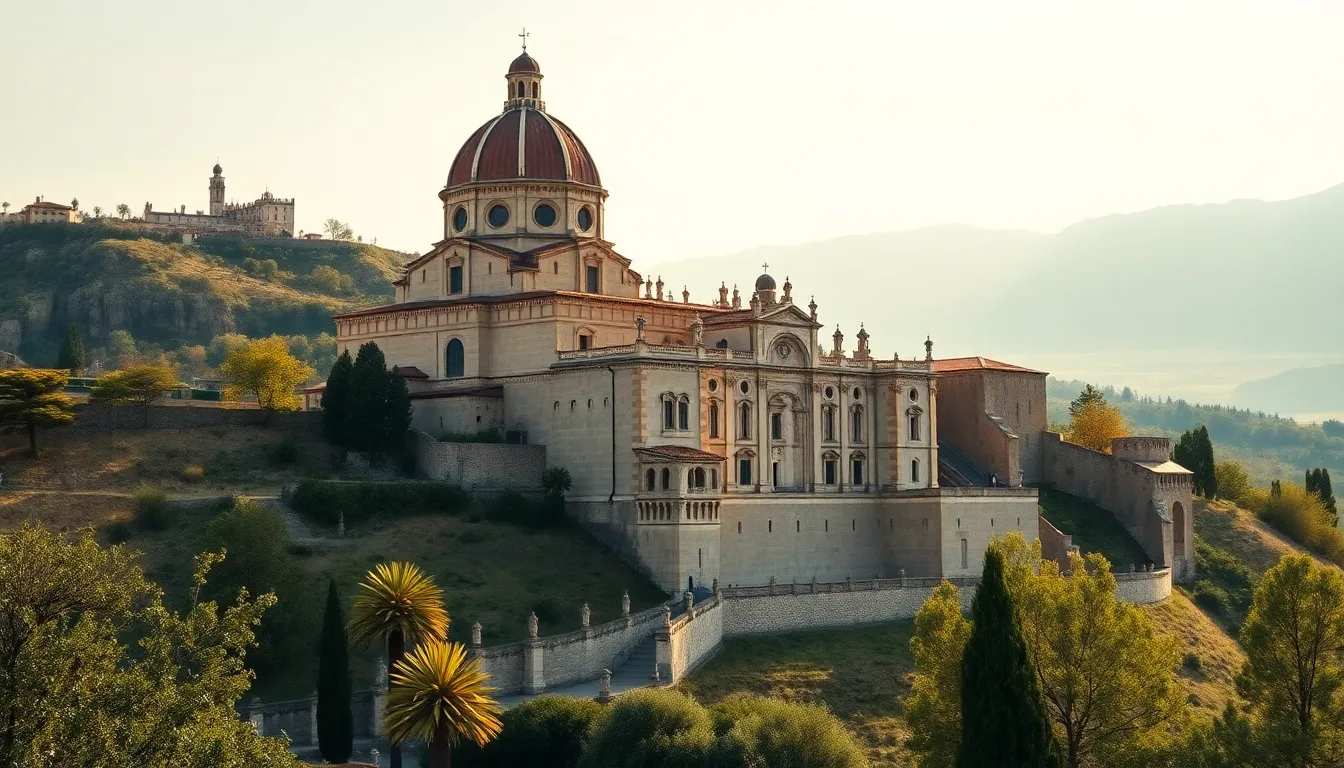
The first time most of my groups see the Basilica of Saint Francis, they see it from a distance, rising up out of the hillside on the western edge of Assisi, held up by a long row of arches. It is an enormous building for a man who owned nothing and asked to be buried in a field reserved for criminals. That tension, between the grandeur of the church and the poverty of the saint, is the first thing I want a group to feel. Hold onto it, because the building itself is built around that very contrast.
This is a guide to what is actually inside, level by level, and how to help a group experience it well rather than just file through it.
A Church in Two Levels
The Basilica was begun in 1228, just two years after Francis died and the very year he was declared a saint. It was finished remarkably fast for a medieval building, with the main structure complete by the 1250s. What makes it unusual is its design: two complete churches stacked on top of each other, the Lower Basilica and the Upper Basilica, plus the crypt beneath holding the tomb.
The two churches are not just a practical solution to the steep hillside. They carry meaning. The Upper Basilica is tall, bright, and triumphant, full of light and soaring color, the church of Francis the celebrated saint. The Lower Basilica is darker, lower, and more solemn, closer to the earth, the church of Francis the humble penitent. And below both lies the tomb, hidden and plain. Climbing and descending through these levels is itself a kind of meditation on the man, and I always tell groups to pay attention to how the mood changes as they move.
The Lower Basilica
Most groups enter through the Lower Basilica, and I think that is the right order. You come in low, into dimmer light and heavier stone. The ceiling is covered in deep blue with gold stars. The walls hold some of the earliest and most precious frescoes in the building, including works by Cimabue and his circle and the painter known as the Master of Saint Francis.
The Lower Basilica has a contemplative weight to it. The famous allegorical frescoes in the vaults above the main altar depict the Franciscan virtues of poverty, chastity, and obedience, with Francis himself shown being honored in heaven. There is also a moving early image of Francis here that some traditions hold to be among the closest to his actual appearance. Groups naturally slow down in this space, and I let them.
The Tomb of Saint Francis
From the Lower Basilica, a stairway leads down to the crypt and the tomb. This is the spiritual center of the entire pilgrimage, and for many groups it is the most powerful moment of the whole Italy trip.
The tomb is deliberately simple. Francis’s stone coffin rests above the altar, surrounded by the tombs of four of his closest companions. After his death, his body was hidden so well to protect it from theft that its exact location was lost for centuries, and it was only rediscovered in 1818. The crypt was then built to house it.
I encourage groups to take their time here. There is usually a stillness in the crypt that asks for silence. Standing at the grave of the man who gave up everything, in a space stripped of decoration, after passing through all the splendor above, the contrast does the teaching. I have watched group members who are not given to emotion stand at this tomb with tears in their eyes. Our broader guide to Assisi and Saint Francis places this moment in the context of the whole town and the saint’s life.
The Upper Basilica and Giotto’s Frescoes
Then you climb up into the Upper Basilica, and the change is dramatic. After the dim, low Lower Church and the plain tomb, you step into a tall, light-filled Gothic space glowing with color. This is where the building’s most celebrated treasure lives: the fresco cycle of the life of Saint Francis, attributed largely to the young Giotto and his workshop, painted around the 1290s to early 1300s.
These twenty-eight scenes run along the lower walls of the nave and tell the story of Francis’s life, from his early privileged years through his conversion, his preaching, and his death. Several are among the most famous images in Western art: Francis giving his cloak to a poor man, Francis preaching to the birds, the dream of Pope Innocent III seeing Francis holding up the collapsing church.
What makes Giotto’s work so important is that he broke from the flat, formal style of medieval painting and gave his figures real weight, real emotion, real space to stand in. Art historians often mark this cycle as a turning point toward the Renaissance. But for a faith group, the deeper value is simpler: these paintings tell the life of Francis in order, like a visual gospel, and a guide can walk a group through them scene by scene as a kind of illustrated sermon.
The upper walls also hold frescoes by Cimabue, including a powerful Crucifixion, though much of that work has darkened with age. Our overview of the spiritual sites of Italy for faith travelers explains why pairing art and faith this way tends to land so well with groups.
How to Walk a Group Through It
The route I recommend follows the meaning of the building. Enter through the Lower Basilica and let the group absorb its quiet weight. Descend to the tomb and give it real time, with silence if the group is willing. Then climb to the Upper Basilica and read Francis’s life through Giotto’s frescoes, scene by scene. Ending in the light, after starting in the dark and passing through the grave, gives the visit a natural shape that groups feel even if they cannot name it.
A practical note that matters: this is an active basilica and a place of prayer, so modest dress is required, with shoulders and knees covered, and silence is expected in the sacred areas. Photography is restricted, particularly in the Upper Basilica, which honestly helps keep a group present. The site can get busy in the middle of the day, so an early arrival is worth the effort.
Planning the Visit
The Basilica deserves a focused block of time, not a rushed pass, and it pairs best with an overnight stay in Assisi so the group is not racing a bus schedule. Since group leaders travel free with fifteen or more participants, building in the time to do the Basilica properly is realistic for a church or study group. Our group heritage tours page explains the group structure, and our Italy destination page shows how Assisi and the Basilica fit a full itinerary.
FAQ: The Basilica of Saint Francis of Assisi
What is special about the Basilica of Saint Francis?
The Basilica is built as two complete churches stacked on top of each other, the Upper and Lower Basilicas, with the tomb of Saint Francis in a crypt beneath. It holds one of the most important fresco cycles in Western art, the life of Saint Francis attributed to Giotto, and it is the central pilgrimage site dedicated to the saint. The contrast between its grandeur and the poverty Francis lived is part of its meaning.
Where is Saint Francis buried?
Francis is buried in the crypt beneath the Lower Basilica, in a deliberately simple stone tomb surrounded by the tombs of four close companions. His body had been hidden after his death to protect it and was only rediscovered in 1818, after which the crypt was built to house it. For most groups, the tomb is the most moving moment of the entire Assisi visit.
What are the Giotto frescoes in the Upper Basilica?
The Upper Basilica holds a cycle of twenty-eight frescoes depicting the life of Saint Francis, attributed largely to the young Giotto and his workshop around 1290 to the early 1300s. Famous scenes include Francis giving his cloak to a poor man and preaching to the birds. The cycle is considered a turning point toward Renaissance painting and works beautifully as a visual telling of Francis’s life for a group.
What is the dress code at the Basilica?
Because it is an active basilica and place of prayer, modest dress is required, with shoulders and knees covered. Silence is expected in the sacred areas, and photography is restricted, especially in the Upper Basilica. Group leaders should remind travelers of the dress requirement before arrival so no one is turned away.
How much time should a group plan for the Basilica?
Plan for a focused visit of at least ninety minutes to two hours to move through the Lower Basilica, the tomb, and the Upper Basilica without rushing, longer if a guide walks the group through the Giotto frescoes scene by scene. An early arrival helps avoid the midday crowds, and an overnight stay in Assisi removes the pressure of a tight bus schedule.
If your group wants to experience the Basilica the way it was built to be experienced, from the quiet of the tomb to the light of Giotto’s frescoes, I would be glad to help you plan the time for it. Contact us to start the conversation.