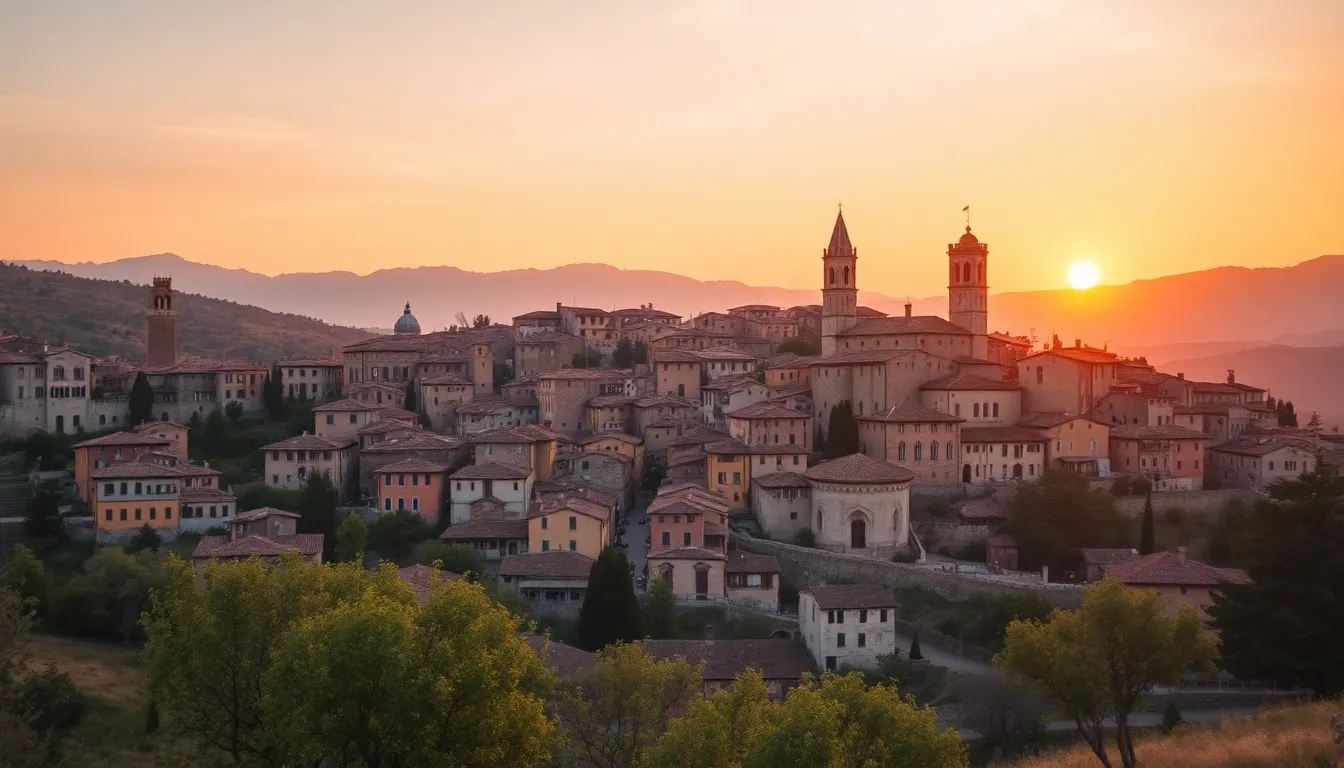
If I could send every faith group I work with to just one place in Italy outside of Rome, I would send them to Assisi. I have said this for years, and nothing has changed my mind. There is something about this small pink-stone town climbing the side of Mount Subasio that settles over a group the moment they arrive. People who came in tired and chatty go quiet. The pace slows. And the story of Saint Francis, which most people know only in broad strokes, becomes something they can almost touch.
Let me tell you what actually happens when a group spends real time in Assisi, and why I think it belongs near the heart of any Italy heritage journey.
The Town Itself Is Part of the Message
Assisi is a medieval hill town, and it has been protected in a way that few places have. Walking its narrow streets, you are walking surfaces that have changed remarkably little since the time of Francis in the late twelfth and early thirteenth centuries. The same pink and white stone, quarried from the mountain, runs through the whole town and gives it a warmth in the evening light that I have not seen anywhere else.
This matters more than it might sound. In most places associated with a saint, you have to imagine your way past modern buildings and traffic. In Assisi, the town is close enough to its medieval self that the imagination barely has to work. You can stand in the main square, the Piazza del Comune, and know that Francis stood there too, in a town that looked much like this.
Who Francis Was
The broad outline of the story is familiar. Francis was the son of Pietro di Bernardone, a wealthy cloth merchant. He grew up with money, ambition, and a taste for fine things. As a young man he dreamed of military glory and even went off to war.
But something broke open in him. After illness, captivity, and a slow disillusionment with the life he had been chasing, Francis began to give himself to prayer, to the poor, and to the rebuilding of ruined churches around Assisi. The turning point came in a moment your group can stand near. In front of the bishop and a crowd, and in front of his furious father, Francis stripped off his fine clothes and handed them back, renouncing his inheritance and choosing poverty in the most public and irreversible way imaginable.
That moment, which happened in this specific town, reshaped the way Christianity understood the relationship between faith and wealth. Francis went on to found the Franciscan order, devoted to poverty, simplicity, and service, and he drew thousands to a way of living that took the gospel at its most literal. He is also remembered for his love of creation, captured in his Canticle of the Creatures, and for receiving the stigmata near the end of his life.
I find that when a group hears this story while standing in the place it happened, it stops being a legend and becomes a decision a real young man made on these streets.
What a Group Actually Experiences
People often ask me what there is to do in Assisi, and my honest answer is that the town works on you more through atmosphere than through a checklist. That said, there is a clear shape to a good visit.
The Basilica of Saint Francis
The great Basilica of Saint Francis dominates the town, built into the hillside on two levels and holding the saint’s tomb. It deserves its own focused visit, and our detailed guide to the Basilica of Saint Francis of Assisi walks through the upper and lower churches, the Giotto frescoes, and the crypt. For a group, standing at the tomb of Francis is the spiritual center of the whole trip.
The Basilica of Saint Clare
Across the town stands the Basilica of Santa Chiara, dedicated to Saint Clare, the noblewoman of Assisi who heard Francis preach, left her family’s wealth behind, and founded the order of nuns known as the Poor Clares. Her tomb is here, along with the preserved San Damiano crucifix, the very cross that, according to tradition, spoke to Francis and told him to rebuild the church. Clare’s story runs parallel to Francis’s, and including her gives a group a fuller picture of what this movement was.
San Damiano and the Porziuncola
Just outside the town walls sit two of the most important sites in the whole story. San Damiano is the small church Francis repaired with his own hands and where Clare later lived and died. Down on the plain below Assisi is the Porziuncola, the tiny chapel that was the cradle of the Franciscan order, now enclosed inside the enormous Basilica of Santa Maria degli Angeli. The contrast of the humble little chapel standing inside the vast church around it tells the Franciscan story in a single glance.
The Eremo delle Carceri
For groups with the time, I always push for the Eremo delle Carceri, a mountain hermitage about a thirty-minute drive up the slope of Mount Subasio above the town. This is where Francis withdrew to pray in the forest. The silence up there is genuine, the kind you rarely find anymore. An hour at the Eremo often does more for a group than a full day of scheduled stops. Our overview of the spiritual sites of Italy for faith travelers explains why these quieter places so often become the highlight of a trip.
How Long to Stay
The common mistake I see is treating Assisi as a half-day stop on the way somewhere else. Groups roll in, see the Basilica, and roll out, and they leave having missed the whole point. Assisi rewards an overnight. Staying in the town after the day visitors leave, walking the empty streets in the evening, hearing the bells, having a quiet morning before the crowds return, that is when the place does its real work.
I always recommend at least one full day and one night. Two nights is better if the itinerary allows it, especially if you want the Eremo and the outlying sites without rushing.
Planning It for Your Group
Assisi pairs naturally with Rome, since it sits a couple of hours north, and it gives an Italy itinerary a completely different texture from the grandeur of the capital. After the scale and crowds of Rome, the quiet of Assisi lands with real force.
Because group leaders travel free with fifteen or more participants, building a proper two-night Assisi stay into your trip is realistic for a congregation or study group. Our group heritage tours page lays out how the group structure works, and our Italy destination page shows how Assisi fits into a full Italy journey.
FAQ: Assisi and Saint Francis
Why is Assisi important for Christian pilgrims?
Assisi is the hometown of Saint Francis, where he was born, renounced his wealth, founded the Franciscan order, and is buried. The town has been preserved in a way that lets visitors walk the same streets Francis walked, and it holds his tomb in the Basilica of Saint Francis along with sites tied to Saint Clare and the early Franciscan movement. It is widely considered the most spiritually significant Christian destination in Italy after Rome.
What is the story of Saint Francis stripping off his clothes?
As a young man, Francis publicly renounced his inheritance by stripping off his fine clothes in front of the bishop, a crowd, and his furious merchant father, handing the clothes back and choosing poverty. The act, which happened in Assisi, was a dramatic and irreversible break from his wealthy upbringing and became a defining moment in how Christianity understood faith and wealth.
Who was Saint Clare of Assisi?
Clare was a noblewoman of Assisi who heard Francis preach, left her family’s wealth, and founded the order of nuns known as the Poor Clares. Her tomb and the San Damiano crucifix, the cross said to have spoken to Francis, are kept in the Basilica of Santa Chiara. Her story runs parallel to Francis’s and is an essential part of understanding the Franciscan movement.
How long should a group spend in Assisi?
At least one full day and one overnight, and ideally two nights. Assisi is often rushed as a half-day stop, which misses its character entirely. Staying overnight, when the day visitors leave and the streets go quiet, is when groups experience the town at its most moving and have time for outlying sites like the Eremo delle Carceri and San Damiano.
What is the Eremo delle Carceri?
The Eremo delle Carceri is a mountain hermitage about a thirty-minute drive above Assisi on the slope of Mount Subasio, where Francis withdrew to pray in the forest. The silence there is genuine, and many groups find an hour at the hermitage to be the most meaningful part of their whole Assisi visit.
If your community is drawn to the quiet of Assisi and the story of Francis, I would love to help you give it the time it deserves. Contact us whenever you are ready to start planning.