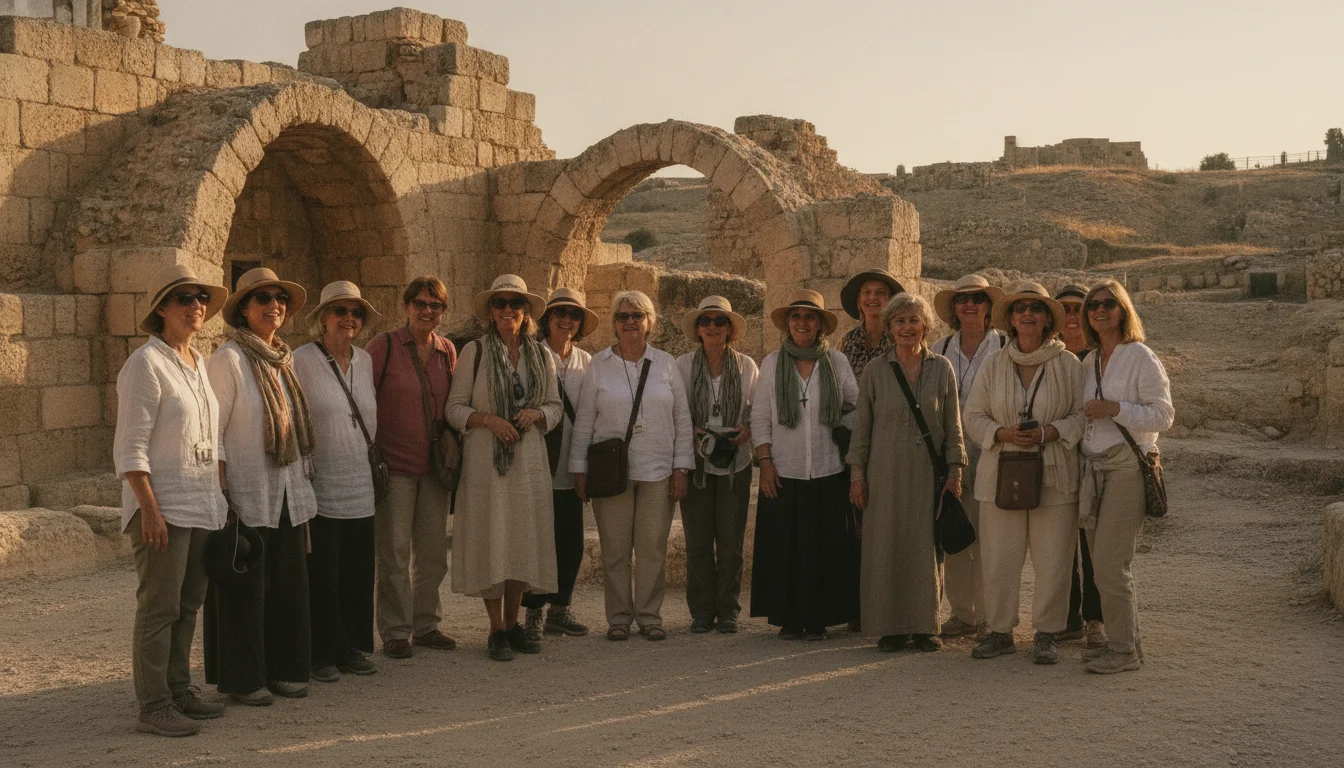
A women’s ministry leader called me last spring with a question I hear more and more. Her congregation had been studying the matriarchs for a season, and the women in the group kept saying the same thing: we want to stand where these women stood. She wanted to know if a Women of the Bible trip was a real thing she could organize, or just a nice idea. It is very real, and it is one of the most rewarding group journeys I help leaders build.
I have built heritage journeys for more than forty years, and I want to walk you through how to plan a Women of the Bible itinerary for a group from the leader’s chair. Not as a traveler picking a tour off a shelf. As the person who has to choose the route, recruit the women, set the budget, and lead the group once you land. That is a different job, and it deserves a plan built around your decisions.
What a Women of the Bible Itinerary Actually Covers
Before you pick dates or a route, it helps to know what this itinerary is built around, because it is not a single geography. The women of Scripture span the whole biblical story, and their sites are spread across the land accordingly.
A well-built itinerary usually threads together a few of these anchors:
- The matriarchs. Sarah, Rebecca, Rachel, and Leah tie to Hebron, Beersheba, and the tomb of Rachel near Bethlehem. This is the origin story, and it grounds the trip in the covenant.
- Deborah and the judges. The Jezreel Valley and the area around Mount Tabor bring Deborah’s leadership to life, which lands hard with a group of women.
- Ruth and Naomi. Bethlehem and the surrounding fields carry the story of loyalty and redemption that most groups already love.
- Hannah and the prophetic women. Shiloh, where Hannah prayed for Samuel, moves people in a way a page of text never quite does.
- Mary, Elizabeth, and the women of the Gospels. Nazareth, Ein Karem, the Sea of Galilee, and Jerusalem carry Mary the mother of Jesus, Elizabeth, Mary Magdalene, Martha and Mary, and the women at the tomb.
You are not going to visit every one of these in a single trip, and you should not try. The leader’s first real decision is which thread to pull. A group studying the Gospels wants a Galilee-and-Jerusalem weighting. A group drawn to the matriarchs wants more time in the south. Naming that focus early is what turns a vague wish into an itinerary your women will commit to.
The Leader’s First Three Decisions
Everything downstream flows from three choices you make before you ever talk to your congregation. Get these settled and the rest of the planning gets much simpler.
1. The Length of the Trip
Most Women of the Bible itineraries run seven to ten days on the ground, not counting travel. Seven days lets you cover Galilee and Jerusalem with the major women’s sites and still breathe. Ten days lets you add the southern matriarch sites, Shiloh, and more reflection time at each stop. My honest guidance: if this is your congregation’s first heritage trip together, start with eight or nine days. It is long enough to go deep and short enough that more women can get the time off work and away from family.
2. The Spiritual Frame
This trip is not sightseeing with a religious label. The women coming with you want the sites to mean something. So decide, up front, what you want the journey to do. Is it a study trip that walks your teaching series into real geography? A pilgrimage centered on prayer and reflection at each woman’s site? A sisterhood-building journey for your women’s ministry? It can be more than one of these, but you lead it differently depending on the frame. Knowing your frame shapes which sites you linger at and which you pass through.
3. The Size You Are Building Toward
This is where the economics enter, and it matters more than most leaders realize when they start. On our group heritage tours, the group leader travels free once you reach fifteen paying travelers. That single fact changes how you plan. It means the number fifteen is not arbitrary. It is the line where your own seat gets covered, so you are organizing rather than paying your own way into a trip you are also running. If you want the full picture of how the free-leader model works, our guide on whether the pastor or leader travels free lays out exactly what the benefit covers.
A Sample Eight-Day Women of the Bible Route
Leaders always ask me to make it concrete, so here is a route I have run in different forms many times. Treat it as a spine you adjust, not a fixed package.
Days one and two, Galilee. Nazareth for the Annunciation and the young Mary, then Ein Karem for the Visitation and Elizabeth, then out to the Sea of Galilee where the women who followed and supported Jesus come into focus. Magdala, the town of Mary Magdalene, has been excavated in recent years and gives your group a real first-century synagogue to stand in.
Days three and four, the valleys and the center. The Jezreel Valley for Deborah, a stop at Shiloh for Hannah’s prayer, and the road down toward Jerusalem. This stretch carries the Old Testament women and gives your group range across the whole story rather than only the Gospels.
Days five through seven, Jerusalem and Bethlehem. The city holds the women of the passion and resurrection: Mary at the cross, the women who came to the tomb, the upper room. Bethlehem and Rachel’s tomb bring Ruth and the matriarch of the south into the same few days. This is usually the spiritual peak of the trip, so I build in more time and less driving here.
Day eight, the south or a Dead Sea reflection day. Depending on your group’s stamina and interest, close with Beersheba and the matriarch sites, or give the women a slower final day for reflection and worship together before flying home.
For a fuller sense of how a Holy Land route is paced across the days, our ten-day Holy Land itinerary shows the same principles applied to a longer trip.
Recruiting the Women to Fill It
A beautiful itinerary that only draws nine women does not become a trip. Recruiting is the real work, and it is squarely the leader’s job. Here is what actually fills a Women of the Bible group.
Start with your core, not your whole roster. You are looking for the six or eight women who already light up when you mention this. They are your foundation, and they bring others. Friends travel with friends. Mothers bring adult daughters. A women’s Bible study often signs up as a unit.
Tie the trip to something you are already doing. If your women’s ministry is studying Ruth or the matriarchs this year, the trip is the living conclusion of the study. That connection converts interest into commitment far better than a standalone travel pitch ever will.
Give them a real date and a real route. Vague plans do not move people. “We are walking the women of Scripture through Galilee and Jerusalem next April, nine days, here is the route” gives a woman something concrete to say yes to and to plan her life around. For a deeper playbook on filling seats, our guide on how to recruit for a church trip walks through the full approach.
Budget and Payment, From the Organizer’s Side
Cost is the question that lives under every other question, so let me be practical. Two things matter most for you as the leader.
First, the free-leader benefit is not a discount you hope for at the end. It is structured into the trip at fifteen paying travelers, and it covers your full trip on participant terms: flights, hotels, ground transportation, and included site entries. That is what makes leading financially possible for most women’s ministry leaders, who are rarely working with a big travel budget.
Second, how your women pay shapes how many say yes. A single large payment scares people off. A deposit followed by scheduled installments across the months before departure lets a woman budget the trip into her ordinary life. Setting up a clear group trip payment plan is one of the highest-leverage things you can do for your fill rate. When people can see how they will pay, more of them commit.
How Far Ahead to Start
For a group of fifteen to thirty women, six to nine months of lead time is the sweet spot. That window gives your women time to budget, request time off, and arrange things at home, and it gives you time to do the recruiting, which is the part that actually takes the months. If you are timing the trip around a holiday season or building toward a larger group, give yourself nine to twelve months. Earlier planning is not extra caution. It is recruiting runway, and runway is what fills the seats. Our guide on how far ahead to plan breaks this down by group size.
Leading the Trip Once You Are There
Here is what I most want women’s ministry leaders to hear. Once the free-leader model takes your own cost off the table and a good operator handles the logistics, your attention is freed for the thing only you can do. You are not the group’s travel agent on the ground. You are its shepherd.
That is the whole point of a Women of the Bible journey. Your job is to read Hannah’s prayer aloud at Shiloh, to gather your women at Rachel’s tomb, to lead a moment of reflection at the empty tomb in Jerusalem where the women were the first witnesses. The operator makes the buses, hotels, guides, and entries invisible so that you can be fully present for your group in the places that move them. When the money and the logistics are handled, that presence is what your women will remember.
FAQ: Planning a Women of the Bible Group Trip
How many women do I need for the group leader to travel free?
Fifteen. With fifteen or more paying travelers, the group leader’s full trip cost is covered, including flights, hotels, ground transportation, and included site entries. Below fifteen the trip is still possible, but the leader pays a participant’s price rather than traveling free.
What sites make up a Women of the Bible itinerary?
The core sites cluster around the matriarchs (Hebron, Beersheba, Rachel’s tomb near Bethlehem), the Old Testament women (Shiloh for Hannah, the Jezreel Valley for Deborah, Bethlehem for Ruth), and the women of the Gospels (Nazareth and Ein Karem for Mary and Elizabeth, the Sea of Galilee and Magdala, and Jerusalem for the passion and resurrection). One trip weaves together a selection of these, not all of them.
How long should the trip be?
Seven to ten days on the ground works best. Seven covers Galilee and Jerusalem with the major women’s sites. Ten adds the southern matriarch sites and more reflection time. For a first group trip, eight or nine days is usually the right balance of depth and accessibility.
Can I focus the itinerary on my ministry’s current study?
Yes, and you should. If your women are studying Ruth, the matriarchs, or the women of the Gospels, the route can be weighted toward those stories. Naming that focus early is what turns interest into commitment, because women can see the trip as the living conclusion of what they are already learning.
How far ahead do I need to start planning?
Six to nine months for a group of fifteen to thirty, and nine to twelve for larger groups or holiday-timed trips. Most of that time goes to recruiting, not booking. Concrete dates and a real route are what move women from interested to committed, so the earlier you can share them, the better your group fills.
If you are ready to build a Women of the Bible itinerary for your group, the free-leader math is usually the thing that makes it feel possible. You can see how the group experience works on our group heritage tours page, look at the full route on our Israel heritage page, and read the complete planning walkthrough in our guide on how to plan and lead a group pilgrimage.
Contact us and we will help you shape the route, run the numbers for your dates, and build a trip your women will carry with them.