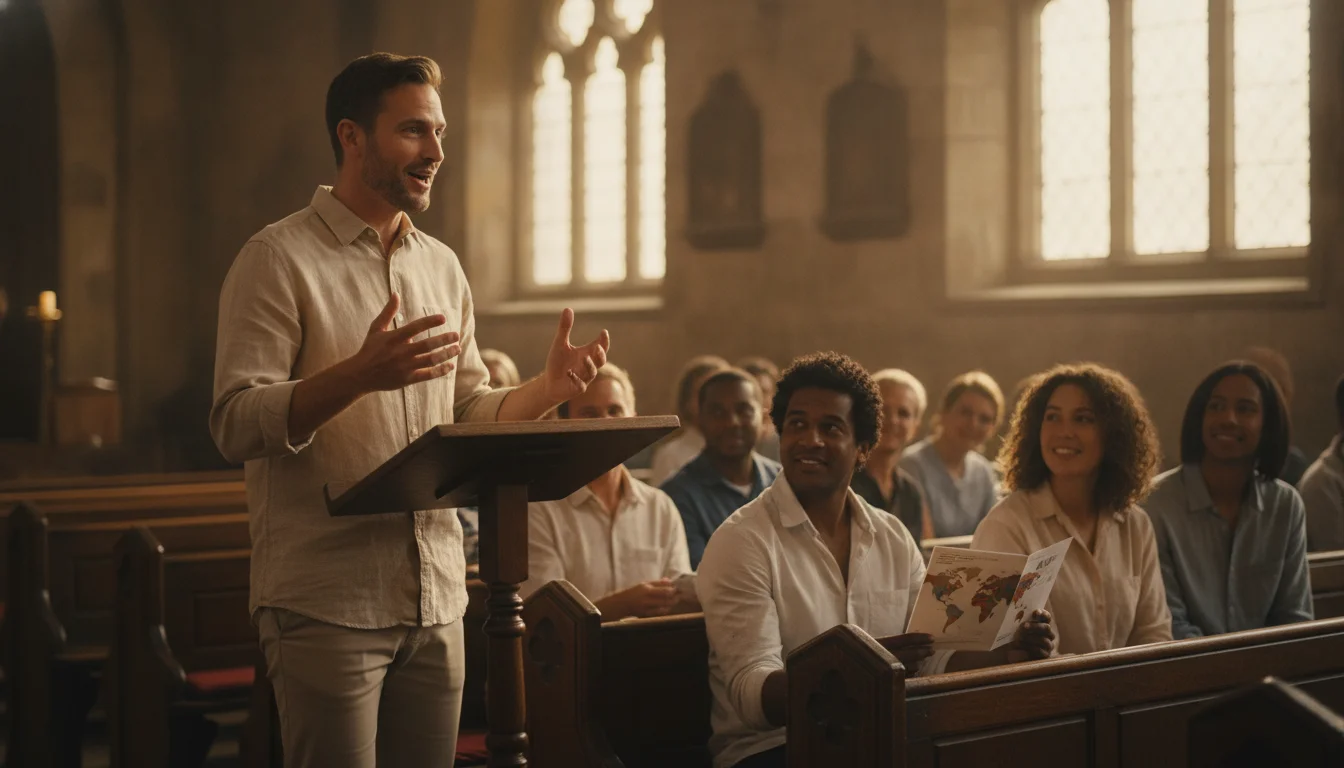
Most leaders I work with do not struggle to pick a destination. They struggle with the part that comes next: standing in front of their people and getting fifteen of them to actually sign up. Moving a trip from your head into other people’s calendars and bank accounts is a different skill, and nobody teaches it in seminary.
I have built heritage journeys for more than forty years, and I have watched the same handful of promotion moves fill group after group. None are clever. They are just done in the right order, early enough to matter. This guide walks you through how to promote a church trip to your congregation, from the first announcement to the holdout who signs up two weeks before the deadline. For the full planning picture, start with my group pilgrimage planning guide, then come back here for the recruiting side.
Lead With the Number That Changes the Room
Before you announce anything, get one fact straight, because it will do half your recruiting for you. On our group trips, the leader travels free once you reach fifteen paying travelers. So when you promote the trip, you are not asking your congregation to fund your vacation. You are inviting them into a journey you are leading at no personal cost, funded by the group itself. Say that plainly and early. People sign up faster when they know you are not profiting and not being subsidized on their backs.
The mechanics are in does the pastor travel free and how many people you need for a free leader. Fifteen is your target, not your ceiling. Aim for twenty so a few inevitable drop-offs still leave you above the line.
How to Announce a Church Trip From the Pulpit
The pulpit announcement is your single highest-leverage moment, and most leaders waste it by being vague. “We are thinking about a trip next year, talk to me if you are interested” converts almost nobody. Interest without a date evaporates by the time coffee hour ends.
Do the opposite. Announce a real trip, on real dates, tied to something your congregation already cares about. The shape I recommend:
- Name the journey and the dates in one sentence: “This coming April, we are walking the footsteps of Paul for eight days.”
- Connect it to your community’s life: “We have been in Acts all spring, and I want us to stand where these events happened.”
- Say the one fact that removes fear: “Spots are limited, there is a payment plan, and you do not need to be a seasoned traveler.”
- Give one clear next step: “There is an info night in two weeks. Come, bring your spouse, no commitment.”
Keep it under ninety seconds. The pulpit plants the seed and points to the next action. Repeat a short version three weeks in a row, because your congregation is not all in the room on the same Sunday, and people need to hear a thing more than once before it feels real.
How to Write a Church Trip Invitation
A good written invitation does the work you cannot do from the front of the room. It answers questions, sets expectations, and gives couples something to discuss at the kitchen table. I have seen trips stall because the only invitation was verbal, and half the church missed it.
Write one page. Not three. Lead with the experience, not the logistics:
- The opening line paints the moment: “Imagine reading Scripture aloud in the place where it happened.”
- The heart of it explains why this trip, for this church, right now.
- The practical block covers dates, length, rough price range, what is included, and the payment plan in plain language.
- The reassurance names the fears out loud: physical pace, first-time travelers welcome, group meals and transport handled.
- The next step repeats one action: the info night, or a reply to reserve a spot.
Warm, specific, honest. If your invitation reads like a brochure any operator could have written, rewrite it in your own voice. For the deeper recruiting playbook, see how to recruit for a church trip.
Your Church Trip Email Announcement Template
Email is where the invitation actually travels. Here is a template I hand to leaders. Adapt the details, keep the shape.
Subject: We are going to Greece next April. Here is how to join.
Hi [First Name],
This coming April, our church is taking an eight-day heritage journey through Greece, walking the route of the Apostle Paul from Philippi to Corinth. I will be leading it, and I would love for you to be part of it.
Here is what you need to know:
- Dates: April 12 to 20, eight days.
- Included: flights, hotels, ground transport, site entries, and daily group meals.
- Cost: roughly [price range] per person, with a monthly payment plan.
- Who it is for: anyone in our community. First-time travelers are welcome, and the pace is manageable.
Spots are limited and they fill from the people leaning in first. If you are even considering it, come to our info night on [date] at [time] in [location]. No commitment, just details and questions answered.
Reply to this email and I will save you a seat.
Blessings, [Your name]
Send it three times over five weeks: the announcement, a “one week to info night” nudge, and a “spots are filling” reminder. Most people commit on the second or third touch. If payment worries surface, point them to how a group trip payment plan works.
How to Build a Trip Landing Page for Your Church
You do not need a fancy website. You need one page people can share and return to, so every announcement can point to it: everything is on the trip page.
A church trip landing page needs seven things:
- A strong photo and a one-line headline naming the destination and the month.
- A short paragraph on why this journey, in your voice.
- The dates, length, and what is included, in a simple list.
- The price range and a clear note about the payment plan.
- A short itinerary or day-by-day highlights so the trip feels real.
- Testimonies or photos from a past trip if you have them.
- One button: register interest, or reserve a spot.
Build it on whatever tool your church already uses. Its job is to convert the interested into the committed, and to be the one link you drop everywhere.
Church Trip Flyer Ideas That Do Not Get Ignored
Printed flyers still work because people hold them, take them home, and stick them on the fridge. The mistake I see is flyers crammed with information. A flyer is a billboard, not a document.
Church trip flyer ideas that pull their weight:
- One image, one promise. A single strong photo and a headline like “Walk Where Paul Walked. April 2027.”
- The three facts that matter: destination, dates, and the info night. Nothing more on the front.
- A QR code pointing to your landing page, so the flyer becomes a doorway, not a dead end.
- A bulletin insert version, quarter-page, that goes home with everyone on announcement Sunday.
Print two sizes: a full poster for the lobby and a bulletin insert for hands. Match the flyer’s look to your landing page so the trip reads as one consistent thing.
How to Promote a Group Tour on Facebook
Facebook is where your congregation already gathers between Sundays, and where couples talk each other into going. It keeps the trip alive for the months between announcement and deadline. How I coach leaders to promote a group tour on Facebook:
- Create a private group for people who register interest, not a public page. People see their friends joining and feel the pull.
- Post rhythm, not volume. Once or twice a week: a photo from the itinerary, a passage tied to a site you will visit, a countdown to the info night.
- Go live for a few minutes to answer questions or walk through the route. Faces convert better than flyers.
- Ask past travelers to comment, not just you. A member saying “this changed how I read the Gospels” is worth more than anything you can post.
- Pin the landing page link to the top of the group so it is always one tap away.
How to Schedule an Info Night for a Group Tour
The info night is where interest becomes commitment, the single event most likely to move someone from “maybe someday” to “we are booking.” Make it the centerpiece, and point everything else toward it.
A few things about running one that fills a trip:
- Time it well. Two to three weeks after your first pulpit announcement, on an evening your congregation already gathers if possible.
- Keep it to forty-five minutes. Fifteen on the vision, fifteen on the practical details and cost, fifteen for questions.
- Show, do not tell. Photos, a short video, or a map on the wall. Let people see themselves in the trip.
- Bring a past traveler to speak for five minutes. Their testimony does what your pitch cannot.
- Have a way to commit that night. A sign-up sheet, a deposit link, a reservation form. Never let warm interest walk out without a next step in hand.
- Invite spouses explicitly. Trips are decided by couples, and a spouse who was not in the room is the most common reason a “yes” quietly becomes a “not this time.”
How to Use Testimonies to Fill a Trip
If you have run a trip before, your past travelers are your most persuasive recruiters, and you are probably underusing them. People believe other members far more than they believe the person leading the trip. Put that to work deliberately:
- Collect them right after a trip, while the emotion is fresh. A two-minute phone video or a few honest sentences is plenty.
- Use one per email and one per Facebook post. A steady drip of real voices beats a wall of praise nobody reads.
- Let a past traveler speak at the info night, unscripted, with one prompt: “What surprised you?”
- Choose ordinary voices, not just the enthusiastic ones. A skeptical member who came back changed is the most convincing testimony you have.
If this is your first trip, borrow credibility instead: the operator’s story and past group photos. Then collect testimonies obsessively on trip one so trip two recruits itself.
How to Market a Pilgrimage to Millennials
If your congregation skews younger, the promotion changes shape. Millennials research before they commit, and they book with their eyes. A few adjustments:
- Lead with meaning and experience, not tourism. Frame it as a journey that deepens faith, not a sightseeing package.
- Make it visual and shareable. Strong photos, short video, an itinerary they can picture.
- Be transparent about cost and the payment plan up front. Younger travelers distrust vague pricing and respect a clear monthly number.
- Meet them where they scroll, and emphasize community. They are far more likely to come if they know friends their age are going, so recruit in small clusters.
Cost is often the real barrier for younger members, so pair the invitation with a clear path to afford it. My guide on how to fundraise for a trip covers how a congregation can help them close the gap.
One note on sequencing: none of this works crammed into the final month. Pulpit and email first, then the info night, then a steady drip of Facebook posts and testimonies, then a final push to cross fifteen before you close registration.
FAQ: Promoting a Church Trip to Your Congregation
How many people do I need before the trip is viable?
Aim for fifteen paying travelers, the point where the group leader travels free and the economics hold together. Recruit toward twenty so a couple of drop-offs still leave you above the line. Below fifteen the trip can still run, it just loses the free-leader benefit.
When should I start promoting?
Six to nine months before departure for a group of fifteen to thirty, and nine to twelve months for larger or holiday-timed trips, as I break down in how far ahead to plan a church trip. Most of that runway is recruiting, not booking. Concrete dates and a real itinerary are what move people from interested to committed.
What if people say they cannot afford it?
Address it before it becomes an objection. Announce the payment plan alongside the price, so people hear a manageable monthly number instead of one large figure. Remind them the leader’s free seat means their payments are not subsidizing your travel.
Do I need a website to promote the trip?
No, but you need one shareable page. A simple landing page with the dates, what is included, the price range, and a single sign-up button becomes the link you drop into every email, text, and post. One stable page beats scattered attachments.
What is the single most effective thing I can do?
Host a strong info night and point every other effort toward it. The pulpit announcement, emails, flyers, and Facebook posts all exist to fill that room. It is where interest turns into commitment, especially when a past traveler speaks and people can commit before they leave.
Promotion is just leadership pointed at your own congregation. You already know how to move your people. This is the same work, aimed at a trip that will stay with them for the rest of their lives. My group planning checklist covers the logistics that run alongside all this recruiting.
When you are ready to build the actual journey, look at how the group experience works on our group heritage tours page. Then contact us and we will help you map the dates, the route, and the numbers for your congregation.