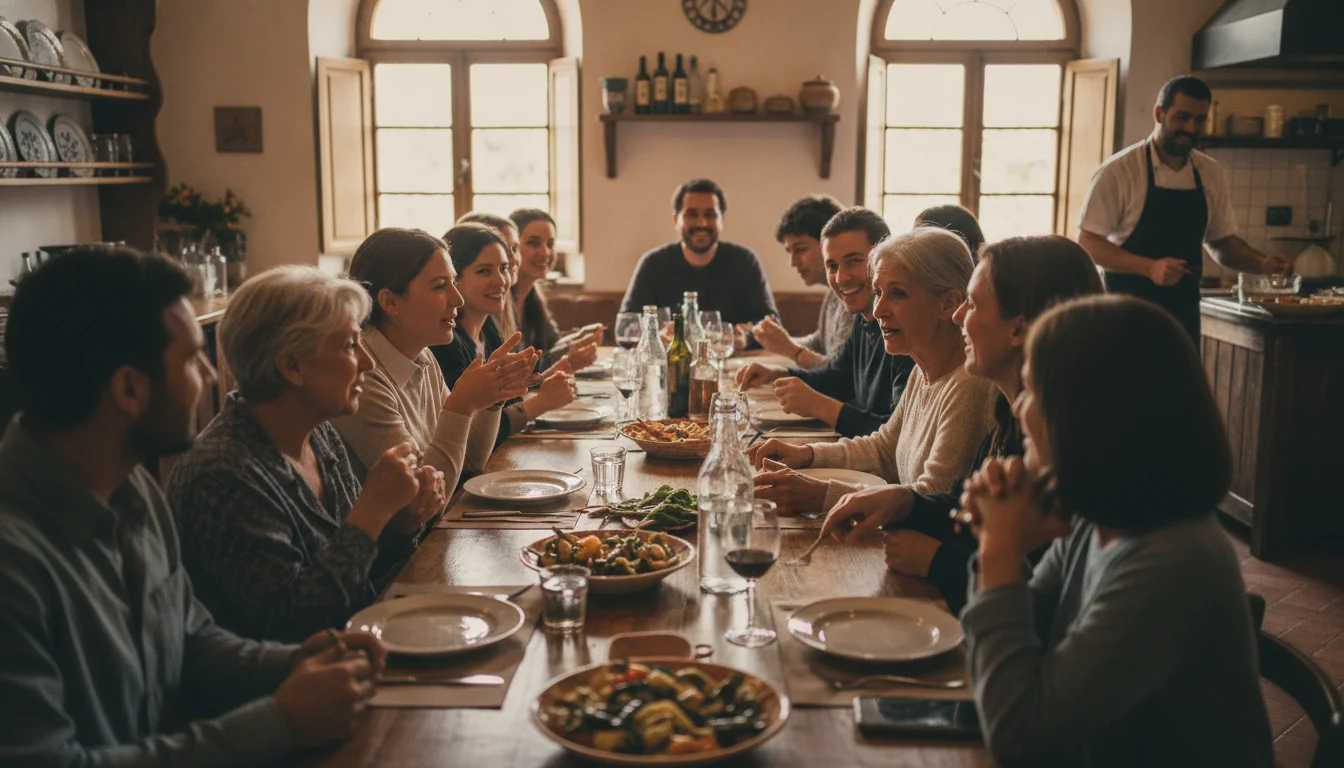
When a pastor or a rabbi sits down to plan a first group trip, the questions that keep them up at night are rarely about theology or itinerary. They are about lunch. Where will forty people eat in a small town at one in the afternoon. What happens when someone cannot eat gluten. Who pays the waiter, and in what currency. These are the questions that decide whether a trip feels smooth or feels like herding.
I have built heritage journeys for more than forty years, and I want to walk you through how meals work on a group heritage tour, and then through the logistics that sit right next to meals: the hotels you can expect, how currency and tipping get handled for a whole group, and how your people stay connected by phone and wifi abroad. None of this is guesswork. There is a real structure behind it, and once you see it, a lot of the worry goes away.
How Meals Work on a Group Heritage Tour
The first thing to understand is that meals on a group heritage tour are planned, not improvised. On a well-built itinerary, breakfast and dinner are included almost every day, and lunches are a mix of included group meals and free time for people to eat on their own. That balance is deliberate, and it matters for both your budget and your group’s experience. Here is why it is built that way.
Breakfast is included because it is at your hotel, it is easy, and it starts the day on time. Almost every hotel we use serves a full breakfast, and a group that eats together leaves together. That keeps your morning departure on schedule, the single biggest logistics win on any group trip.
Dinner is included because it is the meal where your group becomes a group. After a long day of walking sites, nobody wants to scatter across a strange city looking for a table for thirty-five. So dinner is arranged in advance at a restaurant that can seat your whole party, usually with a set menu chosen for the region. This is where the community happens: the day gets shared and the stories come out.
Lunch is where we leave some room. On a full-day site visit we build in a group lunch, because there may be no realistic alternative near an archaeological park or a remote monastery. But in a city, we often leave lunch open so travelers can explore and spend at their own comfort level. Some want a full sit-down meal, others a pastry and a coffee and more time to wander.
What a Set Group Menu Actually Means
When I say dinner is a set menu, some leaders picture the same bland plate every night. That is not what happens. A set menu means the restaurant has agreed in advance to serve your group a fixed selection, usually a starter, a main with a vegetarian option, and a dessert, drawn from what that region does well. The set part is about logistics, not flavor. It lets a kitchen feed forty people at once without a long wait, and it lets you know the cost in advance so there are no surprises on anyone’s bill.
Dietary Needs Are a Planning Question, Not a Day-Of Problem
This is the part I most want organizers to hear. Dietary restrictions are handled during planning, not at the table. Before departure, we ask you to collect your group’s dietary needs (vegetarian, vegan, gluten-free, kosher, dairy-free, allergies) once on your registration form, and we carry that information to every restaurant on the route.
For congregations, this matters in specific ways. If you are leading a Jewish group that keeps kosher, that shapes the entire dining plan, and it needs to be flagged from the first conversation so we build the itinerary around kosher-capable venues. If you have travelers with serious allergies, the restaurants know before your group walks in. The worst way to handle a dietary need is to discover it when the food arrives. The best way is a single clear list, gathered by you, weeks ahead.
If you want the full picture of how a trip comes together from the first idea to the final payment, our guide to planning a group pilgrimage lays out the whole sequence, and meals fit inside it as one piece.
What Hotels Are Used for Church Group Tours
The second question I hear most is about where the group sleeps. Leaders want to know the hotels are safe, clean, well located, and appropriate for a congregation. Here is how selection works.
Group heritage tours use tourist-class and first-class hotels, typically the equivalent of a solid three or four star property. These are not luxury resorts, and they are not budget hostels. They are comfortable, professionally run hotels chosen for three things: location, reliability, and the ability to handle a group of your size at breakfast and check-in without chaos.
Location is the quiet factor that makes or breaks a trip. A hotel thirty minutes outside the city to save a little money costs you an hour of coach time every day and steals your evenings. We favor hotels close to the sites or a walkable center, so people can step out after dinner for a gelato or a quiet stroll without needing the bus.
Rooms are typically booked twin-share, meaning two travelers to a room with two beds. Couples get a double. Anyone traveling alone can request a single room, which usually carries a supplement, since a hotel charges nearly the same for a room whether one person or two are in it. Explain this up front, because the rooming list is something you help assemble. Who shares with whom, who needs a single, who is a couple: that list comes from you and your travelers, and getting it right early prevents awkward conversations at the front desk.
One more thing congregations ask about: the hotels are ordinary hotels, not faith-specific properties. You do not need a Christian hotel or a Jewish hotel. You need a good hotel in the right place that welcomes groups, and that is what we book. The faith character of your trip comes from your group and your itinerary, not the building you sleep in.
How to Handle Currency and Tipping for a Group
Money is the topic that makes new leaders most nervous, so let me make it simple. There are two separate questions: what the trip price already covers, and what people handle on their own.
The trip price covers the big items: flights, hotels, the coach, your guide, site entries, and the included meals. Your travelers do not pay for those on the ground. What they carry money for is personal: souvenirs, free-time lunches, snacks, a glass of wine at dinner if it is not included, and their own incidentals. That is a much smaller amount than most people expect, and it takes a lot of pressure off.
On currency, my guidance to organizers is the same every time. Tell your group not to buy foreign cash at the airport, where the exchange rates are poor. A debit card at a bank ATM in the destination gives a far better rate, and most restaurants and shops in the places we travel take cards. A sensible traveler carries a modest amount of local cash for small purchases and tips, and a card for everything else. Pass this along in a single pre-trip email and it saves your people real money.
Tipping Is Easier When It Is Handled as a Group
Tipping is where a group can either flounder or run smoothly, and the smooth version is easy. On a heritage tour there are two main people who are customarily tipped: your tour guide and your coach driver. These are meaningful tips, and they are customary, not optional, in the travel world.
The clean way to handle this is to collect the guide and driver gratuities from the group as a single pooled amount, rather than asking forty people to figure out the etiquette individually. Many groups build a suggested per-person figure into the pre-trip information, collect it before departure or on day one, and let the leader hand it over at the end. This spares your travelers the guesswork and makes sure the people who served your group all week are thanked properly. For restaurant meals and small services, a little local cash covers it, and in many countries a service charge is already on the bill.
As the organizer, you do not have to become a treasurer. You set the expectation early, name a suggested figure, and decide when to collect. Handled that way, tipping becomes a five-minute item on your checklist. Our group planning checklist is a good place to fold this in so it does not get forgotten.
Phone and Wifi for a Group Traveling Abroad
The last piece of daily logistics is staying connected, and this one has gotten much easier than it used to be. Your travelers will want to reach family at home, share photos, and use their phones to find their way. Here is how to guide them.
Most hotels we use include wifi, and most restaurants and cafes offer it too. For a lot of your group, hotel and cafe wifi is genuinely enough. They message home in the evening and upload their photos, and that covers it.
For people who want to be connected all day, an eSIM is now the simplest answer. An eSIM is a digital SIM your travelers buy and install on their own phone before they leave home, giving them a local data plan without swapping any physical card. It is inexpensive, it activates the moment they land, and it avoids surprise roaming charges. You do not have to become a phone technician. Just tell your group in a pre-trip note that an eSIM is the easy path, with their home carrier’s international plan as the alternative.
There is one connectivity point that matters specifically for you as the leader. You should be reachable, and your group should be able to reach you. Before you travel, make sure your own phone has working data through an eSIM or a carrier plan, so that when the coach is running late or someone gets separated at a site, you are a text away. The leader being connected is part of keeping forty people together in a foreign country.
A practical tip I give every leader: set up a group messaging thread before you leave, add every traveler, and use it for daily logistics. Departure times, meeting points, the name of tonight’s restaurant. That one thread replaces a hundred small questions and keeps your whole group moving as one.
The Point Behind All the Logistics
Meals, hotels, money, and connectivity are not glamorous, but they are the machinery that lets the real trip happen. Handled well, they become invisible, and your people get to focus on standing where scripture happened, on the reflection at a memorial, on the community forming over dinner. The logistics exist so that you can shepherd your group instead of managing their lunch.
Your job as the organizer is smaller than you fear. Gather the dietary list. Help build the rooming list. Send two or three clear pre-trip emails about currency, tipping, and phones. Set up the group thread. Do those few things early, and a good operator carries the rest.
FAQ: Meals and Daily Logistics on a Group Heritage Tour
Which meals are included on a group heritage tour?
Breakfast and dinner are included almost every day, and lunches are a mix. Full-day site visits usually include a group lunch, while city days often leave lunch free so travelers can explore on their own. Breakfast is at the hotel, and dinner is arranged in advance at a restaurant that can seat your whole group.
How are dietary restrictions like kosher, gluten-free, or vegetarian handled?
They are handled during planning, not at the table. As the organizer, you collect your group’s dietary needs on the registration form, and that list is carried to every restaurant on the route. Kosher and other structural needs should be flagged from the first conversation, since they shape the entire dining plan.
What kind of hotels do church and synagogue groups stay in?
Tourist-class and first-class hotels, usually the equivalent of three or four stars, chosen for location, reliability, and their ability to handle a group. They are ordinary well-run hotels close to the sites or a walkable center, booked twin-share by default, with single rooms available for a supplement.
How should currency and tipping be handled for the whole group?
The trip price covers flights, hotels, coach, guide, entries, and included meals, so travelers only carry money for personal spending. Advise them to use a bank ATM rather than airport exchange. For tipping, collect the guide and driver gratuities as a single pooled amount with a suggested per-person figure, so no one has to guess.
How do travelers stay connected by phone and wifi abroad?
Most hotels and cafes include wifi, which is enough for many people. For all-day connectivity, an eSIM installed before departure gives a local data plan without roaming charges. Make sure you as the leader are reachable, and set up a group messaging thread for departure times and meeting points.
If you are planning a first group trip and want the daily logistics mapped out for your specific route and group size, we can walk you through exactly how meals, hotels, money, and connectivity will work. You can also see how the whole experience comes together on our group heritage tours page.
Contact us and we will help you build a trip your people remember.