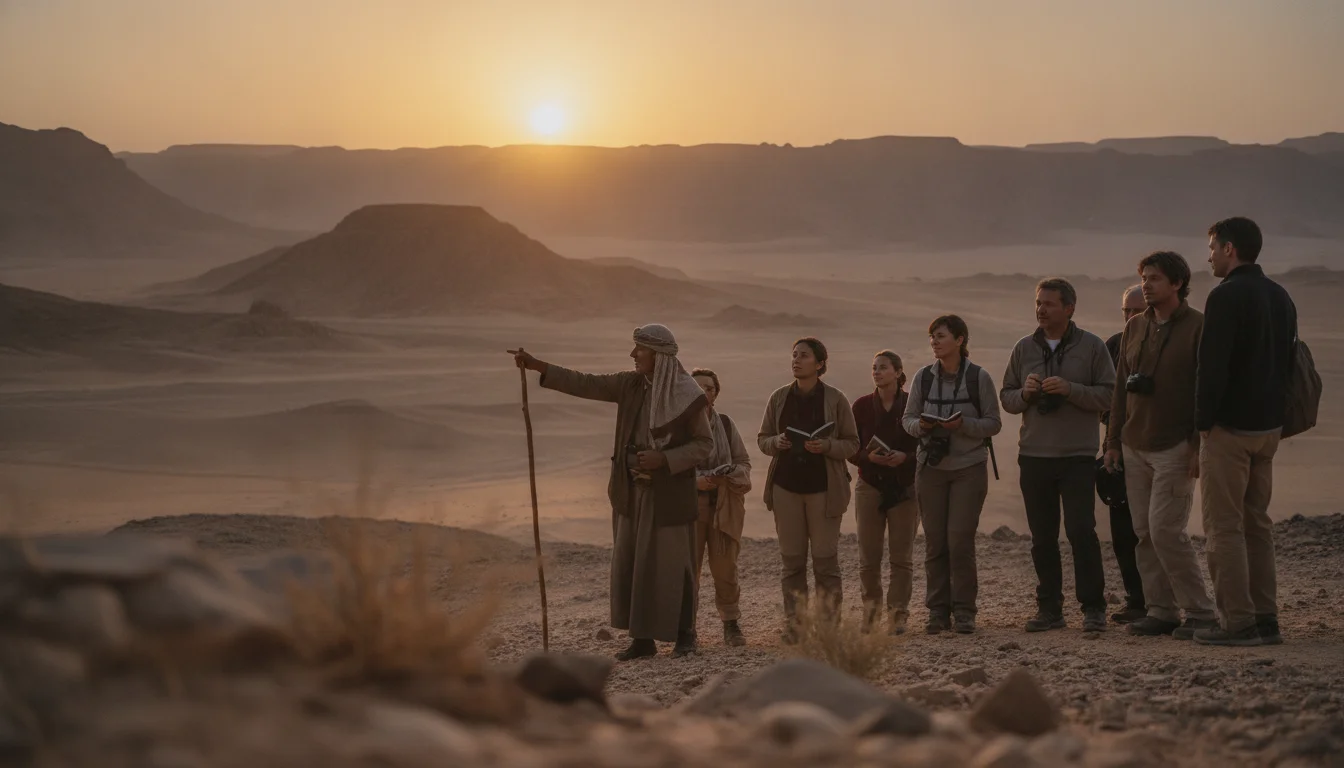
When a pastor or a rabbi first asks me to help them plan an Exodus route itinerary for a group, they usually arrive with a mental picture and very little structure. They can see the Red Sea. They can hear the reading at the foot of the mountain. What they cannot yet see is how forty chapters of Scripture turn into eight or ten days on the ground, in the right order, at a price a congregation will actually pay. That gap is the real work, and it is the work I want to walk you through here.
I have built heritage journeys for more than forty years, and the Exodus route is one of the most rewarding trips a leader can lead. It is also one of the easiest to overreach on if you plan it site by site instead of decision by decision. So this guide is not a list of every place Moses touched. It is a planning framework built around the choices you, the organizer, actually control: what the route should include, how many days it takes, what it costs, and how to structure it so your own seat comes free once fifteen people join you.
Start With the Route, Then the Sites
The Exodus is a journey, not a hub. That single fact shapes everything about how you plan it. Unlike a trip that parks in one city with day excursions, this itinerary moves with the story: out of Egypt, into the wilderness, toward the mountain, and up to the edge of the Promised Land. Your first decision is not which sites to see. It is how much of that arc you want your group to travel.
There are three honest versions of the route, and picking one early keeps the whole plan sane.
The first is the Egypt-anchored version. It stays in the land of the departure: Cairo and the pyramids, the Goshen region where the Israelites settled, the Nile, and a drive toward the traditional Red Sea crossing points along the Gulf of Suez. This version is the most manageable to operate and the strongest for groups new to heritage travel. If you want the full picture of the land the story begins in, our Egypt heritage page lays out the sites and how they connect.
The second is the Egypt-and-Sinai version. It adds the crossing of the peninsula and the ascent to the traditional Mount Sinai at Saint Catherine, usually with a pre-dawn climb so your group reads the giving of the Law where the sun comes up over the wilderness. This is the emotional summit of the trip for most congregations, and it is worth the extra days.
The third is the full arc, Egypt through Sinai and on into Jordan and Israel, following the wanderings toward Mount Nebo, where Moses saw the land he would not enter, and across the Jordan. This is the most powerful version and the longest. It is a two-week commitment, and it works best for groups that have traveled together before.
My advice: choose the version that matches your group’s experience and budget before you fall in love with individual stops. A leader who tries to cram the full arc into eight days ends up with a bus tour of a spiritual journey, and everyone feels it.
How Many Days the Exodus Route Really Needs
Leaders almost always underestimate the time. The distances in Scripture are covered in a sentence. On the ground they are long drives through desert, and the driving is part of the experience, not a delay to minimize.
Here is the honest math I give people.
The Egypt-anchored version needs seven to eight days on the ground, not counting the flights on either end. That gives you real time in Cairo, the Goshen region, a crossing site, and enough margin that a delayed flight does not collapse the schedule.
The Egypt-and-Sinai version needs nine to eleven days, because the Sinai crossing and the Saint Catherine ascent are slow by design. You do not rush a group up a mountain in the dark and then herd them back onto a coach an hour later.
The full arc through Jordan and Israel is a twelve-to-fourteen-day trip. Border crossings, longer coach legs, and the sheer number of meaningful sites all add up. Trying to do it in ten leaves your people exhausted and your best moments clipped short.
Build one full rest or lighter day into any version longer than eight days. Older travelers need it, and the reflective pace is where the trip actually lands for people. A journey about deliverance should not feel like a forced march.
The Cost Conversation, Handled Early
Nothing stalls a group faster than a leader who is vague about money. So let me be direct about the pieces, because your job as organizer is to make the number legible to your people, not to hide it.
An Exodus route itinerary carries the same cost structure as any serious heritage trip: international flights, hotels, ground transportation by private coach, licensed local guides, site entry fees, and the meals built into the itinerary. Egypt and Sinai add two line items many leaders forget. One is the internal travel between distant regions, which sometimes means a domestic flight to save a full day of driving. The other is the security and permit arrangements that a reputable operator builds in for desert and border stretches. Those are not places to cut corners, and a good operator prices them in from the start.
To size the trip for your congregation, I always point leaders to two things in parallel: a realistic per-person price and a clear payment plan. If you want a framework for the full budget before you announce anything, our guide on how to budget a church trip breaks down every line, and the piece on setting up a group trip payment plan shows how deposits and installments keep the money manageable for everyone.
The point is not to present a scary lump sum. It is to say: here is the price, here is the deposit, here is the monthly amount, and here is the date. People can commit to a plan. They freeze at a single big number.
Where the Free Leader Seat Fits
This is the part that changes the whole decision for a lot of pastors and rabbis, so I want to be clear about it.
When your group reaches fifteen paying participants, the group leader travels free. That means your full trip cost, flights, hotels, ground transport, included site entries, and the group meals, is covered. You are not paying your own way and hoping the board approves it. Your seat is built into the economics of the group.
The reason the number is fifteen is simple once you see it. The fixed costs of an Exodus itinerary, the coach, the guides, the permits, the coordination across regions, get shared across the travelers. Below fifteen, those costs sit on too few people and there is no room to carry an extra seat. At fifteen, the structure holds and the leader’s seat fits inside it. Larger groups create even more room, which is where a second complimentary or reduced seat for a co-leader or spouse sometimes becomes possible. If you are building toward twenty-five or thirty, ask about that early. I explain the mechanics in more depth in does the pastor travel free and how many people you need for a leader-free trip.
For an organizer, this reframes the whole trip. You are not asking your community to fund an expensive journey for you. You are organizing a journey your people pay into, and your presence is part of how it is structured. That is a much easier conversation to have with a board and with yourself.
Recruiting a Group for a Trip This Ambitious
The Exodus route is a longer, more demanding trip than a single-city pilgrimage, so recruiting works a little differently. You are asking people for more days and more money, which means you need to start from conviction, not curiosity.
Begin with your core, not your whole membership list. Find the eight to ten people who already light up when you mention the trip, and let them bring others. Couples travel together. Bible study groups travel as a unit. On a story like the Exodus, tying the trip to a teaching series works especially well. Preach or study through the book in the months before you travel, and the group fills itself because people want to stand where the passage happened.
Give them a real date and a real route, not a someday. “We are following the Exodus from Goshen to Sinai next spring, ten days, here is what we will see” converts interest into commitment. “We might do an Egypt trip eventually” never does. If you want a fuller playbook, our guide on how to recruit for a church trip covers the announcements, the timeline, and the follow-up that actually gets people to sign.
Plan far enough ahead to give people room to budget and request time off. For a group of fifteen to thirty on a route this long, nine to twelve months is the honest lead time. That window is not just logistics. It is recruiting runway, and the trip becomes real to people the moment they can see concrete dates.
Your Real Job Once the Logistics Are Handled
Here is what I most want you to hear as the organizer. Once the route is set, the price is clear, and your seat is covered, your attention is freed for the thing only you can do.
You are not the trip’s travel agent. You are its shepherd. Your role on the Exodus route is to read the parting of the sea aloud at the water’s edge, to lead a moment of reflection on the climb up the mountain, to help your people feel the weight of forty years of wandering as the coach rolls through the wilderness. The operator’s job is to make everything else invisible: the permits, the drivers, the hotels, the timing. That division of labor is the whole point, and it is why I tell leaders to hand the logistics to people who do this for a living and keep their own focus on their community. Our group heritage tours page shows how that partnership works in practice.
FAQ: Planning an Exodus Route Itinerary for a Group
How long should an Exodus route itinerary be for a group?
Seven to eight days for an Egypt-anchored version, nine to eleven days if you add the Sinai crossing and the ascent of the traditional Mount Sinai, and twelve to fourteen days for the full arc through Jordan and Israel to Mount Nebo. Build a lighter day into anything longer than eight days so the pace stays reflective.
What does the Exodus route itinerary actually include?
The core sites follow the story: the Goshen region and Cairo in Egypt, a Red Sea crossing point, the Sinai wilderness and Saint Catherine at the foot of the traditional Mount Sinai, and, in the full version, Mount Nebo and the crossing of the Jordan. The right list depends on how many days you commit and which version of the route you choose.
How much does an Exodus group trip cost per person?
It varies with length, season, and group size, so I never quote a single figure without knowing your dates. The price covers flights, hotels, private coach transport, licensed guides, site entries, included meals, and the permits and security arrangements that desert and border legs require. The practical move is to set a per-person price and a payment plan together, so your people commit to a monthly amount rather than a lump sum.
Does the group leader really travel free on the Exodus route?
Yes, with fifteen or more paying participants. At fifteen, the leader’s full trip cost is covered on the same terms as a participant. Below fifteen, the trip is still possible, but the leader pays a participant’s price. Larger groups can sometimes unlock a reduced or complimentary second seat for a co-leader or spouse.
How far ahead should I start planning to reach fifteen people?
Nine to twelve months for a route this long. The Exodus itinerary asks more days and more budget than a single-city trip, so people need runway to commit. Most of that time is recruiting your group, and concrete dates with a real route are what move people from interested to committed.
If you are weighing whether an Exodus journey is realistic for your congregation, start with the route version and the lead time, then let the free-leader math settle the rest. For a step-by-step framework that covers every stage, our pillar guide on how to plan a group pilgrimage walks the whole process.
Contact us and we will help you shape the route, size it for your community, and run the numbers for your dates.